
Research Signal – Source date 2023-09-26
An electric switch instead of a heat or pressure swing
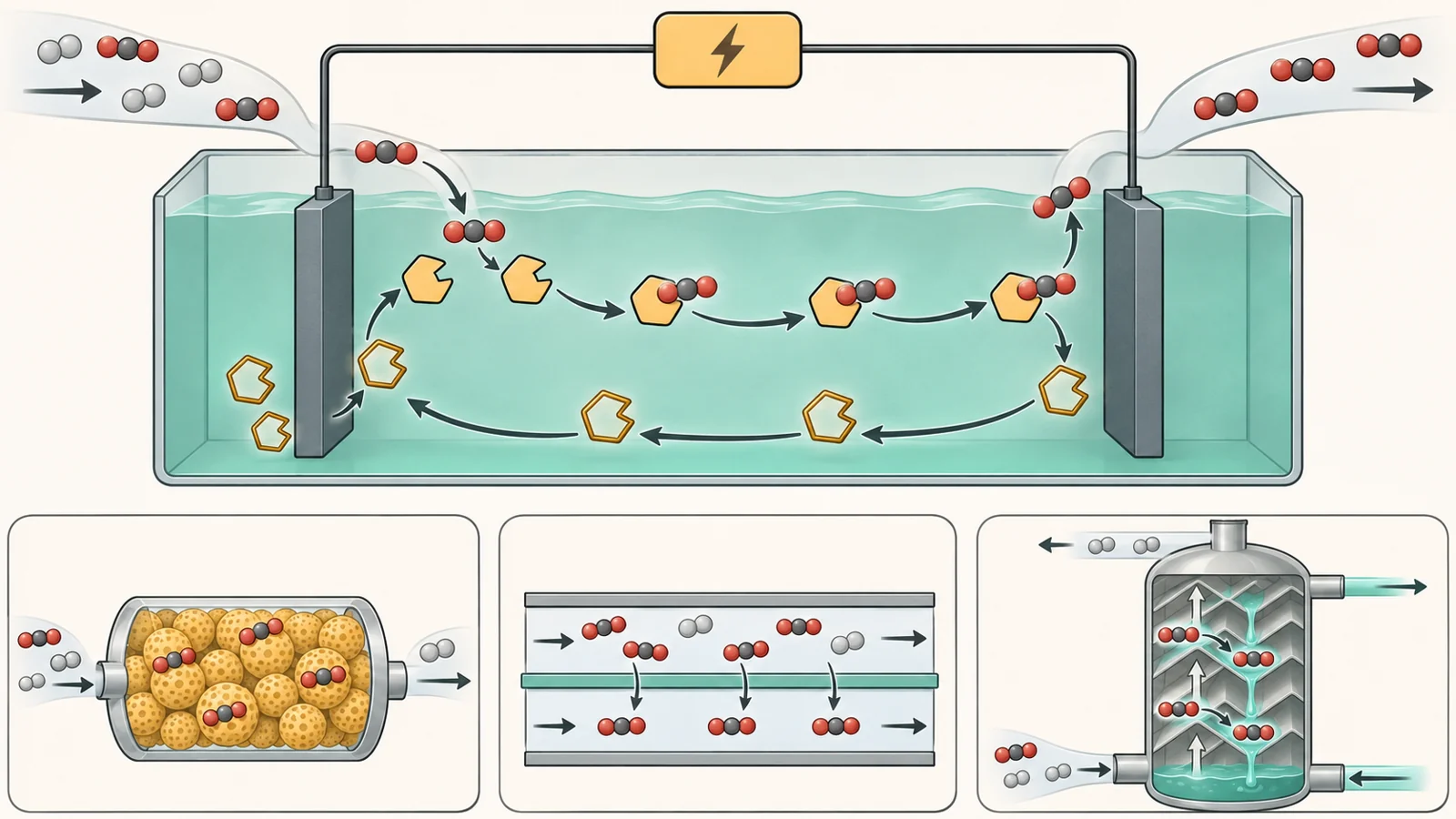
Most familiar carbon capture approaches rely on changing temperature or pressure to make a material take up carbon dioxide (CO2) and then release it. Electrochemically mediated carbon capture, or EMCC, uses an electrical stimulus to drive those two steps instead. The idea is to use electricity to change the capture chemistry, rather than repeatedly heating or pressurizing the capture material.
That operating difference could matter when electricity comes from variable renewable sources: an electrically driven process might be designed to work alongside intermittent power. The 2023 Account by researchers working on EMCC presents this as a potential advantage. It does not provide a quantified comparison showing that the approach uses less energy, costs less, or performs better than conventional capture.
The change in stimulus sounds simple, but the process still has to move CO2 into contact with the capture chemistry and then release it in a useful way. A molecule that binds CO2 is only one part of that task. Electrodes, liquids and other materials determine whether the chemistry can be used repeatedly in equipment.
Why the molecule works in a liquid
Nanoporous materials are often discussed in carbon capture because their large internal surface areas and many active sites can help adsorb CO2 directly from a gas. EMCC, as described in this Account, takes a different route: CO2 first dissolves in an electrolyte, the liquid that carries charged species, and then reacts through acid–base interactions with molecular carriers. These carriers are the dissolved molecules that take part in capturing and releasing CO2.
This helps explain why the field cannot simply take a gas-catching nanomaterial and expect it to serve as the capture agent in an electrochemical system. The chemistry is happening in a liquid, and the carrier must work with the electrolyte and the electrical conditions. The authors discuss molecular design as a way to address challenges including solubility, reactions with oxygen, and compatibility with the electrolyte.
Nanomaterials do not have just one supporting role here. The Account discusses solid sorbents in fixed beds as well as nonswelling membranes and gas–liquid contactors in flow systems. Depending on the design, a material may take part in capture itself or help bring CO2 to the chemistry.
Three material routes, three equipment problems
The Account discusses several early material approaches for different process arrangements. Solid sorbents could be used in fixed beds, where a gas stream passes through a stationary capture material. Nonswelling membranes could help manage flow systems, where liquid and capture chemistry move through equipment. High-surface-area gas–liquid contactors could bring a gas and a liquid into contact across an extensive interface.
These are distinct examples, not parts of one demonstrated machine. Each points to a different engineering question: how to expose a gas to a solid capture surface, how to keep a membrane useful as liquid passes through a system, or how to bring gas and liquid together effectively. The supplied evidence describes early work and directions under study, rather than a validated integrated process.
The distinction between the jobs matters because a promising carrier alone cannot settle questions about how quickly CO2 reaches it, how well an electrode uses its capacity, or whether the capture material stays where it is meant to be. Those questions connect molecular chemistry to device design.
Repeated operation is the engineering test
The Account identifies three barriers that could undermine repeated capture and release. First, molecular oxygen can participate in unwanted side reactions. If the capture chemistry is affected, the process may become harder to operate reliably. Second, an electrode may not make full use of its available capacity, limiting how much of the intended electrochemical function each cycle delivers. Third, capture molecules can move away from where they are needed within a system, a problem called sorbent crossover.
These are not interchangeable problems. Oxygen tolerance concerns the chemistry’s behavior in its operating environment; electrode capacity utilization concerns how effectively the electrical hardware drives the process; crossover concerns keeping the capture molecules in the right place. Solving them requires materials and process design to work together.
The Account lays out design principles and early material results, but the supplied abstract does not give comparative operating figures or show that the approaches have already overcome these barriers in an integrated continuous system. The practical question is therefore not only whether a molecule can capture CO2, but whether the chemistry and equipment can keep doing so through repeated operation.
Where this research could lead
A farther horizon is a dependable process that captures CO2 from a dilute stream and releases it using variable electricity, without arranging a heat or pressure swing for that task. If the electrical chemistry can be paired with materials and equipment that manage gas–liquid contact, electrode use and capture-molecule retention, operators could have another way to match carbon capture to available power. That capability remains a possibility, not a demonstrated outcome of the Account; dependable operation would require system engineering and evidence beyond this overview.
A nearer milestone would be a continuous-flow demonstration that reports repeated CO2 capture and release while measuring oxygen tolerance, sorbent crossover and electrode use. Such a result would help show whether the separate molecular and materials advances can function together under ongoing operation. The Account’s contribution is to describe why that interface matters and identify routes researchers are beginning to explore.
Key Sources
- Primary source: Electrifying Carbon Capture by Developing Nanomaterials at the Interface of Molecular and Process Engineering.
DOI or Journal Page · Peer-Reviewed Paper · 2023-09-26
Keep exploring