
Research Signal – Source date 2021-02-02
A checkpoint drug can release an inhibitory signal and help some tumor-fighting immune cells expand. Yet the same kind of treatment may do little when the cells that could sustain a response are scarce, or when immune cells cannot reach the tumor. A 2021 review of CD8+ T cells describes why both the condition of these cells and their location can matter.
CD8+ T cells are immune cells that can recognize and kill cancer cells. Checkpoint drugs target inhibitory signals that restrain immune activity. Releasing those brakes can help, but it does not make every T cell equally capable of mounting a lasting response. The review’s central distinction is between cells that can renew and produce more fighters, and cells that can attack more forcefully for a time but are less durable.
Persistent stimulation changes the response
During a short-lived infection, a CD8+ T cell can encounter an antigen—a feature recognized by the immune system—become activated, and develop into a cell that kills infected targets. After the threat is removed, most of these effector cells die; some remain as memory cells.
A tumor can keep presenting antigens over time. Under this persistent stimulation, an initially activated T cell may enter a state called exhaustion: it remains part of the immune response, but progressively loses some functions, including the ability to produce signaling molecules such as IL-2, TNF-α, and IFN-γ. Its activity is reduced, not simply switched off.
Inhibitory signals are part of this complicated response. They can restrain T cells and limit damage to healthy tissue, even as tumors can benefit when immune activity is held back. Checkpoint treatment tries to ease that restraint. How much benefit it can provide depends in part on which T-cell states remain available.
A renewable pool and its short-lived descendants
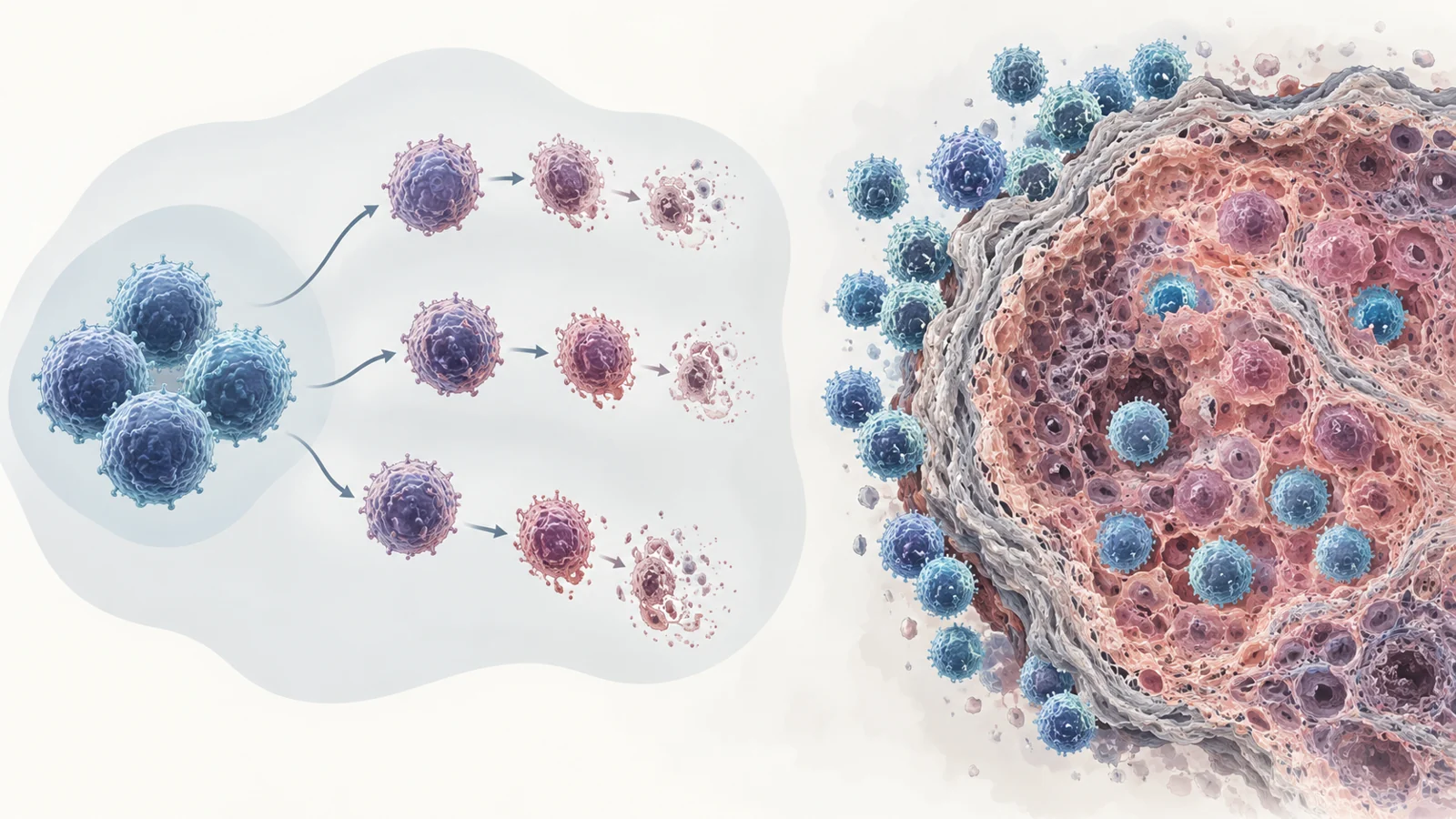
The review describes exhaustion as a changing process rather than one fixed condition. Progenitor exhausted T cells have stem-like properties: they can persist, expand, and give rise to other exhausted cells. They are less directly cytotoxic than their descendants, but their capacity to replenish the response may give them a lasting role.
Terminally exhausted T cells sit further along this path. They can have greater cytotoxic activity—the ability to kill target cells—but are short-lived. A checkpoint drug may prompt progenitor cells to expand and differentiate, producing a temporary increase in effector activity. If a tumor burden is high and the renewable pool has been depleted, the response may be harder to sustain. A burst of killing by terminally exhausted cells is not the same as rebuilding a durable supply.
TCF-1 is a protein involved in controlling which genes a T cell uses. In the studies discussed by the review, cells with both TCF-1 and PD-1 were associated with the renewable progenitor state, while cells with PD-1 but without TCF-1 were associated with terminal exhaustion. This distinction helps researchers study T-cell states; it is not a validated test of how an individual patient will respond to treatment.
A surface marker can tell more than one story
PD-1 is often discussed as an inhibitory receptor on exhausted T cells, but its presence alone does not settle what a cell is doing. The review notes that PD-1 and other inhibitory receptors can also rise during ordinary T-cell activation. Activated and dysfunctional cells may share some surface markers and gene activity, even though their functional state differs.
Researchers therefore look beyond a single marker to the broader programs active inside a cell. The review describes single-cell gene-expression work that separated activation-related and dysfunction-related patterns. In mouse experiments discussed there, disrupting metallothioneins—proteins involved in zinc regulation—was associated with improved T-cell function and tumor control without lowering inhibitory-receptor expression. This illustrates why a receptor count alone may not identify the process behind reduced function. It does not establish a clinical marker or treatment for people.
Tumor geography creates different obstacles
The number and state of T cells are only part of the picture. The review groups tumors by the immune activity found within and around them. In some tumors, CD8+ T cells have entered the tumor but are inhibited or dysfunctional. In others, cells gather near the tumor’s edge and do not penetrate it effectively. Some tumors have little pre-existing T-cell response, in part because priming—the activation of T cells against tumor antigens—has been inadequate.
These situations pose different barriers. Releasing inhibitory signals may address suppression among cells already inside a tumor, but it does not automatically solve poor access or a lack of priming. The review discusses possible combinations aimed at different steps, including checkpoint blockade with approaches intended to improve infiltration or stimulate an immune response. It presents these as strategies under investigation, not as one combination shown to work across tumor types.
A clinical result and a proposed mechanism
The review cites the phase III PACIFIC trial in people with unresectable stage III non-small-cell lung cancer. The review reports that adding durvalumab to the chemoradiotherapy treatment course was associated with a median of 17.2 months before disease progression or death, up from 5.6 months; 66.3% of patients were alive at two years, up from 55.6%.
Those figures describe a clinical comparison involving a combined treatment course. The review explains why radiation might complement checkpoint blockade: radiation can reduce tumor burden and, through immune-related effects, may help prompt responses beyond the treated site. But the PACIFIC outcomes do not show that expansion of progenitor exhausted T cells caused the benefit. The cited trials and treatment settings differ, and the review does not test one unified way to select combinations based on T-cell state or tumor pattern.
Stronger immune activity can also cause harm
The brakes on immune activity help limit collateral damage. When checkpoint blockade releases them, immune-related inflammation can affect healthy tissues. The review describes adverse events involving the skin, bowel, liver, and endocrine system, with severity varying across cases. Efforts to strengthen an anti-tumor response therefore have to account for the possibility of harmful inflammation elsewhere.
Combination treatment adds another question: combining therapies may bring new or greater toxicity, which the review says still needs investigation. The goal is not simply to intensify immune activity. It is to understand which barrier a treatment is meant to address while keeping unwanted effects in view.
What matching treatment to the tumor could change
A clearer account of T-cell renewal and tumor access could eventually help researchers match treatment combinations to the obstacle a tumor presents. If approaches can preserve or expand renewable tumor-fighting cells, improve their entry into tumors, or help initiate a response where few cells are present, some patients might gain more durable immune control. Reaching that capability will depend on establishing which strategies work in which settings, and how to improve responses without unacceptable harm.
The 2021 review synthesizes mechanistic studies and selected clinical results; it reports no new intervention or validated patient-selection method of its own. Its contribution is a way to understand why releasing an immune brake may be enough in one context and insufficient in another.
Key Sources
- Primary source: Exhausted CD8+T Cells in the Tumor Immune Microenvironment: New Pathways to Therapy.
DOI or Journal Page · Review or Meta-Analysis · 2021-02-02
Keep exploring