
Research Signal – Source date 2022-01-25
A drug can release a restraint on immune cells and still leave them unable to attack a cancer. They may not have been activated against it, may not reach the tumor, or may lose effectiveness once inside. That is the central problem explored in a 2022 overview of cancer immunotherapy: an immune response is a chain of linked events, and a treatment aimed at one event may leave another obstacle in place.
The authors describe immune checkpoint inhibitors as a major change in cancer treatment. These drugs can restore the activity of T cells, immune cells that recognize and attack abnormal cells, and some patients have had durable responses. At the same time, the overview gives an approximate 10–30% efficacy figure for checkpoint inhibitors used alone, based on clinical experience discussed by the authors. It is a broad estimate, not a prediction of any individual patient’s response.
The authors’ proposal is to understand where an immune response is being held back and investigate combinations that address that problem. To see why that approach might matter, it helps to follow the immune response from recognizing cancer to reaching and attacking it.
An immune response depends on a chain of events
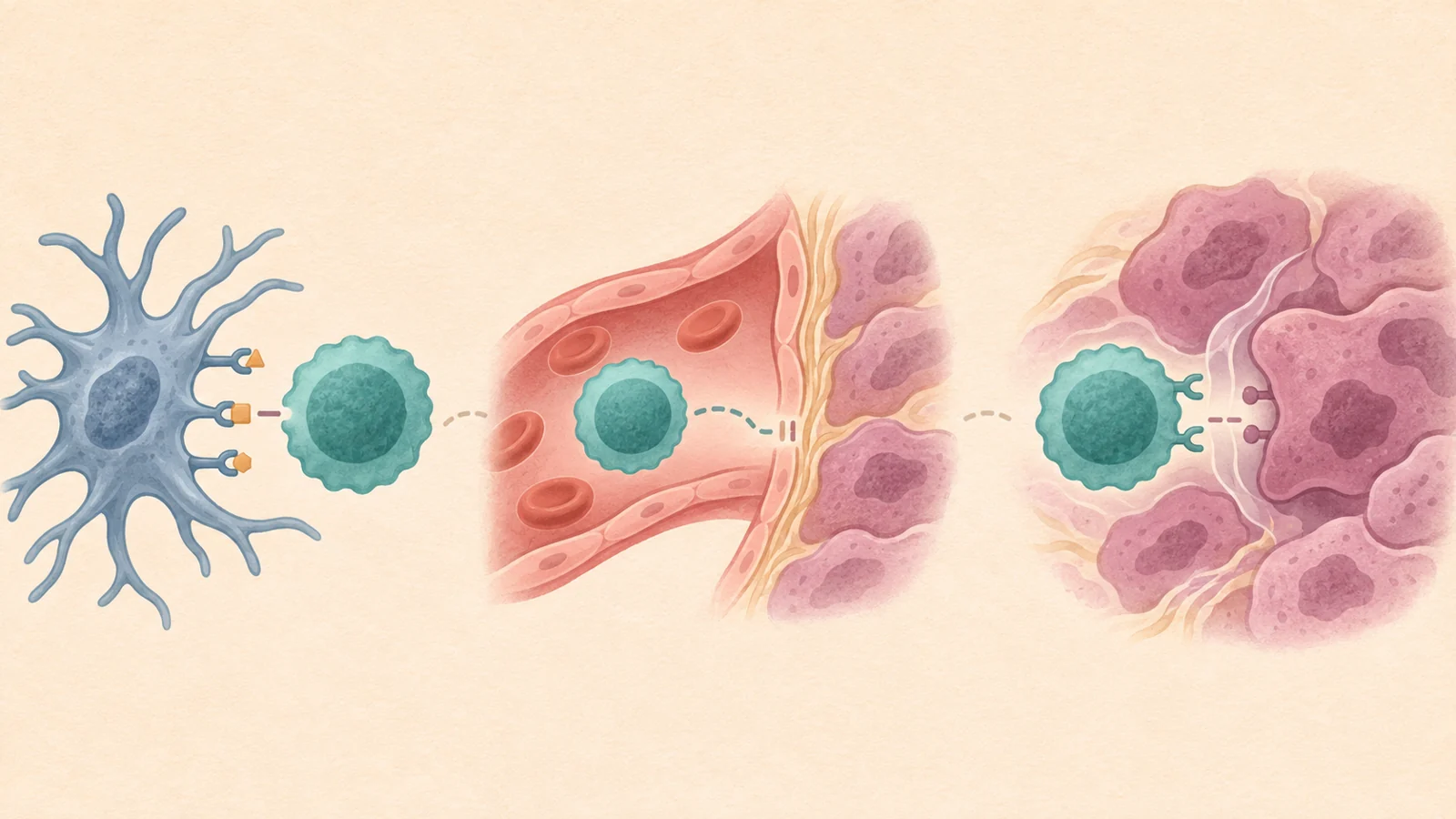
The authors call this sequence the “cancer immunity cycle.” When cancer cells die, they release pieces of themselves, including antigens: features that the immune system can recognize. Dendritic cells, which help present those features to other immune cells, carry cancer antigens to lymph nodes. There, they can activate T cells that recognize the cancer.
Activation begins the next task: those T cells must travel through the blood, leave the vessels, and enter tumor tissue. Once there, they can recognize cancer cells and attack them. The resulting cancer-cell death releases more antigens, potentially giving the immune response fresh material to recognize.
A checkpoint drug acts on restraints that can make T cells unresponsive. That can help a response already directed at a tumor. It does not, by itself, guarantee that useful cancer antigens were presented, that activated cells can enter the tumor, or that the tumor environment will let them keep working. Each of those steps gives the immune response another possible point of failure.
Recognition has to start somewhere
Before T cells can respond to a cancer, the immune system needs cancer material to present to them. The overview describes two broad ways researchers might encourage this early “priming” stage: release more cancer antigens, and improve how antigen-presenting cells activate T cells.
Some anticancer drugs and radiation can kill cancer cells and release antigens. The authors also discuss a form of cell death called immunogenic cell death, which is thought to be particularly able to prompt an immune response. They describe efforts to stimulate dendritic cells or mature them outside the body and return them to the patient. A dendritic-cell vaccine, sipuleucel-T, had been approved for prostate cancer by the time of the overview. The authors also discuss treatments intended to strengthen the activation signal T cells receive.
These approaches address a different task from lifting a checkpoint. Releasing cancer material or presenting it effectively may help start or broaden recognition; checkpoint inhibition targets restraints on immune cells. The overview describes these as approaches under investigation, without establishing that one priming method is superior or that any particular combination reliably solves the problem.
A cell can be activated and still miss its destination
An activated T cell must travel from the bloodstream into tumor tissue before it can attack cancer cells there. Tumors can make that journey harder. The overview describes signals and changes in the tumor environment that may interfere with T cells’ movement, their ability to attach to blood-vessel walls, or their entry into tumor tissue. An immune response can therefore be under way while its activated cells struggle to reach the place where they are needed.
The authors discuss vascular treatments alongside checkpoint inhibitors because the two could address connected parts of this problem: checkpoint inhibition can restore T-cell activity, while changes to the tumor’s blood-vessel environment may help cells enter the tissue. They point to research on structures called tertiary lymphoid structures, clusters within tumors associated with immune activity, and on high endothelial venules, specialized vessels found in those structures. The overview also describes reports of these vessels being induced by anti-VEGF and anti-PD-L1 antibodies.
Those observations offer a reason to investigate whether vascular and immune treatments can work together. They do not show that this pairing benefits patients across cancers, or establish which patients might benefit. The key question is whether a particular tumor’s access barriers are important enough for a treatment directed at them to make a difference.
Inside the tumor, the terms of attack can change
Reaching the tumor is not the same as being able to keep attacking it. The overview describes tumor environments in which signals that suppress immune activity can dominate. Cells around the tumor, including some macrophages and other immune-suppressing cells, may contribute to conditions that make T cells less effective. T cells can also become exhausted: present in the tumor, but no longer responding effectively.
Cancer cells can also evade recognition by changing or losing the antigens or presentation machinery that T cells rely on. A checkpoint inhibitor cannot restore a target that is no longer visible to T cells. These local barriers and changes in recognition help explain why restoring one part of T-cell function may be insufficient once the cells reach the tumor.
From adding treatments to matching them to the obstacle
The overview’s proposed direction is to assess which parts of the immune response are suppressed in each patient, then develop combinations suited to the obstacles found. A tumor with poor T-cell access might call for a different strategy to investigate from one where cells enter but encounter strong local suppression—or one that is difficult for them to recognize.
That requires ways to measure immune conditions at different stages of the cycle and biomarkers that can help describe them. The authors present patient-specific assessment and biomarker-informed combinations as important goals for research. The overview does not establish that these measurements can already guide routine treatment selection, or that matched combinations improve survival. The strategy is a research direction, not a validated prescribing method.
How this could shape the future
By 2022, checkpoint inhibitors had shown that restoring immune-cell activity could produce durable responses in some patients. CAR T-cell therapy, which gives a patient’s T cells a cancer-targeting receptor, had also been approved for specified B-cell cancers. These clinical developments are distinct from the combinations the authors propose investigating for cancers that respond poorly.
The overview reports that more than 2,500 clinical trials were then studying combinations with checkpoint inhibitors. That count signals substantial research activity; it does not tell us that any one combination works, or that the field had solved resistance. The article synthesizes clinical experience and biological mechanisms rather than reporting a new patient trial or a direct comparison of matched treatments.
A useful milestone would be evidence that measurements can reliably identify a patient’s main immune bottleneck and that a treatment selected for that bottleneck improves outcomes. If such an approach holds up, cancer treatment could become more capable of addressing why an immune response stalls, rather than relying on the same added immune stimulus for every tumor. That could help more patients mount a sustained attack, but it depends on both accurate assessment and combinations shown to benefit patients.
Key Sources
- Primary source: Future prospects for cancer immunotherapy – Strategies for ineffective cancers.
DOI or Journal Page · Clinical Trial · 2022-01-25
Keep exploring