
Research Signal – Source date 2021-01-19
Carbon-fiber-reinforced plastic parts can yield fibers for new products, but a 2021 review estimated that less than 1,000 tonnes of carbon-fiber waste was being recycled worldwide. In the same account, the waste stream was about 24,000 tonnes. The figures describe estimates collected by the review, not a new global measurement. They put a practical question in view: why did so little of this valuable reinforcement return to use when recovery methods were already known?
A carbon-fiber composite is plastic strengthened with thin, strong carbon fibers. The review describes a growing market for these materials and examples of recovering fibers from manufacturing waste and used parts. Yet extracting fibers is only one step. The output varies in length and form, and customers must decide whether it can meet the requirements of a particular product and arrive in dependable quantities.
A growing market also creates a growing waste stream
The review reports that global carbon-fiber composite production grew by more than 12% annually from 2010, reaching 128,000 tonnes in 2018. About 37% of carbon-composite use was in North America, including Mexico, and 34% in Europe, according to figures it draws from earlier sources.
Production creates waste before a part reaches service. The review estimates that about two-thirds of carbon-fiber waste came from manufacturing and one-third from used parts. Depending on the technology, it says, waste could amount to 30–40% of the carbon fiber used. Its account places the resulting global waste at about 24,000 tonnes and predicts 32,000 tonnes for 2021, while less than 1,000 tonnes was then recycled. These are cited estimates and a forecast, not a directly measured material balance.
The supply of scrap alone does not create a recycling market. Manufacturers need recovered material with known properties, in forms they can process, and in quantities they can count on. The review describes limited acceptance of recycled raw materials and a lack of confidence in their quality and continuity of supply as barriers. Without buyers and reliable demand, recycling can be less attractive than disposal, even when the waste and recovery methods are familiar.
Recovered fibers come in different forms
The review identifies pyrolysis and solvolysis as practical routes for recovering carbon fibers. Pyrolysis uses heat in a furnace to separate fibers from the surrounding material. Solvolysis uses solvents to recover fibers. The source cautions that ordinary waste-incinerator burning can damage carbon fibers, so burning a part for energy is not the same as recovering reinforcement for another product.
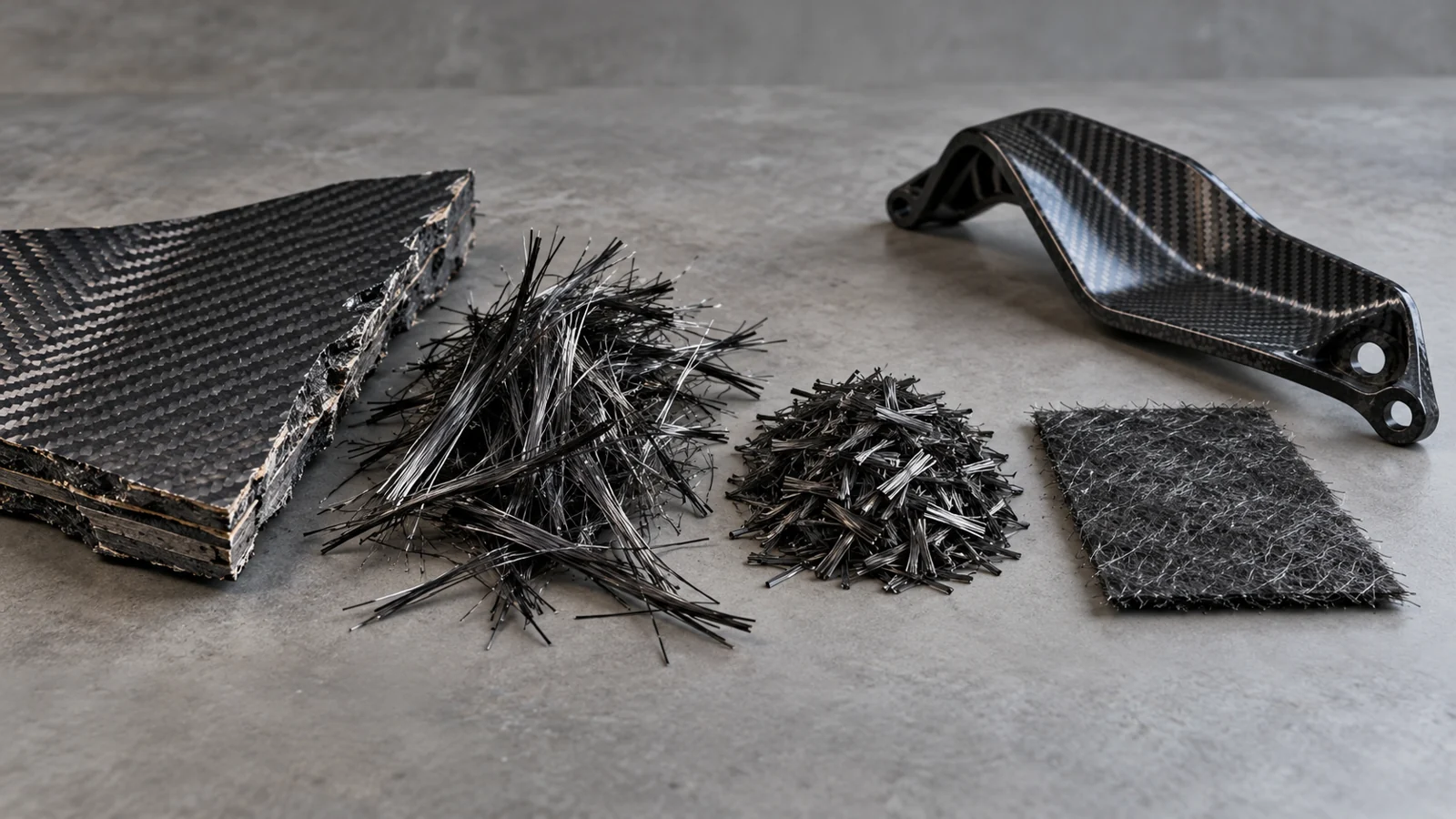
Recovered fiber is not necessarily a ready-made substitute for the continuous, long fibers used in a new composite. The review describes ELG sorting its pyrolysis output by length and intended use. Its categories included ground fiber for molding compounds and coatings, cut fiber for thermoplastic reinforcement, and longer fibers used to make mats. Those mats could be combined with resin into sheets for molding or pressed into parts. ELG also described hybrid mats combining carbon fibers with thermoplastic fibers for fast pressing. These are company-reported product categories and uses; they illustrate how output form shapes the next manufacturing step.
Solvolysis can yield a different form. The review describes a continuous process developed by Shocker Composite to recover fibers from composite material and uncured fiber sheets already combined with resin. The recovered fibers were fluffy, and the company considered them best suited to pellets that reinforce plastics softened by heat. Across these examples, sorting and processing help match recovered fibers to a product, but the material’s form places limits on what that product can be.
A recovered fiber has to fit the part
Shorter fibers or fibers that are not perfectly aligned can reinforce some products, but they do not automatically perform like long, continuous fibers. The review notes that recycled fibers are unlikely to replace new fibers completely, particularly in components that need high strength and stiffness under long-term dynamic loading. Surface condition, adhesion to the surrounding plastic, fatigue damage and resistance to environmental exposure also matter to a finished part.
One example in the review shows both the potential and the constraint. Researchers made reinforcing tapes from pyrolysis-recovered fiber, then formed test composites by drawing liquid resin into a mold around the tapes. The fibers were short, imperfectly oriented and not prepared in the same way as continuous reinforcement. In that comparison, the resulting composites had 38% of the strength and 68% of the stiffness of composites made with long fibers. Those figures describe that particular example, not a general rating for all recycled fibers or products. The review says work was under way to improve orientation and increase scale.
A component with different performance needs may be a better fit for recovered material. The review reports that SGL Carbon made a mat from recovered carbon fibers for the BMW i3 roof and formed it with resin in a mold. The reported roof application shows a specific product use; it does not establish that the same material suits every vehicle part.
Buyers need more than a successful demonstration
A product example and a dependable market are different achievements. The review describes ELG helping customers develop processes and designs for its recovered fibers, which it presented as materials for new applications rather than direct replacements for virgin fiber. It also reports that Boeing signed a 2018 agreement to provide ELG with hardened and unhardened waste material for processing. The review says this addressed continuity of supply for that arrangement. Mitsubishi had also bought shares in ELG and was expected to use its marketing network to promote the products.
Such arrangements matter because manufacturers must qualify a material for a specific use and establish reliable production. The review notes that automotive material testing and certification can take an estimated seven to nine years. A demonstration may show that a recovered fiber can work in one design; a manufacturer still needs confidence in repeatable properties, suitable processing and ongoing supply before adopting it at scale. Named customers and agreements in the review do not mean there was a ready buyer for all carbon-fiber waste.
Waste rules set pressure, while parts set requirements
European Union rules provide broad incentives to reduce waste and make better use of materials. The Waste Framework Directive sets a hierarchy that prioritizes prevention, reuse, repurposing and recycling ahead of recovery and disposal. The review also describes the EU Circular Economy Package and limits on landfill as sources of pressure to divert waste, while noting uncertainty about their effect on industrial and construction waste.
The End-of-Life Vehicles Directive has targets tied to the average mass of a retired vehicle: from 1 January 2015, at least 95% of that mass was to be recovered, and at least 85% was to be available for reuse and recycling. These targets concern vehicle materials by mass. They do not specifically require carbon-fiber recovery, nor do they certify recovered fiber for a particular component. Waste policy can encourage recovery, but material acceptance and a buyer’s technical requirements still shape whether a given waste stream becomes a useful product.
What reliable recycled carbon fiber could make possible
A consistent supply of sorted, specified recovered reinforcement could let manufacturers use more carbon-fiber production scrap in suitable lightweight parts and depend less on newly made fiber. That possibility depends on matching fiber form and properties to each part, qualifying the material for its job, and having buyers and suppliers able to sustain production. The review also cites lower process-energy figures for chemical recycling than for producing new fiber, but those figures alone do not establish a net life-cycle benefit for every recycled product. The practical payoff would be a reliable route from selected waste to parts that can use it.
Key Sources
- Primary source: Recycling of Carbon Fiber Reinforced Composite Polymers-Review-Part 1: Volume of Production, Recycling Technologies, Legislative Aspects.
DOI or Journal Page · Review or Meta-Analysis · 2021-01-19
Keep exploring