
Research Signal – Source date 2021-03-24
For some people with advanced melanoma, combining two immune checkpoint drugs was linked to longer control of the cancer than either drug alone. The same comparison also found more serious treatment-related side effects with the combination. A 2021 review of earlier research uses this tension to explain why scientists have tested many partners for checkpoint inhibitors—and why a promising result with one pairing cannot predict what another will do.
The review brings together studies in different cancers, using different treatments and measuring different outcomes. Its examples are not one direct comparison of all possible combinations. The melanoma results, lung-cancer findings and early microbiome research each answer narrower questions.
Releasing an immune brake is only one part of the problem
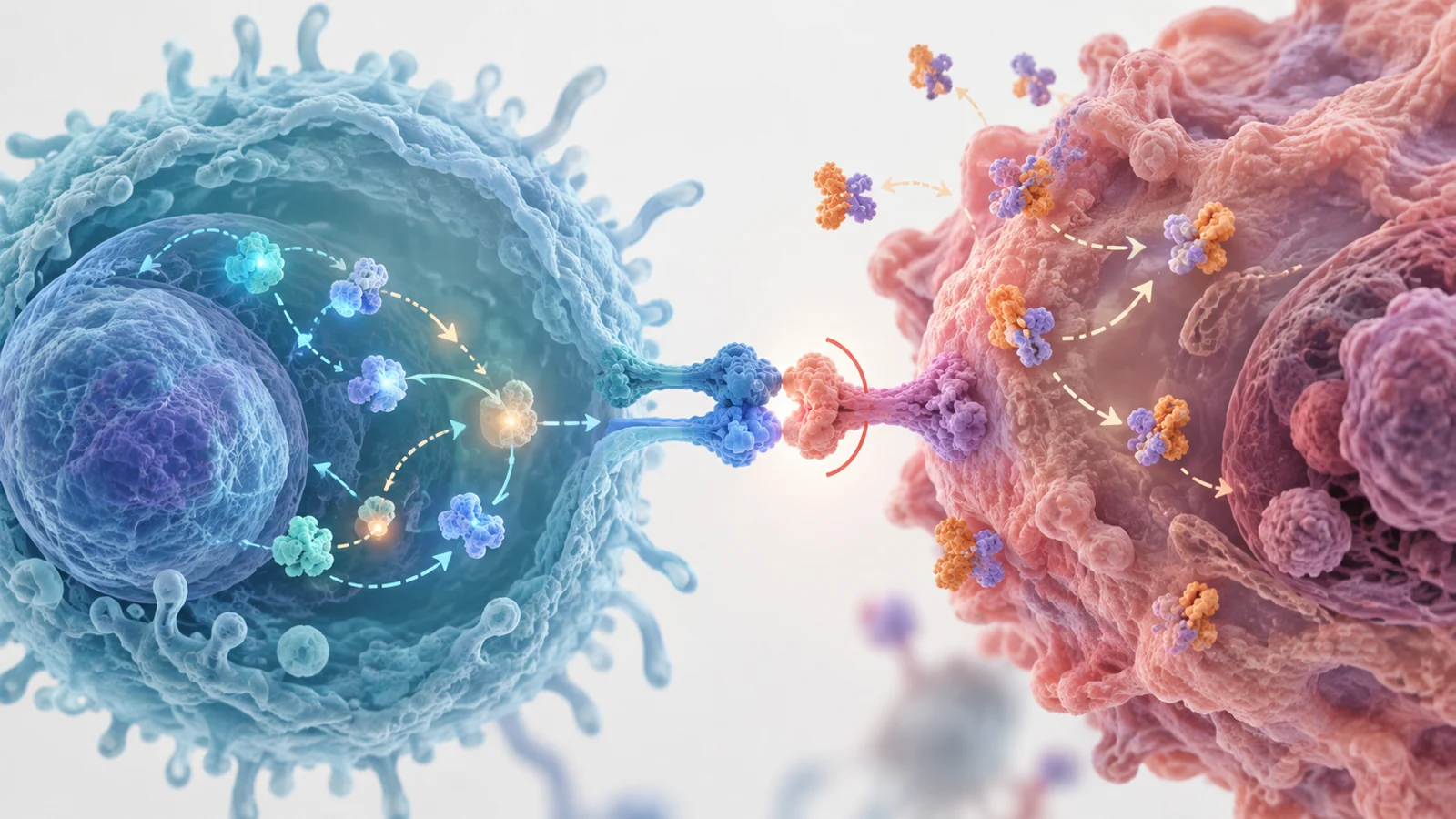
PD-1 is a protein on immune cells called T cells. When it connects with PD-L1, a protein that can appear on tumor cells, the interaction dampens the T cell’s attack. Drugs that block PD-1 or PD-L1 can release this brake and help T cells recognize and kill cancer cells.
That approach has changed cancer treatment, but it does not work for everyone. Some tumors may be difficult for immune cells to recognize in the first place. The review describes mutations affecting JAK1, JAK2 or beta-2 microglobulin that can interfere with antigen presentation—the process by which a cell displays fragments of proteins for immune cells to inspect. If this process is impaired, releasing the PD-1 brake may not be enough to restore an effective response.
Other inhibitory signals can also weaken T cells. The review discusses proteins such as TIM-3, LAG-3 and TIGIT, which are associated with reduced T-cell activity. These overlapping barriers help explain why researchers have explored combining checkpoint inhibitors with treatments that alter tumor cells, immune signals or the tumor environment.
The melanoma comparison paired two immune checkpoint drugs
Nivolumab blocks PD-1; ipilimumab blocks a different immune checkpoint, CTLA-4. The review summarizes a phase II study in advanced melanoma in which the objective response rate—the share of patients whose tumors shrank by a specified amount—was 61% with nivolumab plus ipilimumab, compared with 11% with ipilimumab plus placebo. In the combination group, 22% had a complete response.
A separate clinical comparison summarized in the review reported progression-free survival of 11.5 months with nivolumab plus ipilimumab, compared with 6.9 months with nivolumab alone and 2.9 months with ipilimumab alone. Progression-free survival measures how long patients live before their cancer worsens or they die. In that comparison, treatment-related grade 3 or 4 adverse events occurred in 55.0% of the combination group, versus 16.3% with nivolumab and 27.3% with ipilimumab alone. These grades indicate more serious side effects.
The figures show why a second checkpoint drug could matter: blocking more than one immune brake may strengthen an anti-tumor response for some patients. They also show the cost of that strategy in this setting. The review notes that immune-related adverse effects can include diarrhea, fatigue, itching, rash and nausea, with more severe problems also possible. The balance of benefit and harm depends on the particular treatment and patient group.
Some partners change what the immune system can see
Chemotherapy is usually intended to damage or kill cancer cells, but the review describes additional effects that may make tumors more visible to immune defenses. Cell death can release tumor antigens; chemotherapy may also support the activity of immune cells involved in presenting those antigens. This provides a biological reason to test chemotherapy alongside a PD-1 or PD-L1 inhibitor.
In metastatic lung cancer, the review reports improved outcomes in comparisons involving pembrolizumab plus chemotherapy. For untreated metastatic squamous non-small-cell lung cancer, it gives progression-free survival of 6.4 months with the pembrolizumab combination versus 4.8 months in the comparison group, and overall survival of 15.9 versus 11.3 months. Overall survival measures time until death from any cause. The review also reports lower risks of death and of disease progression or death in the combination group. These findings belong to that lung-cancer treatment comparison; they cannot be used to rank chemotherapy against other partners in melanoma or another cancer.
Radiation can also kill tumor cells and release antigens, potentially changing the immune response around a tumor. The review describes laboratory and animal research in which radiation combined with PD-1 blockade increased immune activity or reduced tumor growth. It also cites clinical evidence involving people with melanoma brain metastases who received stereotactic radiation, as well as trials that were under way at the time. Those different kinds of evidence should not be read as interchangeable: an effect in mice or a trial still in progress is not the same as a demonstrated clinical outcome.
Oncolytic viruses are designed to infect and damage tumor cells while provoking immune activity. The review describes a study of 21 people with advanced melanoma who received talimogene laherparepvec, an oncolytic virus, with pembrolizumab. It reported an objective response rate of 62%; fatigue, fever and chills were among the common adverse events. This small study offers an early clinical signal, but it does not establish whether adding the virus improves outcomes over pembrolizumab alone. Other virus findings in the review, including increased immune-cell activity with vaccinia virus, came from animal studies.
A different lung-cancer pairing did not add benefit
The review also describes phase I/II studies that paired pembrolizumab with the EGFR inhibitors erlotinib or gefitinib in people with advanced non-small-cell lung cancer and sensitive EGFR mutations. In the account provided, the combination did not improve efficacy or show a synergistic effect in killing tumor cells.
This result differs from the pembrolizumab-plus-chemotherapy findings, but the studies involved different partners and patient settings. It does not show that one class of treatment is universally useful and another is not. Instead, it underlines the need to test each pairing in the cancer and population for which it is intended.
Choosing likely responders remains difficult
A useful combination would help patients likely to benefit while sparing others unnecessary side effects. But the markers discussed in the review do not offer a simple, reliable answer for everyone.
PD-L1 testing looks for the protein that can engage PD-1. The review describes variation in PD-L1 expression within tumors, changes over treatment, and differences among staining antibodies and testing methods. A single measurement may therefore not represent every part of a tumor or remain consistent over time. The relationship between PD-L1 levels and treatment outcomes also varies among cancer types.
Tumor-infiltrating lymphocytes, or TILs, are immune cells found within tumor tissue. Their presence can provide context about whether an immune response is reaching the cancer. The review notes that outcomes may differ between tumors with both TILs and PD-L1 and those with PD-L1 but few TILs. Where immune cells are located in the tissue may also matter, so a count alone may not capture the full picture.
Mismatch-repair deficiency is a tumor feature that can lead to many mutations and more unusual proteins for immune cells to recognize. The review describes it as a possible predictor of response to PD-1 treatment, while noting that it occurs in a limited group of patients. No marker discussed here amounts to a universally dependable way to choose a combination for an individual.
Gut microbes are a promising but unsettled lead
The review also summarizes studies linking intestinal microbes with checkpoint-treatment response. It cites findings in which particular bacteria were associated with stronger immune activity, and research in which fecal bacteria transfer or oral supplementation altered responses to PD-1 inhibitors. Some of these findings came from laboratory or animal work; the review also discusses associations observed in people.
Those results raise questions about how gut bacteria may influence immune responses, but a laboratory finding cannot by itself tell clinicians which intervention will help a patient. Human gut communities vary, and results from selected bacteria in controlled studies may not represent that complexity. The evidence summarized here does not establish that taking a probiotic or changing gut bacteria improves an individual’s cancer treatment outcome.
How better-matched combinations could reach more patients
The review’s goal is to help more people benefit from checkpoint treatment, including patients whose tumors do not respond to a checkpoint inhibitor alone. If researchers can identify which tumor features and immune barriers matter for each cancer, clinicians may eventually be able to select combinations that improve control while avoiding some unnecessary toxicity. Reaching that point depends on reliable predictors and cancer-specific evidence of both benefit and harm; the examples reviewed in 2021 show why one successful pairing cannot settle the question for another.
Key Sources
- Primary source: A combination of PD‑1/PD‑L1 inhibitors: The prospect of overcoming the weakness of tumor immunotherapy (Review).
DOI or Journal Page · Review or Meta-Analysis · 2021-03-24
Keep exploring