
Research Signal – Source date 2022-01-01
A treatment that helps the immune system fight cancer can meet two very different obstacles. In one tumor, it may not produce an initial response. In another, the cancer may respond at first and then return. Both patterns are called resistance, but they describe different points in the course of treatment—and may have different origins.
A 2022 review of immunotherapy in human cancers describes this distinction and considers ways researchers are exploring to overcome resistance. Its central message is that an immune-based treatment is not equally effective across cancers, and that a tumor’s initial response does not tell the whole story.
Two different paths to resistance
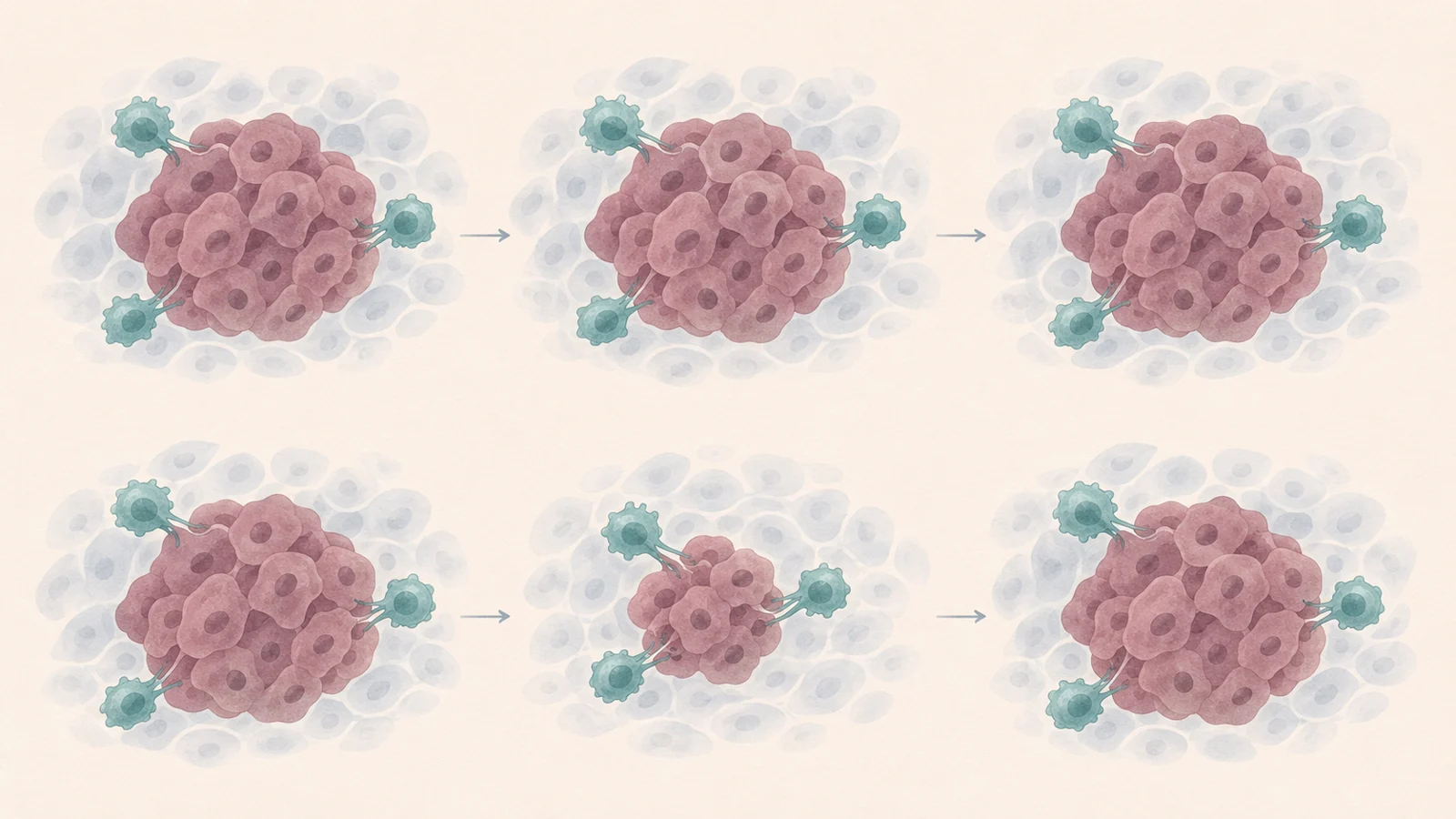
Primary resistance means a tumor does not respond to immunotherapy from the start. Acquired resistance describes a different sequence: treatment appears to work initially, but the tumor later returns or progresses. The review discusses both patterns in relation to checkpoint inhibitors and adoptive T-cell therapy, approaches that use or support immune activity against cancer.
The difference is more than a matter of timing. When treatment does not work at first, the question is why the tumor was resistant at the outset. When a tumor responds and later returns, researchers must also consider what changed during that course. The abstract does not identify a specific cause for an individual tumor, so these categories describe patterns rather than provide a patient-level diagnosis.
Response varies across cancers
The review reports substantial differences in response among cancer types. In its comparison, advanced melanoma and non-small cell lung cancer had the highest response rates to immunotherapy. That relative finding is a reminder that “immunotherapy” does not name one uniformly effective experience: the response depends in part on which cancer is being treated.
The comparison does not supply numerical rates in the evidence summarized here. It supports a broad contrast across cancer types, not a prediction for a particular person or a ranking that can settle an individual treatment decision.
Resistance can arise in different places
For primary resistance, the review points to two broad possible origins. Resistance may be intrinsic to the cancer cells themselves, or it may be extrinsic—associated with the tumor microenvironment, meaning the cellular setting surrounding the tumor. In either case, immune treatment can face obstacles linked to the tumor or its surroundings.
This location distinction gives research more than one place to look. But it does not mean that a clinician can tell from the response pattern alone which source is responsible. The supplied evidence does not name specific molecular pathways or establish what caused resistance in any particular cancer.
An early response may not last
Acquired resistance makes duration part of the question. An initial response shows that the tumor was not wholly unresponsive at the beginning, but it cannot guarantee that the effect will continue. A later return is a different clinical course from a treatment that never worked, even though both can leave patients facing limited benefit.
The review treats understanding these patterns as a route for research into ways of overcoming resistance. It discusses approaches being explored, but the abstract does not provide results for a particular strategy. Identifying a form of resistance could help researchers investigate which approaches fit which problem; whether such matching improves patient outcomes remains to be shown.
Where this research could lead
If researchers can reliably characterize why a tumor begins growing again after an initial response, a future treatment decision might be tested against that specific resistance pattern. A return of cancer could then prompt investigation of a relevant next approach rather than being treated as one undifferentiated event. That possibility depends on dependable ways to characterize resistance and on evidence that choices guided by it can help patients. The 2022 review contributes the distinction among response patterns and possible origins; it does not establish that resistance-guided treatment improves outcomes.
A nearer milestone would be a prospective study in patients that identifies resistance patterns and tests whether treatment choices based on those patterns improve response or help it last longer. Such a study would connect the review’s research direction to a measurable patient outcome.
Key Sources
- Primary source: Resistance to immunotherapy in human malignancies: Mechanisms, research progresses, challenges, and opportunities.
DOI or Journal Page · Review or Meta-Analysis · 2022-01-01
Keep exploring