
Research Signal – Source date 2021-02-25
A brain-controlled device can be difficult to use for reasons that have little to do with effort or intention. The review cites studies estimating that roughly 15–30% of people may not produce brain signals robust enough for a BCI task. It also describes a different problem: a person may produce relevant activity, but the recording method may fail to capture features the system can use. A poor result can therefore reflect the person, the sensor, or how well the two fit together.
That estimate is a range from cited studies, not a universal rate across every person, task, or device. The review’s broader point is that a brain-computer interface, or BCI, must turn variable biological activity into a dependable command. That translation takes several steps, and each creates its own design choices.
From brain activity to a device response
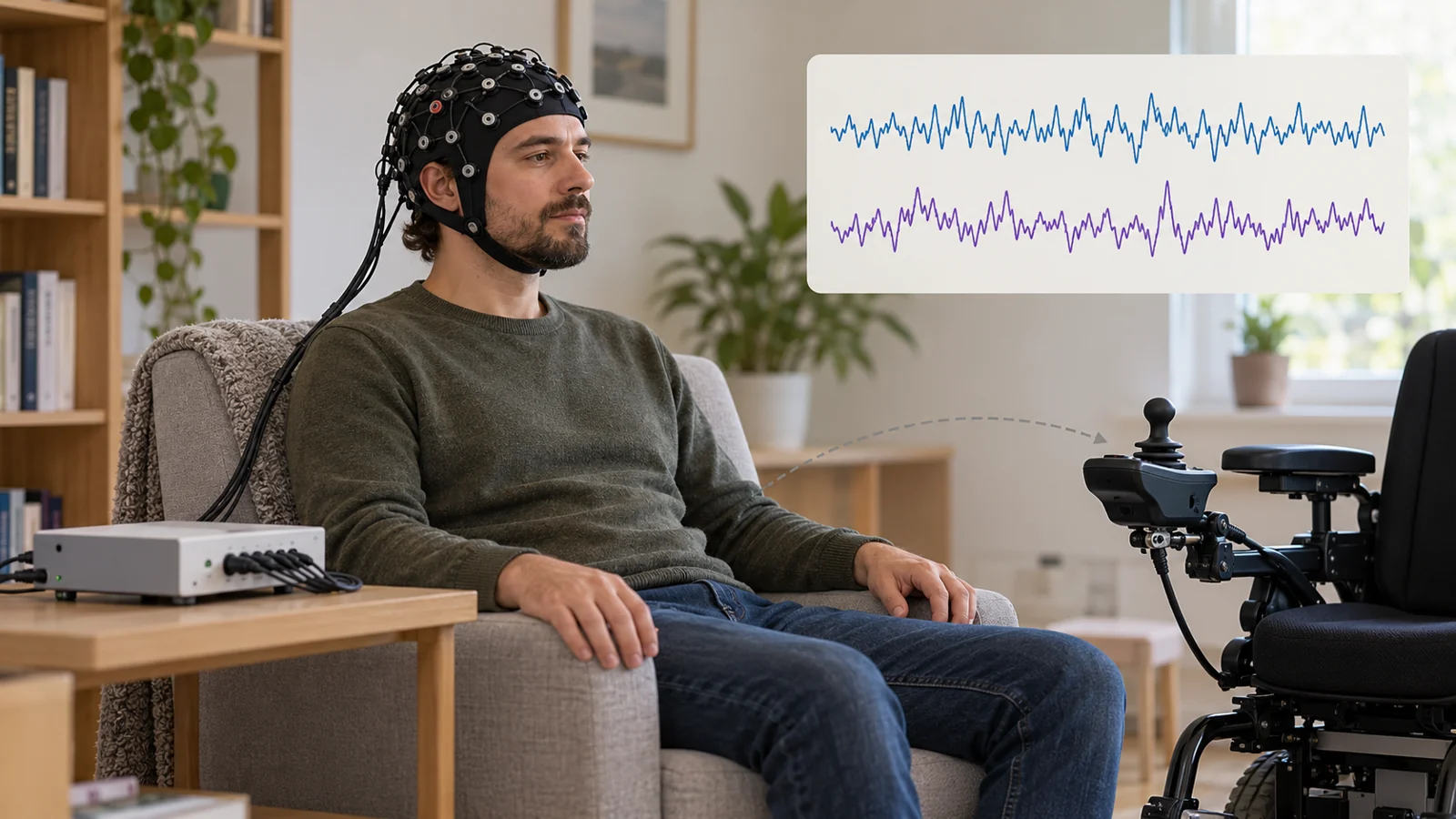
A BCI records activity from the brain, processes the measurements to identify a useful pattern, and classifies that pattern as a command. A computer or another device then responds. In a motor-imagery example, a person imagines moving a hand; the system tries to distinguish the associated brain activity from other activity and translate it into an instruction. The intention is not read directly. It is inferred from measurements.
Other systems use a response to an outside cue. A visual display might flicker in a pattern, for example, and the BCI identifies the brain response associated with the chosen target. The cue and the imagined movement are different ways to generate activity for the system to interpret. Neither works equally well for every application or user.
Before classification, software represents the recorded activity in forms that can reveal patterns over time and across sensor locations. It can, for instance, examine how a signal changes in frequency or how activity differs across channels. A classifier then sorts those extracted features into categories, such as a control state. The review describes methods ranging from linear discriminant analysis to nonlinear support-vector machines, but the central challenge is the same: the software must find a pattern that separates the intended command from competing activity.
A classifier can perform well on the data used to train it and still struggle with new measurements. Brain activity varies, and the relationship between a person’s activity and the recorded features can shift. The device response is only as dependable as the chain connecting recording, feature extraction, classification, and command execution.
A convenient sensor can miss useful detail
The choice of sensor affects both the quality of the measurement and whether the system can be used outside a specialized setting. Scalp electroencephalography, or EEG, records electrical activity without surgery and is comparatively portable. It has finer timing information than some imaging methods, but poorer spatial resolution: it is harder to tell precisely where activity originated. High-density EEG can add spatial detail, while also increasing computational demands and the effort needed to maintain a usable signal across channels.
The scalp is not a transparent window onto every brain pattern. The review notes that the folding of a person’s cortex or the distance between the scalp and cortex can make task-specific features difficult to measure. In other cases, background activity and changes in a person’s state can lower the signal-to-noise ratio, making the relevant pattern harder to distinguish. A system can therefore fail to extract a useful feature even when its user is attempting the task.
Other noninvasive methods measure different aspects of brain activity. Functional near-infrared spectroscopy, or fNIRS, estimates changes related to blood oxygenation and can be portable, but its hemodynamic measurements have delays. The review describes combining fNIRS with EEG as one proposed way to bring together complementary information. Functional MRI can capture blood-oxygen-related activity too, but the review describes its size and cost as impractical for most BCI applications. No single measurement method satisfies every need for signal quality, portability, cost, and ease of maintenance.
Intracortical electrodes and electrocorticography record from within the skull or at the brain’s surface. The review describes these invasive approaches as offering better signal-to-noise ratio and localization than noninvasive recordings. That measurement advantage comes with a different burden: implantation involves surgery and potential complications. The review discusses bleeding and infection as infrequent risks, along with possible psychological or neurological side effects and the need for maintenance or electrode removal in some cases.
For a device intended to support repeated use, convenient setup and upkeep matter alongside signal quality. A sensor that captures detailed activity but requires an invasive procedure poses different practical and safety questions from a scalp system that is easier to wear but may miss useful detail. The right balance also depends on what the device is meant to do.
The cue can help one user and exclude another
A BCI’s control method shapes the experience as much as its sensor. Steady-state visual evoked potential systems use brain responses to flickering visual targets. The review describes this approach as having a high information-transfer rate among noninvasive EEG methods: it conveys relatively more usable choices in a given time. But sustained viewing of flicker can cause visual fatigue, and a visually evoked response may not be usable for someone whose visual processing is impaired.
An auditory evoked response may offer another route when hearing remains intact. It is an example of matching the cue to a person’s available abilities, rather than assuming that one interface suits everyone. The control mapping matters too. In a visual speller, a letter might be linked to a flicker frequency; the connection is assigned by the interface, rather than being an inherent relationship between the letter and the brain response.
Motor imagery has a different appeal: the imagined action can have a more direct relationship to the intended command. Yet the review notes that motor-imagery control may be too slow for some action-control uses. A cue or command method that performs well on one measure may still be a poor fit for a particular task, sensory ability, or user. Design choices involve tradeoffs, not a single winning approach.
Calibration tries to keep pace with changing signals
Many BCI systems require an individual calibration session. The system gathers examples of a person’s brain activity while they perform or imagine the relevant tasks, then uses those samples to learn which patterns should trigger which commands. The review describes calibration as tedious and sometimes frustrating. It also explains why the process is needed: signals can vary within a person over time and differ between people, so a model learned from one session may not classify another session reliably.
Researchers have proposed ways to reduce that dependence on repeated, person-specific training. Transfer learning uses data or learned patterns from other sessions or people to help a system adapt. Other approaches adjust the feature space or align data so that measurements taken at different times are more comparable. The review discusses these methods as responses to session-to-session and person-to-person variability, not as a guarantee that calibration can be eliminated.
There are practical limits. Some data-driven methods need substantial training samples to estimate their parameters. With too little data, a model can overfit: it may learn quirks of the training examples rather than patterns that hold up in later use. Transfer methods also depend on useful commonalities between the data being reused and the person or session where the system will operate. Adaptation is an engineering response to changing signals, but it has to be judged in the conditions where the device is intended to work.
Control and rehabilitation are related, but not identical
Some BCIs translate brain activity into commands for assistive devices. The review describes examples such as controlling a wheelchair, prosthetic arm, or exoskeleton. These systems aim to provide an additional way to operate equipment when ordinary movement is limited. The quality of control depends on whether the system can distinguish intended activity well enough for the relevant task.
Rehabilitation systems can add another step. They may pair a person’s brain activity with feedback, a brace or other device that supports movement, or electrical stimulation during training. The goal can be to engage the nervous system while a person practices a movement, rather than simply to issue a command to an external device. The review connects these approaches to neuroplasticity, the capacity of neural connections and networks to change with experience or stimulation.
It describes studies reporting changes in task-related brain activity and examples in which rehabilitation was associated with increased muscle activity. Those observations help explain why researchers investigate BCI-assisted training. They do not, by themselves, establish lasting recovery for every patient or a single clinical benefit across the range of conditions and devices discussed. The review brings together varied applications and cited studies; its examples are not a pooled estimate of treatment effect.
Sensitive measurements need meaningful safeguards
A system that records brain activity raises questions beyond comfort and accuracy. The review notes that consumer-grade BCIs have been used in studies to decode passwords or recognize faces, illustrating why access to raw data and its later use matter. Brain-related measurements can also be used to infer affective or cognitive states. Users need to understand what is collected, how it is stored, who can access it, and what the system is designed to infer.
Consent may be especially difficult when a potential user has limited ability to communicate or few alternatives. Clear information and safeguards are therefore part of whether a BCI is appropriate to use, not an administrative detail added after the technology is built. The review also points to cybersecurity concerns, including unauthorized access to stored information or interference with a wireless device or computer-guided stimulation.
When a system can stimulate the brain, safety questions become more direct. The review discusses possible effects on behavior, emotion, personality, or memory, while emphasizing the need for ethical and safety guidance. Invasive devices add the physical risks of surgery and ongoing maintenance. These concerns do not mean all BCIs pose the same risk; the relevant protections depend on what a particular system records, controls, or stimulates.
What the review can tell us
Published on February 25, 2021, this review surveys BCI approaches and challenges across different sensors, tasks, algorithms, and applications. Its tables bring together a broad set of examples without specific selection criteria. They are useful for understanding design tradeoffs and reported possibilities, but they do not provide a single performance estimate for the field or establish that one approach works reliably for all intended users.
The review also describes the gap between laboratory experiments and plug-and-play use in daily life. It cites studies reporting that reliable use over several months is feasible in some settings, while the broader account shows why performance can still depend on the person, the task, the recording method, and changes in the signals. The examples are evidence of progress and active engineering, not a promise of universal everyday control.
What reliable brain control could offer people with limited movement
If recording, calibration, and safeguards can be made dependable for the people and tasks a system is designed for, BCI could give some people with movement disabilities an additional way to control assistive equipment. In rehabilitation, pairing brain activity with feedback or stimulation could support training that engages movement-related networks. Those possibilities depend on matching the interface to the user, managing changing signals, and showing that the intended use is safe and useful in practice. The review presents routes toward those capabilities, while leaving their reach conditional on solving those practical and ethical challenges.
Key Sources
- Primary source: Progress in Brain Computer Interface: Challenges and Opportunities.
DOI or Journal Page · Review or Meta-Analysis · 2021-02-25
Keep exploring