
Research Signal – Source date 2025-10-09
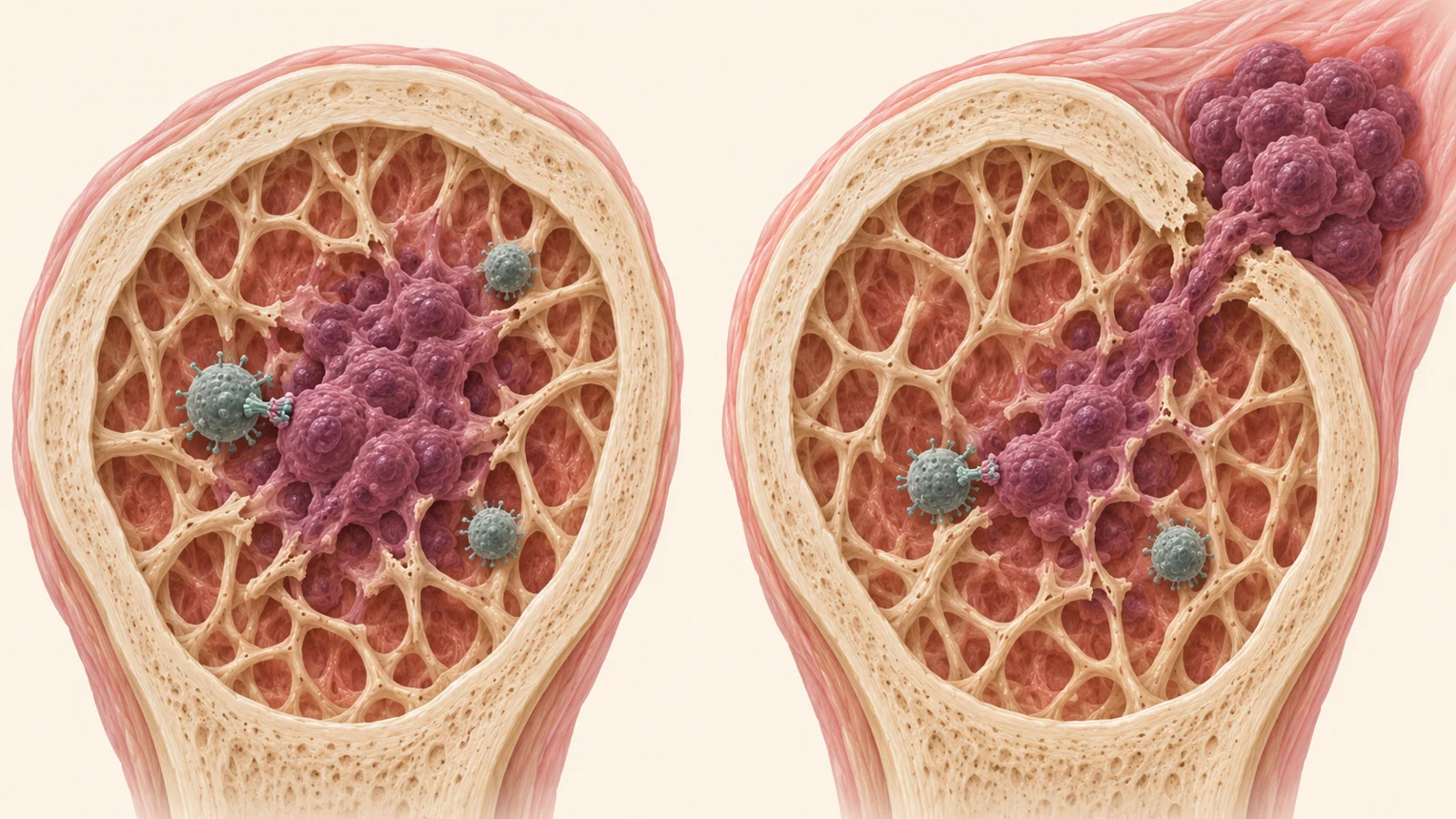
A tumor found in bone can have started there—or arrived after spreading from somewhere else. That difference matters when researchers ask whether an immune treatment might work: a breast cancer deposit in bone is still breast cancer, while osteosarcoma is a primary bone cancer with its own biology.
A review published October 9, 2025, surveys immune treatments being studied for bone tumors. Its central challenge is that these treatments need two things to line up: tumor cells must be recognizable to the immune system, and immune cells must be able to act inside the tumor. The review discusses immune barriers in bone tumors; it does not show that the same treatment evidence applies to primary cancers and bone metastases.
A tumor in bone can have two different origins
Primary malignant bone tumors include osteosarcoma, chondrosarcoma and Ewing sarcoma. Osteosarcoma is the most common primary malignant bone tumor and often affects children and adolescents. By contrast, tumors in bone are more commonly metastases—cancer cells that have spread from cancers such as those of the breast, prostate or lung.
The distinction is more than anatomical. A metastatic tumor retains the identity of the cancer from which it began. Treatment evidence from breast, prostate or lung cancer therefore cannot automatically be treated as evidence for osteosarcoma, even if both are present in bone. The review discusses primary tumors and bone metastases together as a field of interest, but they are not one interchangeable disease.
Existing care also depends on the disease and setting. For localized osteosarcoma, the review describes chemotherapy before surgery followed by additional chemotherapy as a standard approach. Surgery, radiation and chemotherapy each have limitations, including possible effects on function and side effects. Those limits help explain interest in other approaches; they do not mean an immune treatment is already a replacement for established care.
Immune treatments try to change different steps
Immunotherapy means treatment that enlists or directs the immune system against cancer. One obstacle is that some bone tumors are relatively weak at provoking an immune response. Tumors also vary: cells within the same cancer can differ, and the surrounding tissue can contain immune-suppressing cells that hinder an attack. A treatment may have a promising target yet still struggle if immune cells cannot recognize or function against enough of the tumor.
Checkpoint inhibitors try to release an inhibitory signal. T cells—immune cells that can kill abnormal cells—may become less active in a tumor. Checkpoints such as PD-1 and CTLA-4 help restrain immune responses; drugs that block them aim to restore some T-cell activity. The review describes abnormal PD-1/PD-L1 signaling in bone tumors as a reason to investigate these drugs, not as proof that blocking the pathway works broadly in those diseases.
CAR-T cells take a different approach: a patient’s T cells are engineered to carry a receptor that recognizes a chosen tumor target. Researchers are exploring targets such as GD2 and HER2 in bone tumors. The appeal is more directed recognition. The challenge in solid tumors is that the local environment can suppress the engineered cells, while a target must be present on the cancer without causing unacceptable harm to other tissue.
Cancer vaccines try to prompt recognition by showing the immune system tumor-associated targets. Researchers have investigated targets such as NY-ESO-1 and MAGE-A3, as well as personalized approaches based on features of an individual tumor. The hard part is finding an antigen that is present, distinctive enough to target and capable of prompting a useful immune response.
Why results in other cancers do not transfer automatically
The review’s therapy table helps put these approaches in context. Checkpoint inhibitors have uses in several cancers, including melanoma and lung cancer. CAR-T therapies have established uses in some blood cancers, while their use in solid tumors remains largely experimental. The table also lists preventive cancer vaccines and therapeutic vaccines being explored in cancers such as melanoma and lung cancer. These examples explain why researchers are testing related ideas against tumors involving bone, but they do not show that results transfer from one cancer type to another.
Selection depends on what a tumor displays. The review’s table lists tumor markers that can help select checkpoint treatment in other cancers. CAR-T needs its chosen target on cancer cells; a personalized vaccine needs a tumor feature the immune system can recognize. These requirements do not provide a validated way to choose an immune treatment for every primary bone cancer or bone metastasis.
The table also describes class-level risks. Checkpoint inhibitors can cause inflammatory effects in different organs, including the bowel, skin, liver, lungs or hormone-producing glands. CAR-T treatment can cause severe acute reactions such as cytokine release syndrome, as well as neurologic effects. These are potential harms associated with the treatment classes; the table does not establish bone-tumor-specific rates. The risks and selection questions are part of judging a treatment, alongside whether it controls the cancer.
One osteosarcoma comparison has a narrow meaning
The review cites a Phase II study in resectable, primary osteosarcoma that compared conventional neoadjuvant chemotherapy with a combination of a cDC1 dendritic-cell vaccine and PD-1 blockade before surgery. The review reports a major pathological response in 56% of the vaccine-combination group, which included 25 patients, compared with 20% in the chemotherapy group.
A pathological response is assessed in tumor tissue after preoperative treatment: it indicates how much response the pathologists observed in the removed tumor. It is not the same measure as survival or proof that a treatment improves a patient’s long-term outcome. The reported comparison is also for a combination, so it cannot isolate the vaccine’s effect from PD-1 blockade or establish that the vaccine alone produced the difference.
This is a specific result in a defined setting, not a result across all bone tumors. It concerns a preoperative combination for primary osteosarcoma, not cancer that has spread to bone. The review’s account makes it a reason to study the strategy further while leaving its broader clinical reach unsettled.
Where this research could lead
If trials validate both an immune regimen and selection markers for a defined group such as patients with osteosarcoma, clinicians could identify who might benefit and weigh the treatment alongside established care. For those patients, the payoff would be a treatment choice grounded in outcomes from their disease rather than borrowed from another cancer. Trials would need to demonstrate clinical benefit and harms, beyond response measured in removed tumor tissue.
The review supports the early links in that path: tumor origins differ, immune barriers can limit treatment, and researchers have candidate strategies to address those barriers. It does not establish a marker-guided pathway for all tumors in bone. A nearer milestone would be a prospective multicenter study that separates primary bone cancers from bone metastases, tests marker-defined groups and reports clinical outcomes and harms against appropriate standard care. Such evidence could show whether the biological distinctions lead to dependable treatment choices—and for whom.
Key Sources
- Primary source: A review of immunotherapy for bone tumors.
DOI or Journal Page · Review or Meta-Analysis · 2025-10-09
Keep exploring