
Research Signal – Source date 2021-02-27
A discarded plastic print might be usable again with little processing. In one study summarized by a 2021 review, recycled PET was reported to be more suitable for 3D printing than pure PET. That is a notable result, but it concerns one plastic and one set of conditions; it is not a general rule that recycled filament prints better.
The practical question is what kind of waste is at hand. A clean object may be reused directly. Scrap that is dirty or no longer performs well may need grinding, extrusion or added materials before it can be printed again. Some plastics can instead be chemically broken down into smaller building blocks. These routes preserve different things, and each has its own limits.
A printed object is not a single kind of plastic
The review, published February 27, 2021, surveys recycling and degradation approaches for plastics used in 3D printing. It describes materials including PLA, ABS, PET, polyamide and polycarbonate. Their different properties matter because a process that works for one polymer may not work for another.
The condition of the scrap matters too. Contamination can make direct reuse unsuitable, while the material’s properties and how many times it has already been processed can affect the quality of another product. The review treats these as central questions for future recycling work, rather than describing one recipe that fits every discarded print.
Clean plastic can sometimes keep its shape
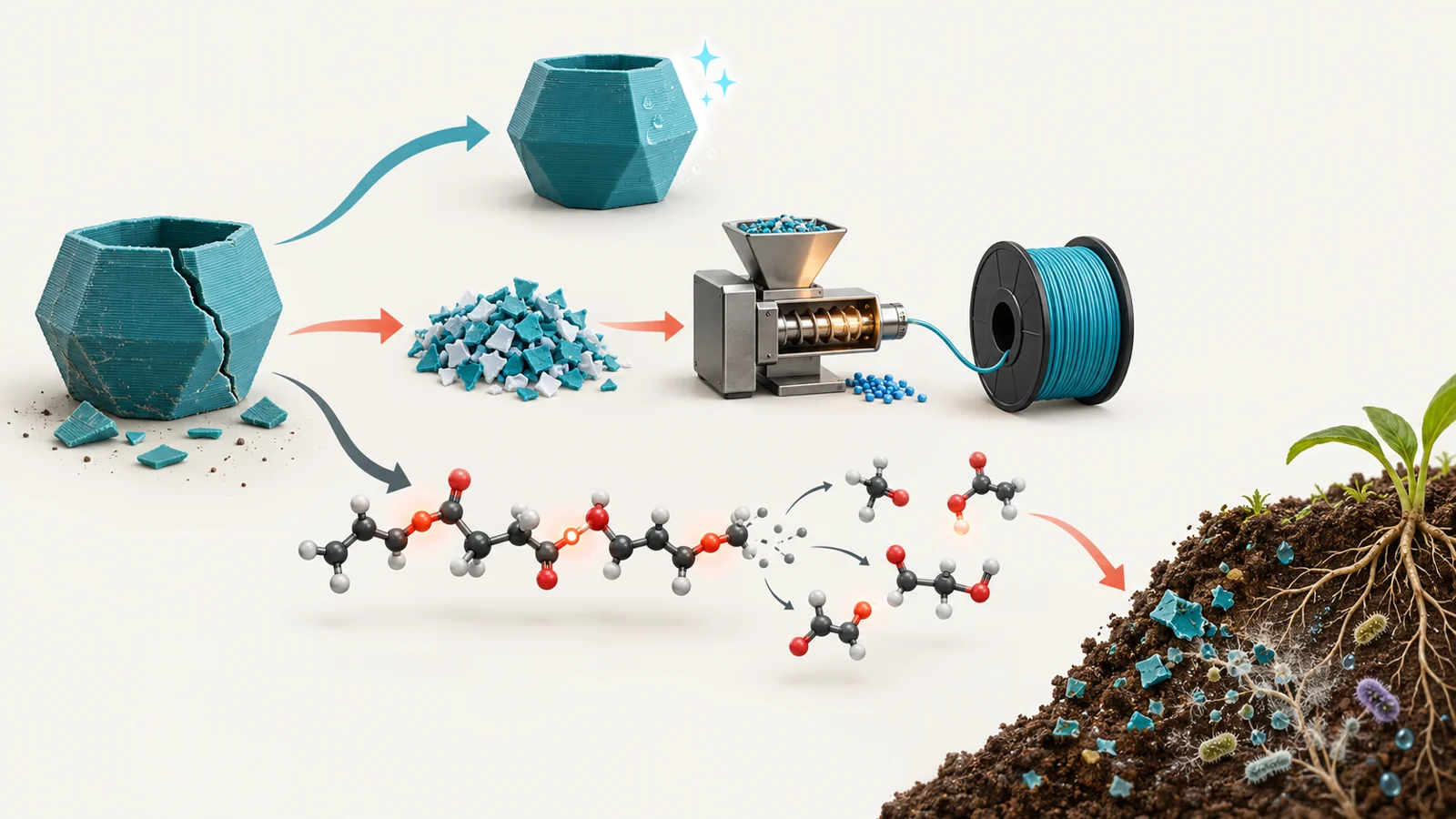
Direct reuse means using a plastic object again without first breaking it into particles or molecules. The review describes a printed ABS framework with a porous coating that captured a dye from a solution. After cleaning with dilute acid, its ABS skeleton could be used again.
This example is a reuse of a particular structure in a particular application. It shows why clean, intact waste can have value without becoming filament first. But the review notes that direct reuse requires high-quality waste and applies to a limited range of plastics. Repeated use can also reduce plastic properties, so keeping the object intact does not make its reuse unlimited.
Reprocessing turns scrap into feedstock again
When a discarded print cannot be reused as an object, physical reprocessing offers another route. Grinding or pelletizing the material and extruding it can produce material for another print. This restores a usable feedstock form, but it also adds processing and energy, and the resulting material may not perform exactly like its original version.
The cited examples show how results varied by plastic and printing method. In one study summarized by the review, products printed from recycled ABS and PET using a particle-based method were reported to perform similarly to products made with a filament-based method. Recycled PLA and polypropylene performed less well in that comparison, though changing particle size or the printer opening was reported as a way to improve performance.
A separate PLA example involved grinding discarded prints into powder and printing them again. The review reports that some properties declined slightly while overall performance remained similar to the original filament. Other examples explored adding materials to change performance: silica was added to PLA, while dopamine coating was described as improving tensile properties of recycled PLA. These are specific formulations, not evidence that additives can restore every plastic or erase the effects of repeated processing.
The PET example that opened this article belongs in the same category of material-specific findings. A prior study summarized in the review found waste PET suitable as a 3D-printing material and used the resulting print material in circuit boards. Together, such examples make reuse plausible, while showing why a single result cannot predict how every plastic will behave after another cycle.
Chemical recovery breaks the print back down
Some recycling methods do not try to preserve the printed plastic’s form or properties. Instead, catalysts or solvents can break certain polymers into smaller molecules that may serve as chemical feedstock. This can be useful when a plastic is not suited to direct reuse or straightforward reprocessing, but the chemistry is selective: the review describes these methods as applicable to particular polymer types, especially ester-containing plastics.
For PET, the review summarizes a study using a choline-based ionic liquid called choline acetate. The process converted PET waste into bis(hydroxyalkyl) terephthalate, or BHET, with a reported efficiency of up to 85.2%. BHET is a smaller chemical building block, rather than a recovered PET print. The review also describes a further reaction that can produce another chemical used in paints and modified materials.
That result is a reported example, not proof of a broadly operating recovery system. Chemical treatment needs an appropriate plastic and solvent, and the review flags questions about processing and the environmental effects of ionic liquids. Breaking a polymer down can recover useful molecules, but it does not by itself show that every input, output or step forms a practical closed loop.
Biodegradable does not mean quickly back in the printer
Biodegradation is different from both reuse and chemical recovery. The plastic breaks down under particular conditions; that does not automatically return it as ready-to-print material. The review notes that PLA can degrade in soil, but that the rate depends on environmental conditions and can be very slow. In the example discussed, degradation over a few weeks was described as almost negligible.
The label “biodegradable,” then, does not tell us that a discarded print will disappear quickly in ordinary surroundings or become feedstock for a new print. Degradation and recycling answer different questions: one concerns the material breaking down, while the other seeks to retain or recover material for another use.
What a recycling loop for 3D printing could deliver
If material-specific recycling can reliably turn suitable print waste into usable objects, feedstock or chemical building blocks, 3D printing could use more of its own discarded plastic as a resource. That could reduce the need to treat every failed or finished print as unusable waste. Reaching that capability depends on matching the material and its condition to a workable route, while accounting for performance across repeated processing and the demands of chemical treatment. The review’s examples show possibilities across several routes; they do not establish one best method, unlimited reuse or an overall environmental benefit for all printed plastics.
Key Sources
- Primary source: Realization of Circular Economy of 3D Printed Plastics: A Review.
DOI or Journal Page · Review or Meta-Analysis · 2021-02-27
Keep exploring