
Research Signal – Source date 2021-02-28
A plastic object can emerge from a 3D printer with crisp detail and still be intended mainly as a model. Another printed object may be designed to perform a job, such as carrying a load or sensing strain. The difference is not simply how carefully each shape was made. It also depends on the material, the way the printer forms each layer, and whether those layers and any added reinforcements hold together under the demands placed on the part.
A 2021 review, “Additive Manufacturing of Polymer Materials: Progress, Promise and Challenges,” surveys printing routes, polymer materials and applications. Its examples show why additive manufacturing has moved beyond prototyping, while also illustrating how far a successful demonstration is from a general guarantee of performance.
A printed shape is only the beginning
Additive manufacturing builds an object from a digital design by depositing, curing or fusing material in successive layers. That approach makes complex forms practical to produce, but a precise shape does not by itself establish that a part has the strength, durability or other properties needed for a particular use.
The review describes material extrusion being used to make functional components as well as prototypes. In this process, a thermoplastic filament is pushed through a heated nozzle, laid down in a pattern and fused to the layer below as it cools. The method’s relative simplicity and range of printable plastics have made it useful across settings from product development to specialized parts.
Material jetting offers a different combination. It places droplets of liquid build and support materials, then cures them, often with ultraviolet light. The review describes smooth, detailed parts and the ability to combine materials in one print, including rubber-like and transparent options. Yet it characterizes material-jetted parts as mainly suitable for non-functional prototypes, citing concerns including mechanical properties, material cost and change over time. Similar-looking objects can therefore have different intended roles because their materials and manufacturing routes give them different properties.
Three routes shape different tradeoffs
In heated-filament extrusion, the printer pushes a continuous strand of thermoplastic through a nozzle and lays it down in lines. The method can use a range of commodity and engineering plastics, and the material solidifies and joins the layer beneath it. The finished object’s properties depend in part on how well those deposited lines fuse, as well as on their orientation and spacing.
Light-cured resin printing starts with liquid material. A light source selectively hardens it into the designed shape, layer by layer. The review notes that this route can produce fine detail and smooth surfaces, with layer heights adjusted to balance speed and quality. It also describes possible brittleness over time and higher expense as considerations. The resin and curing process therefore matter alongside the apparent precision of the surface.
Laser-based powder bed fusion works differently again. A laser selectively fuses polymer powder, such as nylon, building the part in successive layers. The review describes micro selective laser sintering, a microscale version reported to produce features below five micrometres; that figure describes feature size, not the strength of a finished part. It does not make powder fusion the best route for every component.
These methods do not simply offer different ways to draw the same object. They begin with different forms of material and turn them into a part through different physical steps. The choice changes what materials are available, the detail a process can produce and the properties that must be managed in the finished piece.
Fibers can reinforce plastic, if they bond well
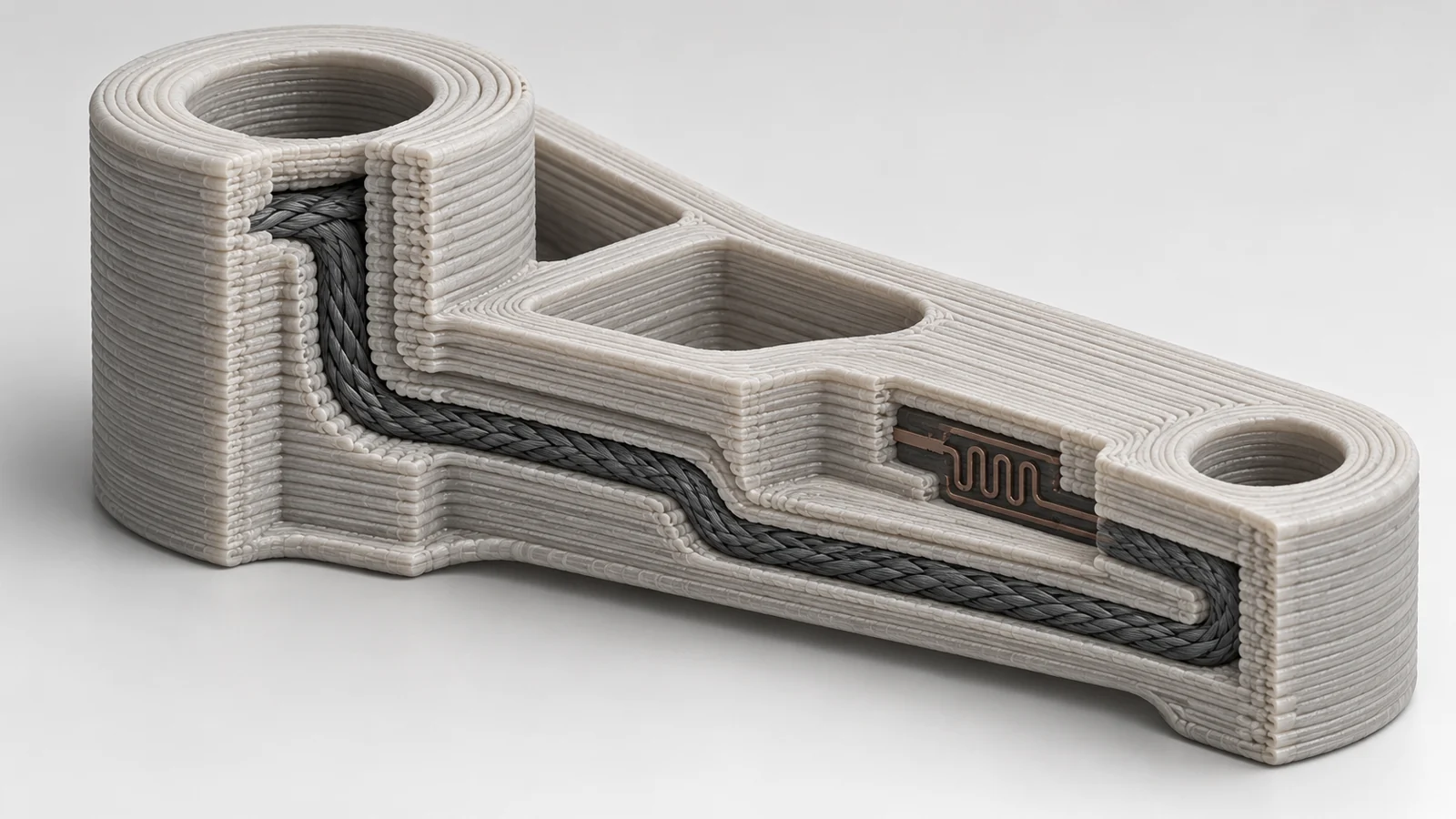
Polymers are adaptable and can be shaped into complex forms, but the review identifies their comparatively limited mechanical properties as a challenge for load-bearing uses. Adding fibers or particles is one way researchers have tried to improve a polymer’s performance. The reinforcement can change properties such as stiffness or strength, but the fiber must also connect effectively with the surrounding polymer matrix—the material that holds the reinforcement in place.
The review cites an individual study of a polymer composite containing 20 percent carbon fiber by weight. That study reported a 350 percent increase in flexural Young’s modulus, a measure of resistance to bending, and a 500 percent increase in thermal conductivity. These figures belong to that specific material and study; they are not a general result for all printed carbon-fiber plastics.
The interface between reinforcement and polymer is part of the design problem. If the materials do not adhere well to one another, the intended reinforcement may not transfer forces as needed. The review describes work using coupling agents to improve affinity between glass fibers and polymers, and surface treatment in a study of sisal-fiber composites. Reinforcement can expand what a plastic part is designed to do, but its benefit depends on the combination and how that combination is processed.
A part can combine structure and sensing
Some printed objects are designed to do more than take a shape or carry a load. The review describes conductive materials incorporated into polymer structures for electronics and sensing. In one cited example, researchers printed a flexible pressure sensor using a composite of carbon black and silicone rubber. Other examples include conductive nanocomposites explored for strain sensing, including a printed specimen used to monitor movement at a human wrist joint.
These demonstrations add a functional dimension to printing: a designed form can incorporate material intended to respond electrically as it bends or is pressed. The review also describes multimaterial printing, in which different materials are combined in a single object to alter its function or weight. Such combinations bring their own manufacturing constraints, including limits on dimensions and accuracy, post-processing needs, and the challenge of processing materials under compatible conditions.
The examples show possible approaches, not a shared test of sensing performance or evidence of a finished product’s reliability across uses. Their value here is to show how material selection can make a printed shape functional in ways that geometry alone cannot.
Settings and layer bonds affect the finished part
Once a design is fixed, printer settings still help determine the properties of the object that comes out. The review lists variables such as nozzle diameter, extrusion temperature, layer thickness, deposition speed, raster orientation, fill density and platform or chamber temperature. These settings affect how material is placed and how the layers meet, so changing them can influence dimensions, surface quality and mechanical behavior.
The bond between layers is especially relevant when a part faces humidity, vibration, temperature changes or shock, conditions the review discusses for electronic components. A part may appear well formed while its internal layer connections remain a critical factor in how it performs. Measuring those connections is not straightforward: some approaches provide only qualitative indications, while tests that load overlapping layers can estimate bond strength in a more direct way.
Layer adhesion also links manufacturing conditions to the final part. Material, orientation and temperature choices interact with the way each layer is deposited or cured. A result from one print setup therefore describes that setup and material combination, rather than establishing how every part made by the same broad method will behave.
What a broad review can and cannot compare
The review brings together research on different polymer printing processes, composites, nanocomposites, elastomers, responsive materials and applications. Its examples range from component fabrication to biomedical, electronics, textile and aerospace research. This breadth helps readers see the variety of directions that polymer additive manufacturing had taken by the review’s 2021 publication date.
The studies summarized use different materials, designs and measures of performance. The review does not provide one common benchmark that would rank every route or material for making a dependable working part. A result for one composite or sensor cannot establish performance under every intended condition, and the application areas discussed do not establish clinical benefit or universal industrial readiness. The evidence is most useful for understanding the kinds of capabilities being explored and the material and process questions that shape them.
What reliable printed plastic could enable
For engineers and manufacturers, dependable printed plastics could make it possible to produce tailored components whose shape and material functions are designed together. A part might combine a structure with a sensing region, or pair a polymer with reinforcement to meet a particular mechanical need. If material combinations can be made consistent, printer settings controlled and layers bonded reliably, additive manufacturing could support working components that are difficult to make through conventional methods. The review presents this as a developing possibility, with performance tied to the specific materials, processes and conditions involved.
Key Sources
- Primary source: Additive Manufacturing of Polymer Materials: Progress, Promise and Challenges.
DOI or Journal Page · Review or Meta-Analysis · 2021-02-28
Keep exploring