
Research Signal – Source date 2021-03-24
A small backing changed two different results for a wearable Wi-Fi antenna: measurements showed stronger gain, while a computer model showed less radio energy absorbed by nearby tissue. In this 2021 preprint, the researchers built the antenna and tested its electrical and radiation performance. They evaluated absorption separately, using a simulated three-layer tissue model. That split matters: the prototype measurements describe antenna behavior, while the absorption figures describe one modeled arrangement.
A slot gives one antenna two operating bands
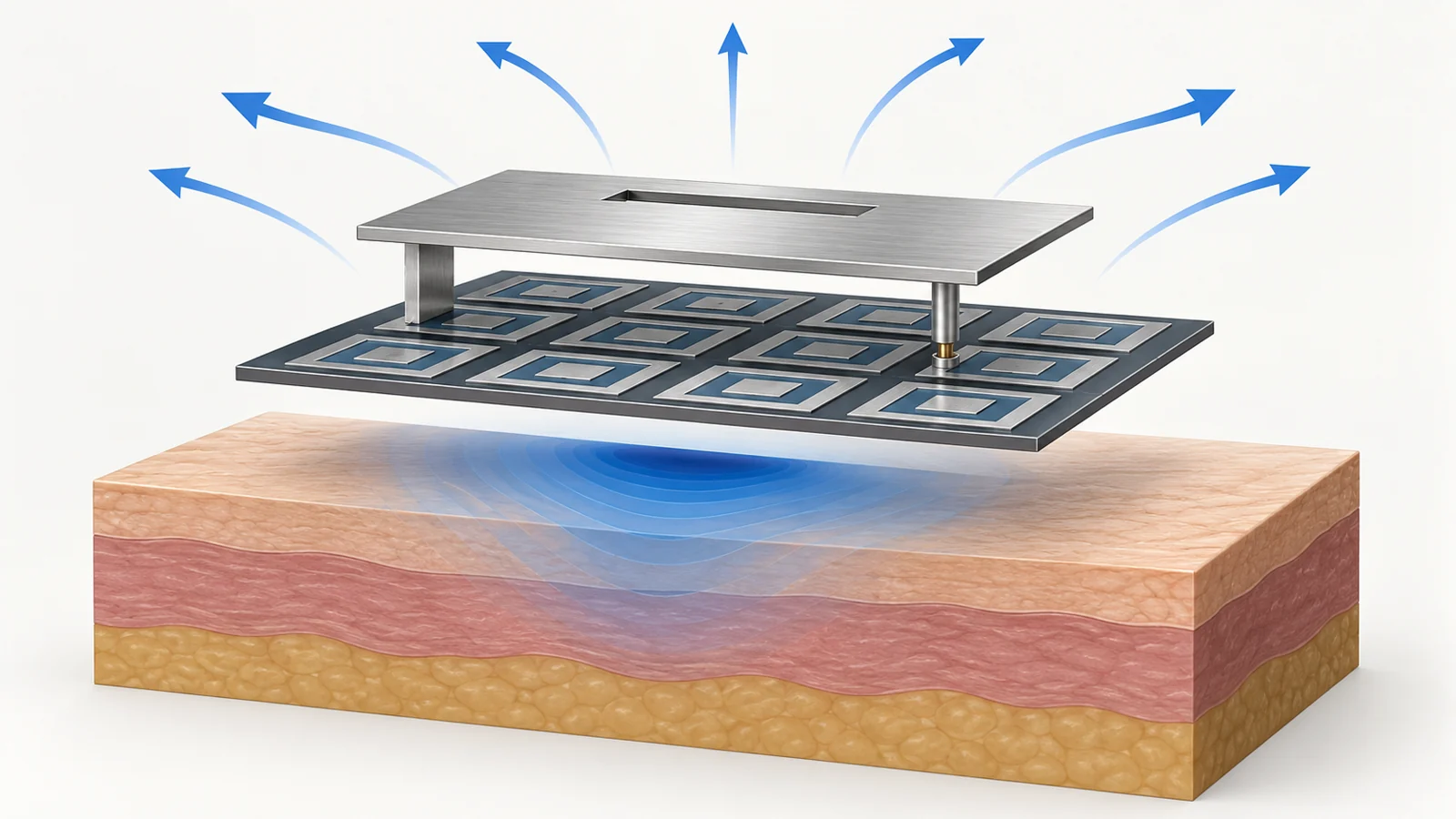
The device is a planar inverted-F antenna, or PIFA. In plain terms, it uses a flat metal radiating plate, a shorting connection and a feed to send and receive radio signals. The researchers designed a compact version on a semi-rigid substrate for two frequency bands, around 2.45 and 5.8 gigahertz, used by Wi-Fi applications.
A cut in the metal plate helps the antenna work across both bands. The researchers added a rectangular slot, which interrupts the path followed by electrical current across the plate. Current travels around the opening, changing the antenna’s electrical behavior and producing a second resonance. The slot therefore helps one structure operate at two frequencies rather than requiring a separate antenna for each band.
The other part of the design is a four-by-four array of engineered cells called an artificial magnetic conductor, or AMC. Tuned for the antenna’s two bands, this patterned backing is intended to reflect radio waves away from the side facing the tissue model and strengthen radiation outward.
The prototype measurements showed higher gain
The team first tested the antenna without the AMC and then compared its performance with the backing. In the lower band, reported measured gain rose from 1.84 decibels to 3.8 dB. In the upper band, it increased from 2.4 dB to about 4.1 dB. Gain describes how effectively an antenna directs radio energy in a particular direction; here, the reported increase is consistent with the design goal of sending more energy outward.
The study also reports improved front-to-back ratio with the backing. This compares radiation in the forward direction with radiation behind the antenna, so a larger ratio indicates a more forward-focused pattern. Together, those antenna measurements suggest the patterned surface changed where the prototype radiated, as intended.
These results concern measured antenna characteristics. Gain alone does not tell us how far a connection will reach or how quickly data will transfer. Those outcomes also depend on other parts of a wireless system and its surroundings.
A tissue model absorbed less energy with the backing
The researchers assessed absorption using a computer simulation, not a measurement on a person. They placed a three-layer cubic tissue model 5 millimeters below the antenna and modeled operation at an input power of 0.5 watts. Specific absorption rate, or SAR, expresses how much radio-frequency energy is absorbed per unit mass of tissue, in watts per kilogram.
In that modeled setup, the reported peak SAR in the lower band fell from 5.3 W/kg without the AMC to 1.45 W/kg with it. In the upper band, it fell from 4.8 W/kg to approximately 1.1 W/kg. The authors attribute the reduction to the backing’s effect on the antenna’s radiation toward the tissue model.
Those figures are specific to the simulated placement, tissue representation and input power. They do not establish the absorption experienced by a person wearing a finished device, and the same reduction cannot be assumed for other body shapes, placements or operating powers. The physical prototype tests and the tissue simulation answer related but distinct questions: how the antenna performed, and how much energy the modeled tissue absorbed under the stated conditions.
What this could mean for body-worn connectivity
A dual-band wearable device could potentially direct more of its radio output away from the body while keeping less energy absorbed by nearby tissue, if the measured antenna performance and modeled absorption result carry over to realistic wearing conditions. That combination could help designers pursue outward wireless connectivity in compact devices. Whether it does so in practice depends on how the antenna and backing perform when integrated and worn; these results establish a prototype measurement and a model-specific comparison, not a demonstrated user benefit.
Key Sources
- Primary source: Analysis of electromagnetic absorption in new design of PIFA antenna using metamaterials
DOI or Journal Page · Preprint · 2021-03-24
Keep exploring