
Research Signal – Source date 2026-01-01
Materials designed to absorb water and repair damage bring together two useful but potentially competing behaviors. Swelling can help activate repair, while a structure still needs enough mechanical strength to remain useful. A review published on January 1, 2026, surveys ways researchers are combining these functions and the design choices that may shape their applications.
How a network draws in water
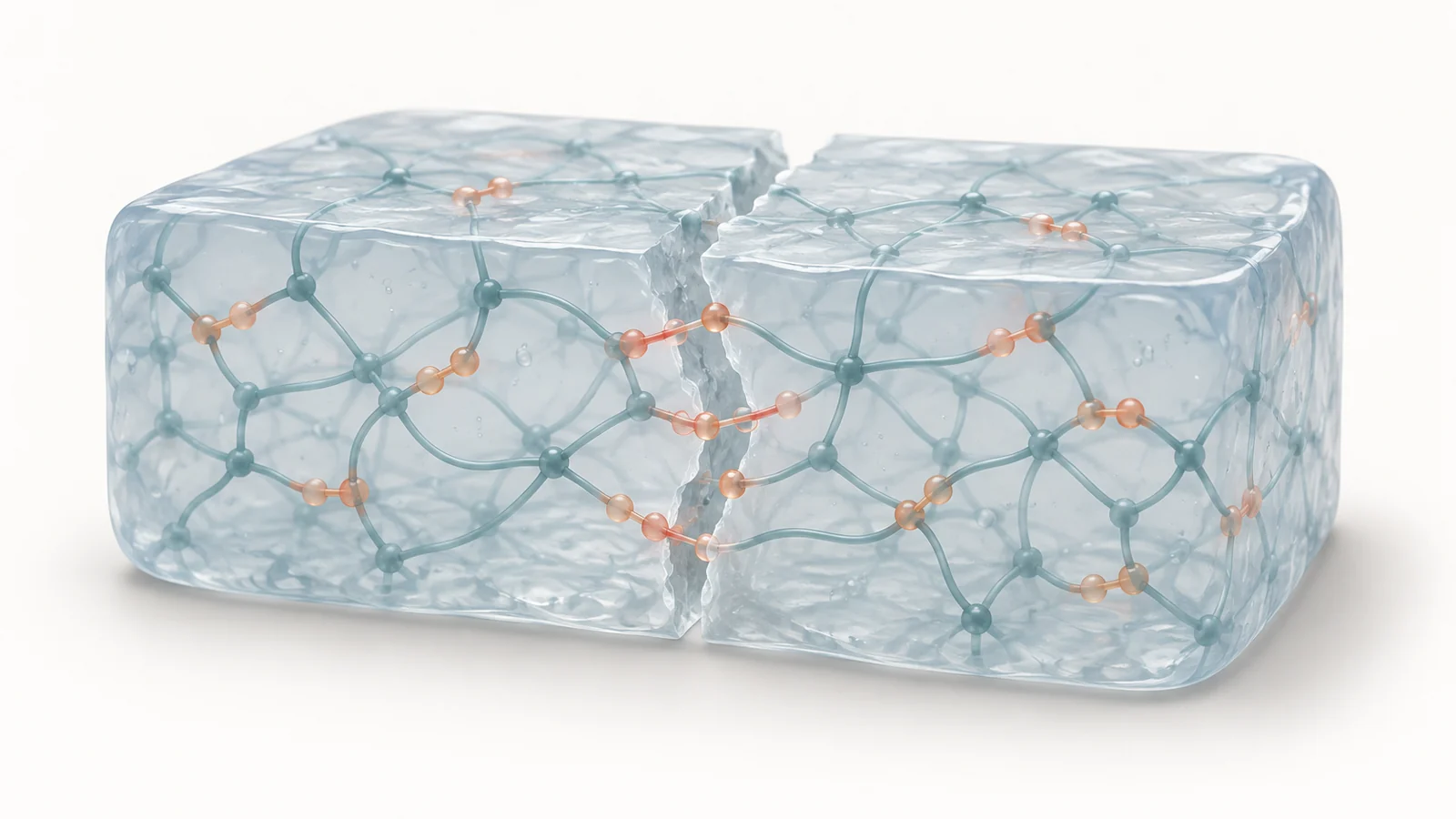
Water-swelling materials rely on hydrophilic groups, which interact with water, and a three-dimensional crosslinked network. The hydrophilic groups support water absorption; the network provides a connected structure that can take up and retain water as the material expands.
The combination matters because swelling is a change in volume within a structured material, rather than simply water sitting on its surface. How much expansion is useful will depend on the intended function. The supplied abstract presents this architecture as the basis for water uptake and swelling; it does not compare particular designs under a common test.
Repair depends on reversible interactions
A material that swells does not necessarily restore a damaged structure. Self-healing designs instead rely on interactions that can re-form after disruption. The review identifies dynamic covalent bonds and noncovalent interactions as routes to restoring structural integrity.
These descriptions point to a capacity for bonds or interactions to respond and reconnect; the abstract does not specify particular chemistries or conditions. The key design idea is that the material’s internal connections can help recover integrity after damage, rather than depending on swelling alone.
Coupling water uptake with repair
The review surveys three approaches to combining the functions: microencapsulation, dynamic network response and multinetwork collaborative design. The supplied abstract does not rank them. Across these approaches, the proposed coupling is that water uptake can trigger or enhance a repair mechanism, while dynamic chemical networks help the material retain stability.
That creates a design problem as well as an opportunity. A response that supports repair has to work alongside the network’s structural role. The review describes this synergy as a route toward greater durability and environmental adaptability, but the supplied evidence does not quantify a durability gain or establish which approach performs best under a common test.
Strength sets the practical limit
Healing efficacy is only one part of performance. A material may reconnect after damage yet still be unsuitable if it loses too much mechanical function. The review identifies balancing mechanical functionality with healing efficacy as a priority for future design.
It also points to sustainable biobased materials as a direction for expanding practical applications. That goal adds another design consideration: candidate materials need to combine useful swelling and repair behavior with the performance required for their intended setting. The abstract frames these as research priorities, rather than evidence that a particular material is ready for use.
What self-repair could mean for water-exposed structures
Construction or marine materials that recover from damage could, in principle, remain serviceable longer in places where water exposure is routine. For that possibility to translate into a practical benefit, a material would need to achieve useful repair while preserving the mechanical performance its job requires. The review presents these fields as application prospects; the supplied evidence does not establish a deployed product or a measured extension of service life.
Key Sources
- Primary source: Water-Swelling and Self-Healing Synergistic Design Materials: Performance Optimization and Application Prospects.
DOI or Journal Page · Review or Meta-Analysis · 2026-01-01
Keep exploring