
Research Signal – Source date 2026-01-07
A coating that makes rain bead and roll away may seem like a straightforward way to protect a monument or artifact. But preservation is not simply a matter of keeping liquids off a surface. A treatment must also leave the object’s appearance intact, work with the material beneath it and allow conservators to make different choices later.
A review published on January 7, 2026, surveys research on protective coatings for stone, concrete, ceramics, glass, metal, wood and textiles. It gives particular attention to surfaces designed to repel water or oil. Across those materials, the central challenge is to make a coating protective without making repellency the only measure of success.
The texture behind water beading
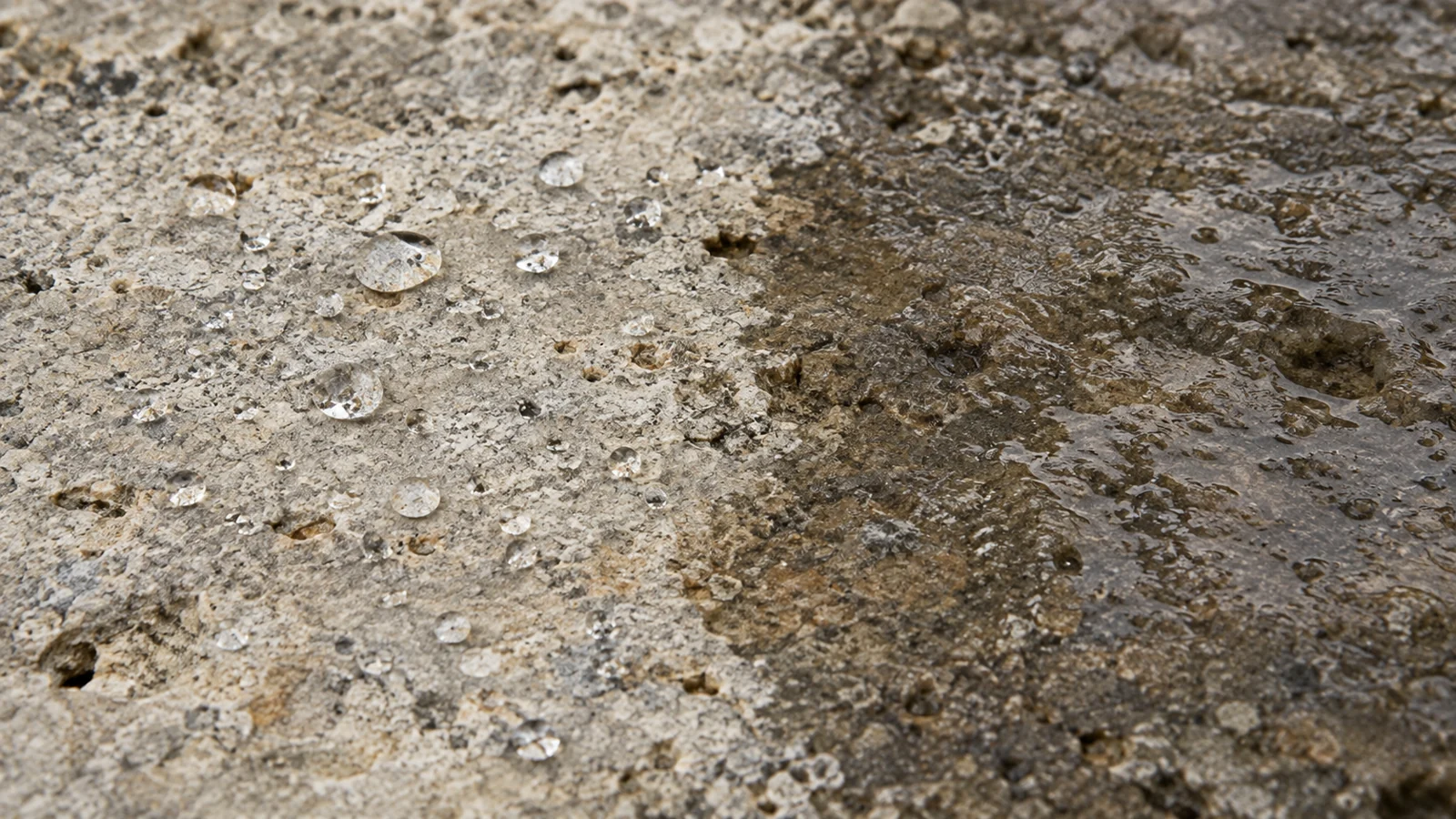
Superhydrophobic surfaces are designed to make water wet the surface very little. The review describes the familiar result as a water contact angle greater than 150 degrees: a droplet sits high rather than spreading out, and can roll away. The angle describes how the droplet meets the surface; it is a measure of wetting behavior, not a direct measure of how well a historic object will be preserved over time.
The effect depends on two features working together. Fine texture at micro- and nanometer scales creates roughness, while low-surface-energy chemistry makes it harder for water to spread. Researchers take inspiration from the “lotus effect” in nature by combining structured surfaces with water-repelling substances, including silicone-based or fluorinated materials.
That combination can help limit liquid-water contact and support self-cleaning. Yet historic materials are not interchangeable test surfaces. A coating that beads water effectively may still change color or gloss, interfere with moisture moving through a porous material, or prove difficult to remove. The useful question is therefore not only whether water rolls off, but what else the treatment does to the surface and the material beneath it.
Stone, metal and wood face different threats
Porous stone is vulnerable to water entering its pores, while damp conditions can also encourage biological fouling. Outdoor stone may face pollutants and acids as well. For a breathable wall or sculpture, a coating needs to limit liquid-water uptake without trapping water vapor inside. A striking contact angle alone cannot answer that compatibility question.
One stone formulation discussed in the review combined a silane treatment with titanium dioxide and silica nanoparticles. It achieved water contact angles above 152 degrees and roll-off angles below 10 degrees. Water absorption fell by more than 92 percent compared with untreated stone, while vapor permeability remained above 82 percent. The review also describes how silica helped preserve water-repelling performance during ultraviolet exposure in this formulation, where titanium dioxide alone reduced hydrophobicity under irradiation.
Those measurements address several relevant properties at once: liquid-water resistance, breathability and performance under particular tests. They belong to a specific formulation and stone context. They do not show that the same recipe suits every monument, or that contact-angle results by themselves predict decades of outdoor preservation.
Metal presents a different concern. Moisture and pollutants can contribute to corrosion, while a protective layer may affect the finish people see. The review describes hybrid coatings that combine low-surface-energy substances with micro- and nanoscale fillers. Their intended functions include water repellency, self-cleaning and corrosion protection. For metal, the design problem includes preserving aesthetic qualities as well as limiting exposure to damaging conditions.
Wood can absorb water, swell and warp, with consequences for its structure. A reviewed approach used lignin derived from beechwood in a solvent-free silane system on oak and chestnut. The coating increased water repellency, with reported contact angles of 145 degrees on oak and 135 degrees on chestnut, and had minimal impact on color. It retained hydrophobicity and mechanical durability after the reported tape-peeling cycles and exposure to ultraviolet radiation and outdoor conditions; separate soil-burial tests addressed biological durability. These results illustrate a material-specific approach; they are not evidence that a coating will behave the same way on every historic wooden object.
Oil needs its own kind of repellency
Water repellency does not automatically mean that a surface will repel oil. Superoleophobic coatings aim to make oil droplets behave in a similarly non-wetting way, using surface texture and chemical modification to reduce adhesion. The review discusses this as a possible response to threats such as oil-based spray paint used in graffiti.
That is a separate design problem because oil and water interact differently with surfaces. The review’s definition of oil repellency describes droplet behavior; it is not, by itself, a demonstration that a treatment reliably prevents graffiti from damaging a historic site or makes paint easy to remove. For a conservator, any proposed benefit must be considered alongside the treatment’s effect on appearance, substrate compatibility and future care.
When a protective layer changes the object
A glazed Portuguese tile example shows why compatibility can outweigh a promising protective effect. Researchers applied thin titanium-dioxide sol-gel coatings to tiles made using different manufacturing techniques. The coating slightly reduced the growth of the tested fungus, but it also changed surface colors and interacted chemically with the glaze’s mineral composition. The review describes the treatment as unsuitable for that application because those changes posed risks to the artwork’s physical integrity.
The lesson is concrete: reducing one threat does not make a treatment acceptable if it alters qualities that conservation is meant to retain. Transparency, color, gloss and texture matter because they are part of the object’s visible and material character. A coating also needs to remain compatible with its substrate, not merely perform well in a narrow test.
The review frames conservation criteria broadly. A treatment should be optically unobtrusive, stable under expected conditions, safe and reversible—or at least removable without damage. Reversibility matters because future conservators may have better information or different priorities. A coating that is effective but cannot be removed safely can limit those future choices.
Durability can complicate that goal. Fluoropolymers and other fluorinated materials can provide strong repellency and weathering stability, but the review notes concerns about persistence and bioaccumulation. Some robust polymer systems, including polyurethanes and epoxies, can also fall short on reversibility. Long service life is useful, but it does not by itself settle whether a material is responsible to produce, apply or eventually dispose of.
Bio-based polymers, including materials such as ethyl cellulose and shellac, are presented as emerging possibilities. They may offer renewable or otherwise attractive properties, and some are being explored for transparency or self-healing behavior. The review identifies limits that remain open: their oil repellency and long-term resilience outdoors still need to be demonstrated. Sustainability, meanwhile, is increasingly considered alongside established conservation requirements, although the reviewed work does not provide full life-cycle or disposal assessments.
What this could change for historic art
Coatings that protect exposed monuments and objects from moisture and contaminants could help conservators extend their useful life while keeping their appearance and preserving options for later treatment. That capability depends on more than a high contact angle: each coating must prove durable and compatible with the material and setting, come from responsible materials, and be safely removable when future care calls for it. The studies reviewed in January 2026 show ways researchers are approaching that challenge, with results that vary by formulation and substrate. They offer useful directions for conservation, not a universal treatment ready for every historic surface.
Key Sources
- Primary source: Functional surface engineering for cultural heritage protection: the role of superhydrophobic and superoleophobic coatings – a comprehensive review.
DOI or Journal Page · Review or Meta-Analysis · 2026-01-07
Keep exploring