
Research Signal – Source date 2026-03-19
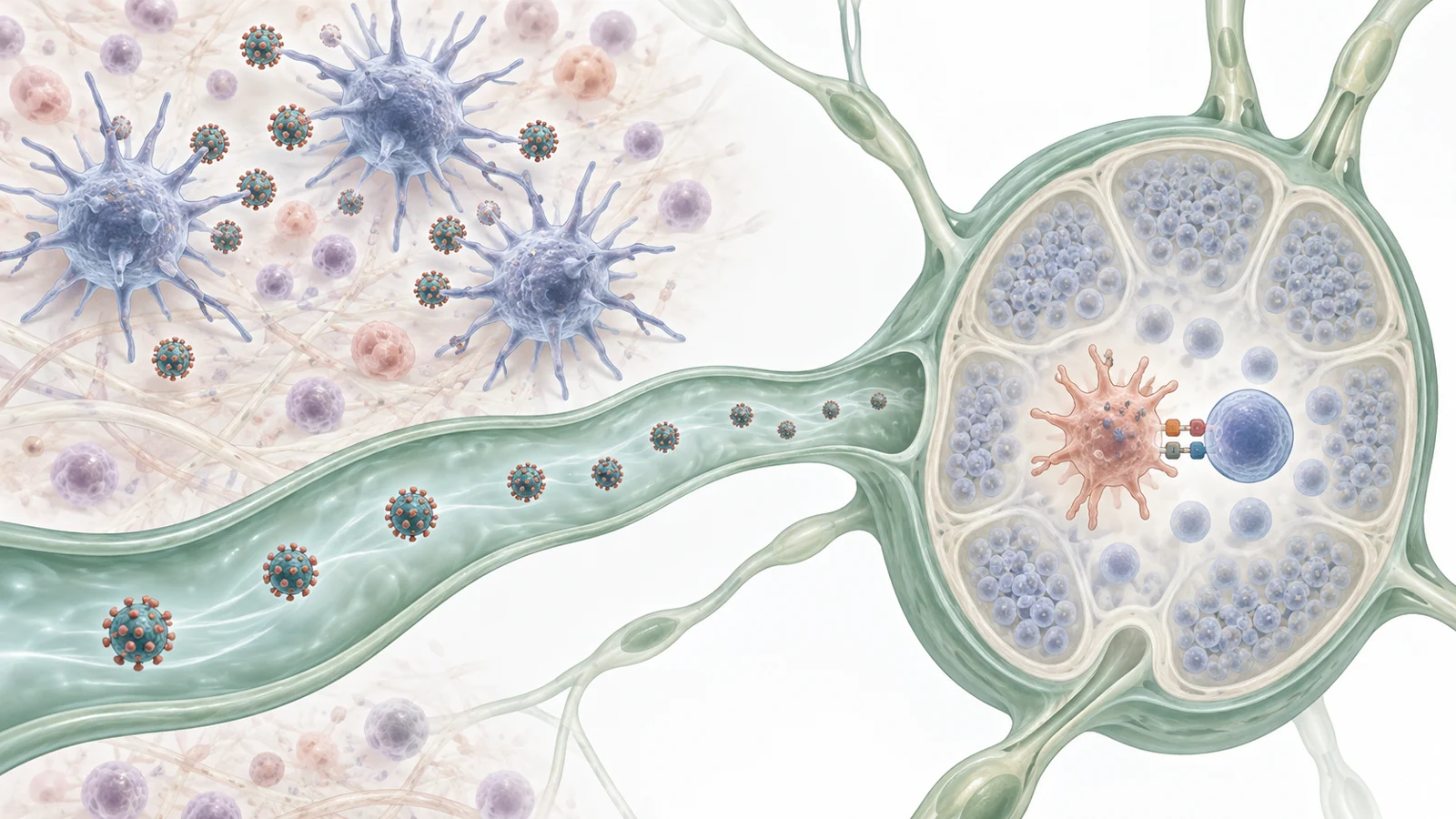
Cancer vaccines depend on the immune system recognizing a target. A review published March 19, 2026, considers whether engineered virus-like particles could help direct that immune signal toward lymph nodes, where the authors focus on antigen presentation and T-cell activation.
Virus-like particles, or VLPs, resemble viruses in structure but are discussed here as engineered delivery platforms. The review highlights their strong immunogenicity—their capacity to prompt immune attention—as a reason they are being explored for cancer immunotherapy. Its central question is how to steer these particles toward lymph nodes, rather than whether a particular vaccine has already shown patient benefit.
Two ways to target lymph nodes
The review distinguishes active targeting mediated by dendritic cells from passive targeting based on lymphatic drainage. In the passive approach, particles can drain toward lymph nodes; the supplied abstract does not establish that dendritic cells carry particles to the nodes.
The destination matters to the review because it links lymph-node targeting with antigen presentation and T-cell activation. The abstract presents these as the aims of the engineering strategies, not as measured outcomes of a single treatment. It does not provide a comparison showing that one route works better than the other.
Chemical and genetic tools for changing particles
The authors group the engineering approaches into chemical modifications and genetic methods. The chemical toolkit includes strain-promoted azide-alkyne cycloaddition (SPAAC), sulphur fluoride exchange (SuFEx) reactions and photoinduced crosslinking. The genetic approaches include SplitCore technology and incorporating unnatural amino acids, or uAAs.
These named methods represent ways researchers can modify VLPs as part of a lymph-node targeting strategy. The review abstract identifies them but does not give technique-by-technique results or quantify how much any one method changes particle delivery or immune response. Their inclusion signals a range of engineering options, not a ranking of candidates.
The translation hurdles
A particle that can be engineered for a desired route still has to be made reliably at useful scale. The review identifies scalable production as a challenge to clinical translation. Producing a design in research settings and making it at a scale suitable for wider use are distinct demands.
Immune variability is a separate concern. Responses can differ across immune systems, so a targeting strategy cannot be assumed to produce a consistent response for everyone. The abstract describes VLP-based vaccines as promising in preclinical and clinical settings, but that broad description does not establish benefit from a particular VLP cancer vaccine for patients.
What targeted cancer vaccines could make possible
For people receiving cancer immunotherapy, the potential value is a vaccine whose engineered particles direct an immune signal toward lymph nodes, making that destination a more useful part of treatment. That possibility depends on dependable production and on responses that remain useful across the variation in people’s immune systems. The review presents a direction for engineering; those practical and biological conditions still have to be established for the hoped-for benefit to follow.
Key Sources
- Primary source: Engineering virus-like particles for lymph-node targeted cancer immunotherapy: strategies, challenges, and future prospects.
DOI or Journal Page · Review or Meta-Analysis · 2026-03-19
Keep exploring