
Research Signal – Source date 2026-03-13
The proposed two-step idea has a safety question
Some cancer treatments can push tumor cells into senescence, a state in which cells stop dividing. The state may not always be permanent: some senescent tumor cells can escape and resume growth. Researchers have therefore proposed a “one-two punch”: first induce senescence, then use a senolytic drug to clear senescent cells.
Venetoclax is a BH3-mimetic drug that targets the anti-apoptotic protein BCL-2. It is used in blood cancers, including in combinations with chemotherapy. The safety question is consequential because blood cancers and their treatments can involve changes in blood-cell counts, and a strategy that combines cell-stressing treatment with cell clearance needs careful scrutiny of those effects.
The study considered whether blood-cell adverse events appeared differently in U.S. reports involving venetoclax alone and reports involving venetoclax with chemotherapy previously linked to senescence in research models. It analyzed co-exposures recorded in reports. The records did not establish that patients received a planned sequence of senescence induction followed by senolytic clearance.
What the report comparison counted
The researchers retrieved U.S. Food and Drug Administration Adverse Event Reporting System (FAERS) reports on 1 August 2025. The venetoclax reports covered the period from the second quarter of 2016 through the second quarter of 2025. After applying the study’s inclusion and classification rules, the analysis included 47,508 reports: 34,485 classified as venetoclax monotherapy and 13,023 as combination therapy.
To define the combination group, the authors reviewed prior research for evidence that chemotherapy agents could induce senescence. Evidence from preclinical or clinical models was enough for an agent to qualify. The patient reports themselves did not verify senescence in anyone receiving treatment.
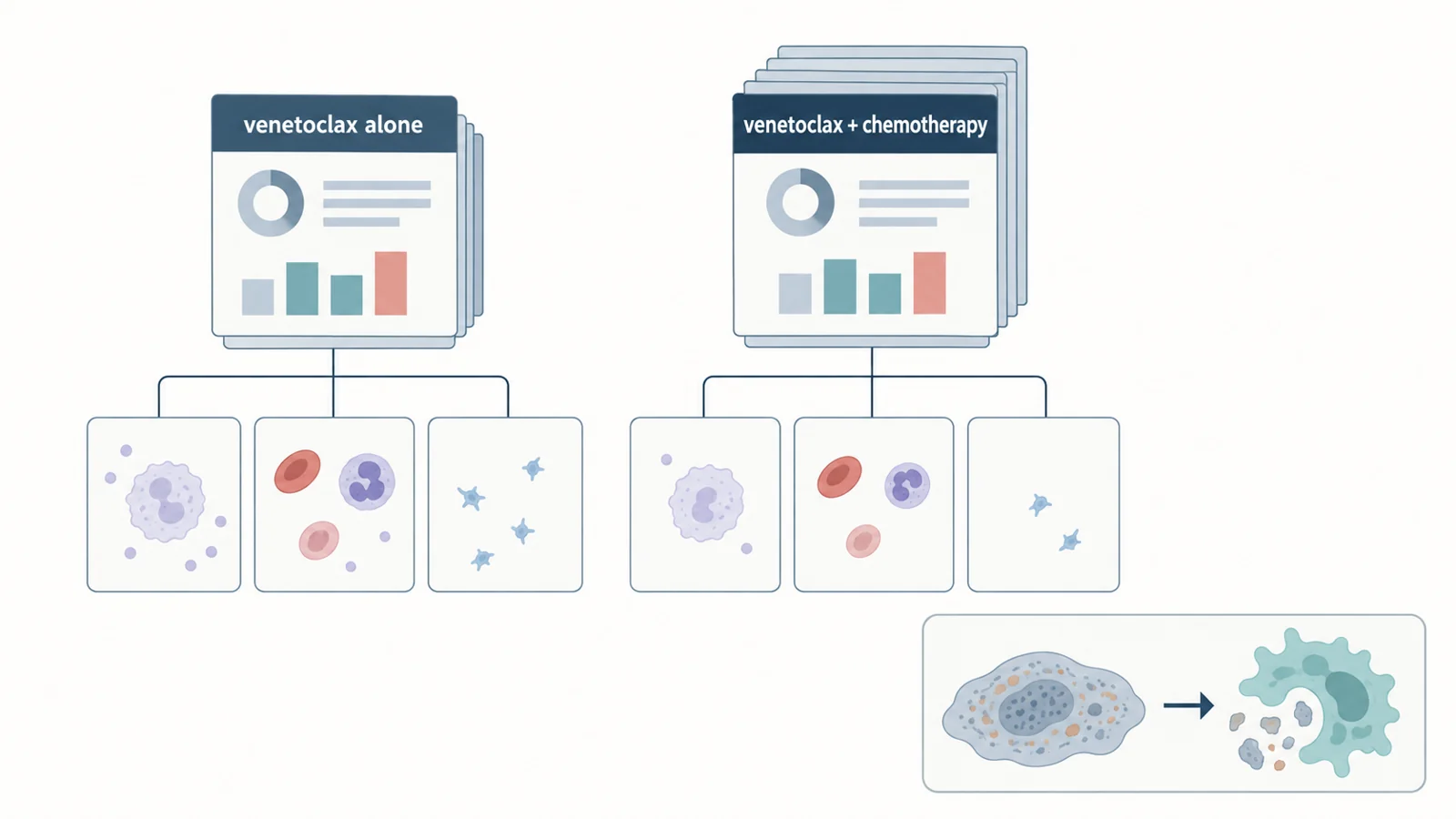
The researchers grouped blood-related reports into three categories: isolated low white blood cell counts, isolated low platelet counts, and low counts involving more than one blood-cell line. This last category covered multi-lineage cytopenia or bone-marrow-suppression terms. The groupings depended on the adverse-event terms recorded in each report, so they describe patterns of coding as well as the clinical events represented by those terms.
The blood-cell pattern was uneven
Reports classified as combination therapy more often included isolated low white blood cell counts: 15% of combination reports compared with 5.8% of monotherapy reports. The reporting odds ratio (ROR) was 2.87 and the proportional reporting ratio (PRR) was 2.59. In plain language, low white-cell terms made up a larger share of the combination reports than of the monotherapy reports under the study’s comparison.
The gap was also apparent for low counts across multiple blood-cell lines. These terms appeared in 23.7% of combination reports and 8.1% of monotherapy reports. The ROR was 3.54 and the PRR was 2.94, indicating a stronger relative reporting pattern for multi-lineage cytopenia in the combination group.
Isolated low platelet counts went in the opposite direction: they appeared in 1.1% of combination reports and 3.6% of monotherapy reports. The ROR was 0.31 and the PRR was 0.32. That is an inverse reporting signal, not evidence that combination treatment protects platelets. Because the study assigned reports to categories using recorded event terms, a report coded under broader marrow suppression or multiple blood-cell abnormalities might not appear as an isolated platelet event. The authors raised this as one possible explanation; the analysis cannot determine whether coding patterns account for the difference.
Serious reports and deaths point in different directions
Combination reports also had higher relative reporting signals for life-threatening outcomes and hospitalization. The ROR was 7.06 for life-threatening outcomes and 1.74 for hospitalization; the corresponding PRRs were 6.56 and 1.39. The death category, by contrast, had a lower signal: ROR 0.55 and PRR 0.65. Non-serious outcomes were also proportionally less reported, while “other outcomes” had a higher signal.
These ratios compare how often an outcome appears in one group of submitted reports relative to another. They are not rates among treated patients. FAERS has no reliable denominator for how many people received each treatment, and its reports are voluntary. They can be incomplete, shaped by reporting practices, and affected by the underlying disease, treatment context, co-medications, and illness severity. The study included reports where venetoclax had any recorded drug role, not only reports naming it as the primary suspect. Those features make the ratios useful for noticing reporting patterns, but they cannot tell whether a combination raised an individual patient’s risk or caused an outcome.
The lower death signal therefore does not show that combination therapy improves survival. Outcome fields can overlap within a report: a single record may include hospitalization, a life-threatening event, and death. The study also found that hospitalization-only reports and reports combining hospitalization with life-threatening outcomes were more frequent in the combination group, while death-only reports were less frequent. The pattern is not a comparison of survival between patients receiving the two treatments.
Co-exposure is not the proposed treatment sequence
The “one-two punch” idea describes a therapeutic sequence: induce senescence in tumor cells, then clear those cells with a senolytic. The FAERS analysis could not establish that sequence. It did not confirm senescence in patients, and the reports did not document whether the drugs were given sequentially or on overlapping schedules.
This matters because the study’s combination group was assembled from reports of co-exposure to venetoclax and chemotherapy selected through prior senescence-induction evidence. That evidence came from different research models, and an agent’s inclusion does not demonstrate that it induced senescence in a patient’s tumor. The observed blood-cell patterns may be relevant to safety questions around such combinations, but they do not measure the effects of an optimized two-step senolytic treatment or show that it improves tumor control.
Navitoclax offers only a limited comparison
The study also summarized 172 reports involving navitoclax, another BH3 mimetic. Navitoclax acts on BCL-2 and related proteins, including BCL-XL, which is important for platelet survival. Its platelet effects have constrained its development. Venetoclax is more selective for BCL-2 and spares BCL-XL, offering a mechanistic reason to distinguish the drugs when considering platelet-related effects.
But 172 reports were too few for the same formal monotherapy-versus-combination disproportionality analysis used for venetoclax. The navitoclax findings were descriptive. They cannot establish that one drug is safer than the other or settle what would happen in a senolytic treatment sequence.
What a safer two-step cancer strategy could offer
If further clinical research confirms that these combination settings carry a meaningful blood-cell burden, clinicians and researchers could better identify where safety monitoring or treatment adjustments are needed as senolytic strategies are developed. That could help preserve access to effective cancer therapy while clarifying whether a carefully timed two-step approach can add tumor-control benefits without unacceptable harm. This FAERS comparison is an early safety prompt for that work, not evidence that the proposed strategy is ready or effective.
Key Sources
- Primary source: Disproportionality Analysis of Hematologic Adverse Event Signals Associated with Venetoclax in Combination with Senescence-Inducing Chemotherapy.
DOI or Journal Page · Peer-Reviewed Paper · 2026-03-13
Keep exploring