
Research Signal – Source date 2021-04-02
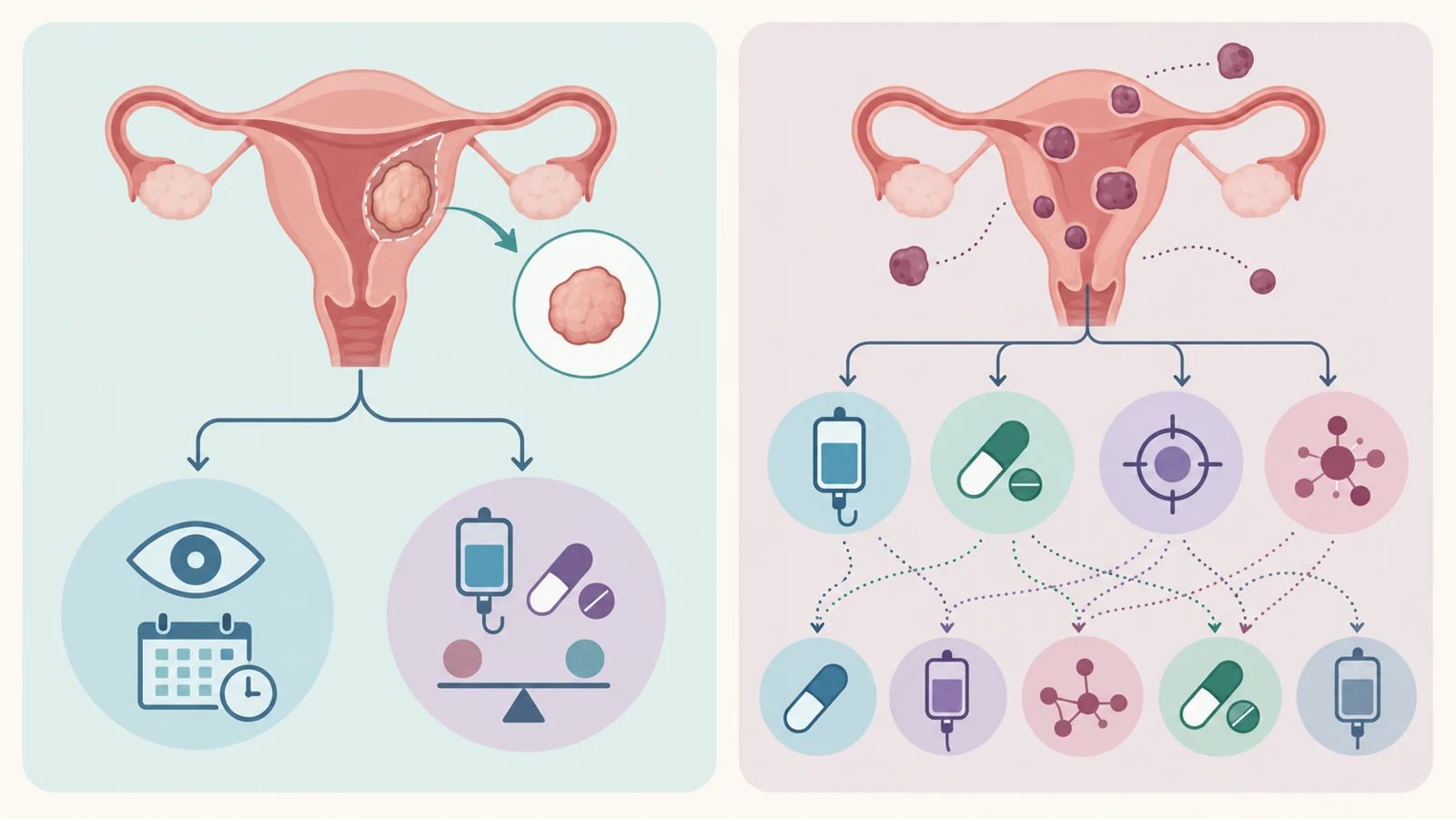
Uterine leiomyosarcoma is a rare cancer of the uterus. For someone whose tumor has been completely removed, the question is whether additional treatment can lower the chance it returns. For advanced or metastatic disease, treatment instead aims to control cancer that is present. The options discussed for these two situations are not interchangeable, and evidence for one does not settle the other.
A 2021 systematic review of treatment research found no settled overall approach. It described chemotherapy and radiation after surgery as disputed, while identifying doxorubicin-based treatment and gemcitabine–docetaxel as principal first-line options for advanced disease. Several treatments had been studied, but the findings came from different settings and kinds of research rather than a single comparison of an entire treatment sequence.
The evidence came from many kinds of studies
The authors searched MEDLINE for articles published from January 1, 2011, through December 31, 2019, then added eligible papers found through reference lists. They included 108 articles in a qualitative synthesis. These comprised reviews, guidelines and consensus papers, retrospective studies, and clinical trials. Case reports were excluded; the search considered articles in English, French, and German.
That total describes the size of the literature they gathered, not the number of patients in one experiment or the strength of one treatment comparison. The articles addressed different questions: whether treatment after surgery prevents recurrence, how to treat advanced disease, and what later options might do after an earlier treatment stops working. Some evidence covered leiomyosarcoma broadly or sarcomas as a group, while other findings concerned uterine leiomyosarcoma specifically. Those differences matter when interpreting each result.
After surgery, the prevention question remains open
Adjuvant treatment means therapy given after surgery, when the visible tumor has been removed, in an effort to reduce the chance of recurrence. The rationale is recurrence prevention; the evidence summarized in this review did not resolve whether chemotherapy after complete resection improves survival compared with observation.
A prospective trial was designed to compare observation with four cycles of gemcitabine–docetaxel followed by four cycles of doxorubicin. It ended early because too few participants enrolled. Early closure for insufficient enrollment leaves the planned comparison unable to provide a decisive answer. It should not be read as proof that the treatments are equivalent, or that chemotherapy helps; the result is that the uncertainty remained.
Other studies offered clues without closing the gap. In a phase II study of women with disease limited to the uterus, the sequence of gemcitabine–docetaxel followed by doxorubicin was associated with progression-free survival rates of 78% at two years and 57% at three years. Progression-free survival measures how long people live without their cancer worsening. Those figures describe outcomes in that study, but do not by themselves show what would have happened to comparable patients assigned to observation.
Radiation raises a related but distinct question. The review describes a prospective study in stage I and II disease that did not improve progression-free or overall survival compared with observation. Retrospective studies suggested a possible reduction in local pelvic recurrences, which are returns of cancer in the pelvis. Preventing a local relapse and extending life are different outcomes; evidence about one cannot automatically answer the other. The authors report that guidelines differed in how they approached adjuvant treatment, reflecting the limited and unsettled evidence.
Advanced disease has first-line options, not a proven sequence
For advanced or metastatic uterine leiomyosarcoma, the review identifies doxorubicin-based therapy and gemcitabine–docetaxel among the main first-line choices. Doxorubicin alone and combinations that include it had evidence of activity. A phase II trial of doxorubicin with ifosfamide in advanced or metastatic disease reported a response rate similar to the 25% cited for doxorubicin alone in soft-tissue sarcomas. A response rate counts tumors that shrink by a defined amount; it is not the same measure as how long patients live or remain free of progression.
Gemcitabine–docetaxel was also a central option. The review describes it as a standard first-line treatment and discusses studies in both first-line and later-line settings. Evidence that a regimen can produce responses or delay progression helps explain why clinicians consider it. It does not establish one best starting regimen or show the ideal order in which treatments should be used. The review’s authors concluded that the optimal first-line regimen remained unproven.
Two drug additions showed no benefit in phase III trials
Olaratumab illustrates how an encouraging early finding can change after a larger test. In a phase II study of unresectable or metastatic soft-tissue sarcomas, adding olaratumab to doxorubicin was associated with longer median overall survival than doxorubicin alone: 26.5 versus 14.7 months. Leiomyosarcoma was one of the tumor types included, and the review describes a favorable result in a leiomyosarcoma subgroup analysis. But the later phase III ANNOUNCE trial did not confirm a benefit from adding olaratumab, either across the overall study population or in its leiomyosarcoma group.
The difference is consequential: an early result can justify further testing, but the larger confirmatory trial is the test of whether the apparent advantage holds up. Here, it did not.
Bevacizumab was tested as an addition to gemcitabine–docetaxel in a randomized phase III study. The review reports no improvement in progression-free survival, overall survival, or overall response rate with the addition. Those are distinct measures—time without worsening, time alive, and the share of patients whose tumors respond—and none showed a reported advantage in that comparison. The finding concerns the tested combination and study, rather than every possible use of bevacizumab.
Later-line results depend on the outcome and the tumor group
When disease progresses after an earlier treatment, later-line options have been studied with different endpoints and in populations that do not always match uterine leiomyosarcoma alone. For example, a phase III trial of trabectedin after anthracycline-based chemotherapy found a progression-free survival benefit over dacarbazine in a subgroup with advanced uterine leiomyosarcoma: median progression-free survival was four months versus 1.5 months. This is evidence of a longer interval before progression in that comparison. It is not, by itself, evidence of longer overall survival.
Eribulin shows why the tumor group also matters. A phase III trial found an overall-survival improvement for advanced leiomyosarcomas and liposarcomas considered together. But when leiomyosarcoma was examined by itself, median overall survival was 12.7 months with eribulin and 13 months with dacarbazine. The combined-population result therefore cannot be assumed to describe a benefit for the leiomyosarcoma subgroup.
These examples make later-line evidence harder to condense into a ranked list. A treatment may improve one measured outcome in a particular population while another outcome, or a narrower tumor group, gives a different picture.
Immune markers are not treatment responses
Interest in immunotherapy persisted despite limited clinical results in the review. Nivolumab did not show benefit as a single-agent treatment in a phase II uterine leiomyosarcoma study, and further studies of that regimen were halted. In a separate small report, four people with uterine leiomyosarcoma treated with pembrolizumab plus axitinib all had disease progression. The same report described a partial tumor response in one person with soft-tissue leiomyosarcoma and stable disease with some tumor shrinkage in another; those outcomes should not be conflated with the uterine cases.
Researchers also reported PD-L1 expression and tumor-infiltrating immune cells in uterine leiomyosarcoma. These are observations about features of tumors, not proof that a treatment targeting the immune system will work. A marker may help motivate a clinical question, but treatment response must be established through clinical outcomes. In the evidence summarized here, the marker observations and the reported treatment results point to different kinds of information.
A clearer treatment path for a rare uterine cancer
A more reliable way to match treatment to the clinical setting could help patients and clinicians weigh the purpose of therapy after surgery separately from the choices available for advanced disease. If future research establishes which approaches reduce recurrence, control tumors, or extend survival for specific groups, treatment decisions could become more grounded in the outcome that matters for each situation. That would require well-enrolled studies that distinguish uterine leiomyosarcoma from broader sarcoma populations and report outcomes in ways that can be compared. The review’s central message in 2021 was that those answers were still needed.
Key Sources
- Primary source: The systemic treatment of uterine leiomyosarcomas: A systematic review. No news is good news?
DOI or Journal Page · Review or Meta-Analysis · 2021-04-02
Keep exploring