
Research Signal – Source date 2025-01-15
Tinnitus is often described as ringing, buzzing or other sound that has no outside source. When it persists alongside poor sleep, the combination can affect how a person functions during the day. A small registered trial is testing whether a non-drug brain-stimulation approach could address both problems together.
The study, Low-intensity TUS for Sleep Disturbances in Patients With Chronic Tinnitus (NCT06776705), lists 15 January 2025 as its actual start date. The supplied ClinicalTrials.gov record describes the study as recruiting and lists no posted results. Those are record-state facts; they do not show what happened at the start of the trial or whether the estimated completion dates were met.
The important question is not simply whether participants report feeling better. It is whether an active treatment produces a different pattern from a sham treatment, and whether the study can show that a larger trial is practical and worth conducting.
How the ultrasound intervention is planned
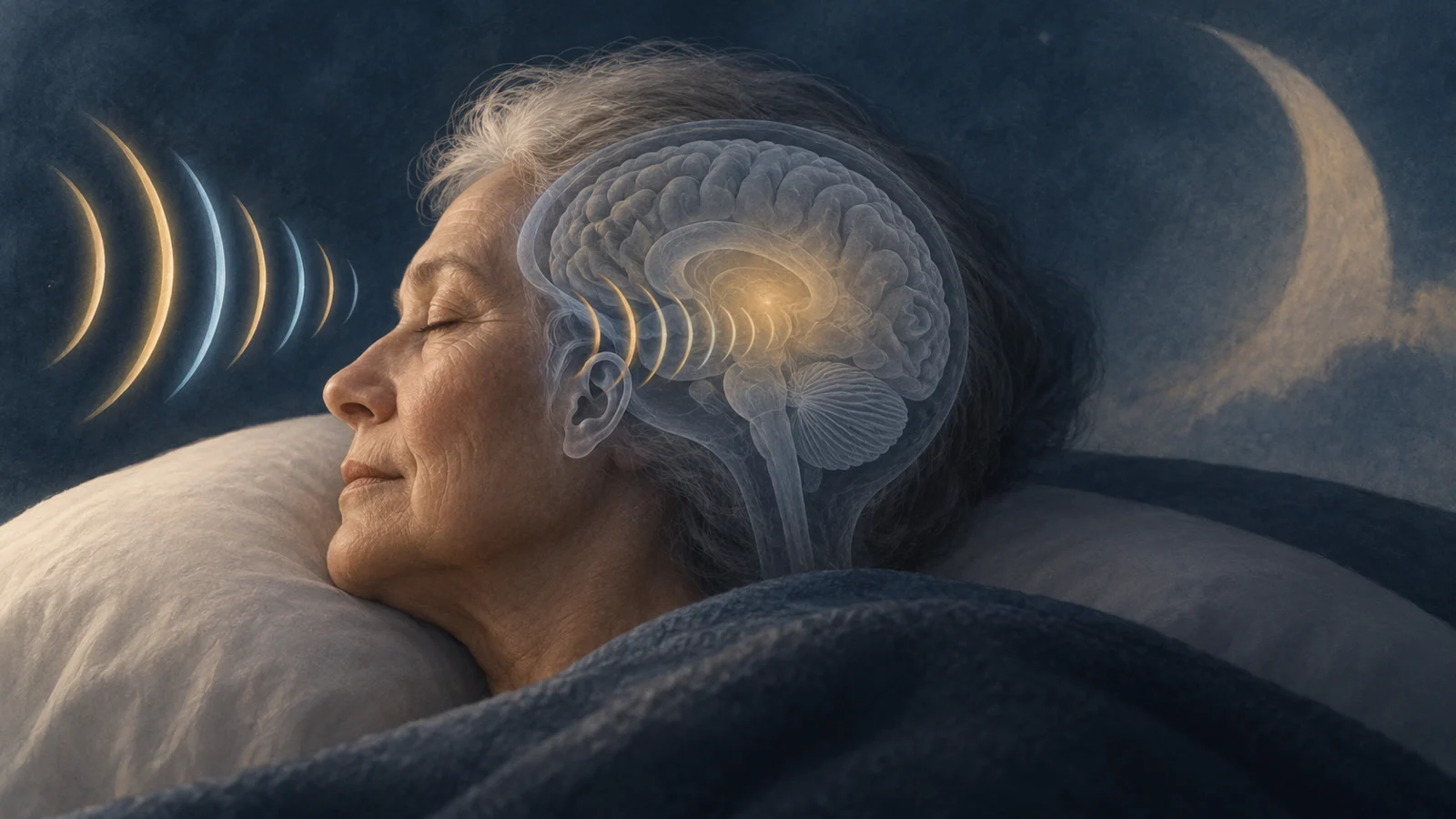
Transcranial ultrasound stimulation, or TUS, uses sound waves directed through the skull. In the active arm, the registry specifies low-intensity TUS at 500 kHz. Before treatment, the methods describe using structural and diffusion MRI to build an individual head model for each participant. That preparation is intended to support individualized delivery through the skull.
The record describes the ability of this technology to stimulate deeper brain structures with focused sound waves. It does not establish that a particular named brain target will be reached in these participants, that target engagement will occur, or that the stimulation will produce a biological or clinical effect. The supplied details also do not establish every exposure parameter.
The intervention is planned to last two weeks. The narrative describes participants receiving assessments at baseline and around weeks 2, 4 and 6, with adherence and adverse effects monitored during the intervention. The structured registry outcomes use 12-week timeframes. These entries should be read as differing parts of the record, not combined into one invented schedule.
What the sham comparison can show
The trial is described narratively as randomized, double-blind and controlled. Seven participants are planned for the active group and seven for the sham group, for an estimated enrollment of 14. The sham arm is described as receiving no active ultrasound.
That comparison matters because tinnitus and sleep can vary over time, and participation itself can influence how symptoms are reported. Random assignment gives the study a way to compare changes between groups rather than treating improvement within one group as evidence that the ultrasound caused it. Blinding is intended to reduce expectations about which intervention a participant receives, although the supplied evidence does not establish how successful the blinding will be.
The registry also labels the intervention model “factorial,” but the supplied two-arm description does not explain that classification. It is safer to focus on the clearly described active-versus-sham comparison than to infer an additional study structure.
The record contains two age descriptions as well. Its narrative refers to Chinese right-handed patients aged 60 to 90 with tinnitus and sleep disturbances, while the structured eligibility summary gives a minimum age of 60 and a maximum of 85. The evidence does not resolve those entries into one definitive age range.
The study measures two kinds of experience
The primary measures are intended to capture what participants report about tinnitus-related functioning and sleep. A short version of the Tinnitus Primary Functions Questionnaire covers areas including concentration, emotion, hearing and sleep. The Pittsburgh Sleep Quality Index asks about subjective sleep quality, time to fall asleep, sleep duration, sleep efficiency, sleep difficulties, sleeping-medication use and daytime dysfunction. Higher PSQI scores indicate worse sleep quality.
These questionnaires describe lived experience. A change in a sleep score would address how restful or disrupted participants perceive their sleep to be; a change in tinnitus functioning would address how the symptom affects parts of daily life. They are not direct measurements of hearing restoration, brain repair or protection from dementia.
Secondary assessments add different kinds of information. The Tinnitus Handicap Inventory measures the functional, emotional and catastrophic burden associated with tinnitus. An attention network test examines aspects of attention through timed visual cues and targets. A word-list learning test assesses performance on a structured learning task. Patient-reported symptoms and cognitive-test performance can move differently, so they should not be treated as interchangeable evidence of one broad outcome.
The planned analysis is intended to compare changes from baseline across time and between groups, using an intention-to-treat approach and mixed-effects models. The registry lists the study’s objectives as including safety, feasibility and efficacy, as well as estimating the sample size needed for a full-scale randomized trial.
Why this small trial will have a narrow reach
Fourteen planned participants can help investigators identify whether the procedure is workable, whether people adhere to the schedule and whether the assessment plan is usable. It can also contribute to planning the size of a larger randomized study. It is not a realistic basis for broad conclusions about durable benefit across older adults with tinnitus, and it is too small to characterize uncommon harms reliably.
Estimated enrollment is not the same as the number who actually took part. Likewise, estimated primary completion on 31 December 2025 and estimated study completion on 30 June 2026 do not establish that the trial finished. The supplied record provides intended methods and outcomes, not measured improvements in tinnitus, sleep, cognition or quality of life. It also provides no findings showing that adherence, tolerability or safety were acceptable.
The investigators’ rationale connects tinnitus, sleep and cognition as areas to study together. That rationale does not show that tinnitus causes dementia, that poor sleep will lead to dementia, or that ultrasound prevents cognitive decline, dementia or hearing loss. Any such claims would require evidence beyond this registration and beyond a feasibility-scale comparison.
What this could mean for sleep care in tinnitus
For older adults living with both tinnitus and poor sleep, the longer-term possibility is a non-drug treatment option aimed at symptoms that interfere with rest and daily functioning. This trial could help determine whether the approach is tolerable and practical enough to test properly, and whether changes in tinnitus and sleep justify a larger controlled study.
That possibility remains conditional. Meaningful benefits would need to survive larger comparisons, alongside evidence that the treatment can be delivered consistently and safely. The study does not promise restored hearing, dementia prevention or near-term clinical availability. It is an early test of whether a focused sound-wave intervention deserves that next level of evaluation.
Key Sources
- Primary source: Low-intensity TUS for Sleep Disturbances in Patients With Chronic Tinnitus
Government or Regulator · Clinical Trial · 2025-01-15
Keep exploring