
Research Signal – Source date 2026-12-01
In a humanized-mouse experiment, a tumor-binding antibody and a separately administered T-cell engager worked only when paired: together they partly controlled tumor growth, while either component alone performed much like the control. A direct antibody designed to connect the same tumor target to T cells did better in that comparison. The result shows both the appeal and the tradeoff of a modular design: its parts can be recombined, but assembly does not guarantee the strength of a purpose-built antibody.
The study tested this idea in cells and mice as a preclinical research platform. It does not establish that the approach is safe or effective in people, or that every possible pairing would work in a living organism.
One antibody marks the target, another recruits an immune function
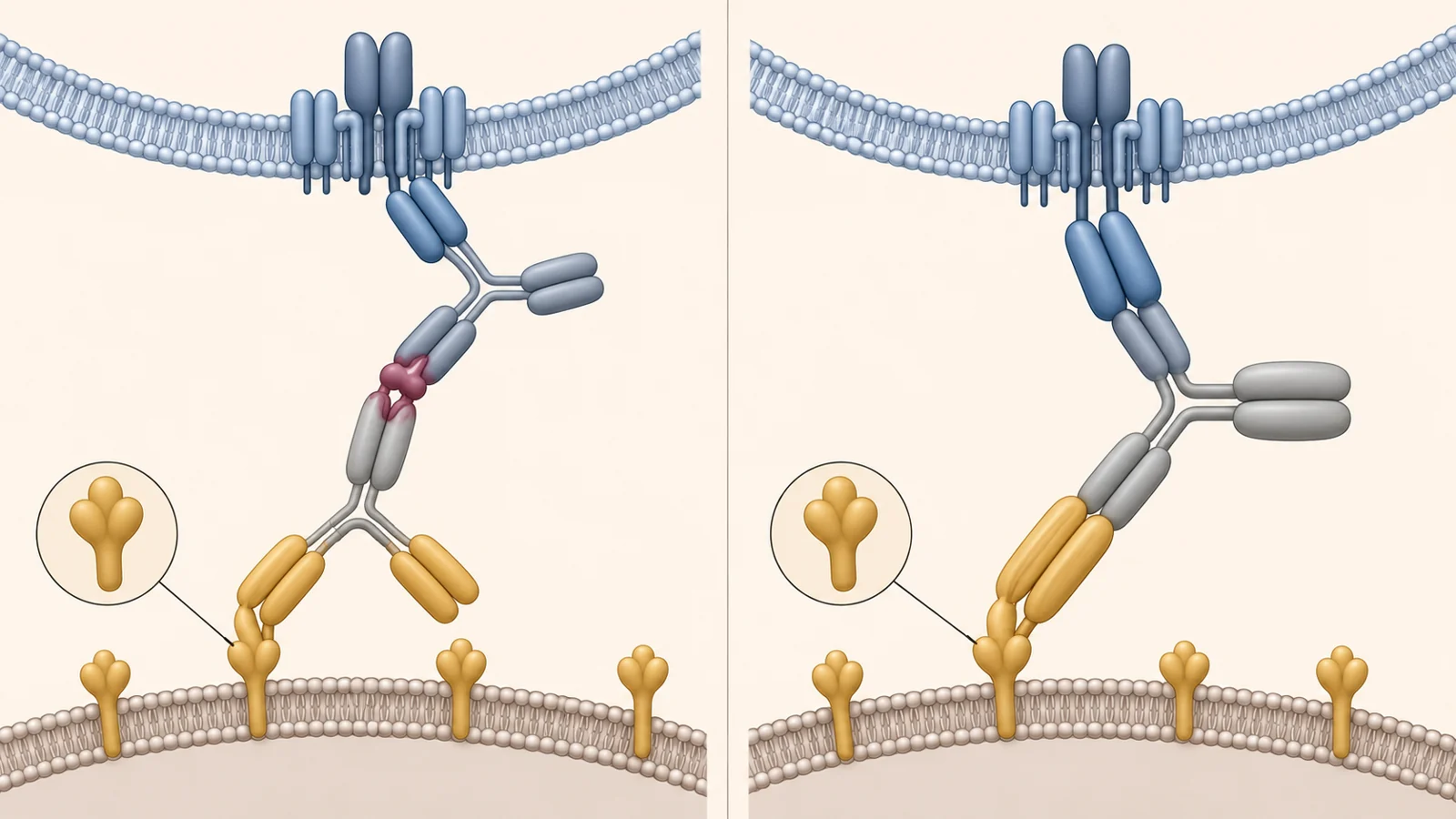
An antibody has two broad regions with different jobs. One part binds a chosen target; the Fc region forms the antibody’s tail. In this platform, researchers changed one amino acid in the Fc region to create a docking feature called P329G. A tumor-targeting antibody carrying that change can bind a marker on a cancer cell and, in principle, provide a landing point for a second antibody that recognizes P329G.
The first antibody is the adaptor. The second is selected to bring a particular immune activity to the marked cell. For the main mouse experiment, it was a T-cell engager: one binding end recognized the P329G feature and another engaged CD3, a receptor on T cells. When the adaptor was attached to a cancer cell, the second antibody could connect that cell to a T cell. The researchers administered the adaptor first, then the engager 24 hours later.
The two components were designed to be inactive on their own in this system and to gain their intended activity when assembled. That separation is what makes the approach modular: a tumor-binding adaptor and an immune-engaging antibody can be selected as separate pieces rather than built as one direct, target-specific molecule.
The experiments changed both sides of the pairing
The researchers explored more than a single tumor marker with one fixed immune action. In laboratory assays, adaptors directed at several targets—including CD19, CD20, PSMA, HER2, EpCAM, CEACAM5 and STEAP1—were paired with a P329G-targeting T-cell engager. Reporter cells registered target-dependent activation across the tested combinations. A reporter signal indicates that a pathway was activated in that assay; by itself, it is not evidence that a tumor was killed or that a treatment would work in an animal or person.
The second part of the platform was also designed to support different immune functions. The tested P329G-engaging molecules included T-cell engagers, engagers for innate immune cells, molecules that boost immune-cell activation, and a modified immune-signaling protein called an IL-2 variant. In their respective cell assays, paired components produced immune-cell signaling or other measured activity. This breadth supports the platform’s mix-and-match premise in experimental systems. It does not show that every combination was tested against every tumor target, or that all pairings would have the same effect.
Primary T cells killed some matched cancer cells
The team also moved beyond reporter readouts. In co-culture experiments, primary human T cells were combined with cancer cell lines carrying CEACAM5 or FOLR1, a tumor-associated surface marker. With the matching adaptor and P329G T-cell engager, the T cells killed the cancer cells. The imaging assay followed this activity for up to 180 hours.
At the tested concentration, killing by the modular CEACAM5 pair reached a level comparable to its direct-antibody comparator. The FOLR1 pair also killed its matched cells, but its maximum effect was weaker than the direct FOLR1 antibody. In both pairings, the measured timing of killing was comparable to that of the direct T-cell engager. The FOLR1 experiments also showed dose-dependent increases in T-cell activation markers, while the CEACAM5 co-cultures showed dose-dependent release of measured inflammatory signaling proteins.
These results help answer whether the two pieces can do more than trigger a reporter: selected combinations can activate primary human T cells and kill matching cancer cells in a dish. They also show why “mix and match” does not mean interchangeable performance. Results differed by tumor target and pairing, even before the added complexity of an animal model.
In mice, the direct antibody had the stronger effect
For an in vivo test, the researchers chose a CEACAM5-targeting adaptor and a P329G T-cell engager. They treated mice given human blood-forming stem cells and bearing tumors grown from MKN-45 cancer cells after the tumors reached the study’s treatment threshold. The adaptor was given a day before the engager to allow it to accumulate in the tumor. Control groups received the adaptor alone, the engager alone or vehicle; another group received a direct CEACAM5 T-cell engager.
The paired modular treatment partly inhibited tumor growth. The adaptor alone and the P329G engager alone had effects comparable to vehicle, consistent with the need for the two components to assemble. The direct CEACAM5 engager produced the strongest tumor control among the groups tested. Tumors from mice given the direct antibody also had greater infiltration of several measured T-cell populations than tumors from mice given the modular pair. The authors noted that the lower T-cell presence in the modular-treatment tumors could help explain the difference in tumor control.
This was a proof of concept for one selected pairing in one humanized-mouse model, not an in vivo test of every adaptor and immune-engager combination. Its clearest result is bounded: the parts worked together in that model, but the direct comparator worked better.
Concentration and antibody shape changed the signal
The modular pair’s performance depended partly on how much of each component was present. Cross-titration experiments varied adaptor and engager concentrations across a range of combinations. Several ratios produced activity, so the system did not rely on one exact ratio in those assays. But activity varied across the tested combinations and was generally lower than the direct comparator for some targets.
More is not always better for a two-sided antibody bridge. At excessive concentrations, each component can occupy its binding partner separately—the tumor target or the immune-cell receptor—leaving fewer opportunities for one assembled complex to connect the two cells. The researchers observed this kind of bell-shaped response in their concentration studies. These laboratory ranges describe experimental behavior, not a dose or regimen for people.
The number and arrangement of binding arms mattered too. Tests of different adaptor and engager formats changed signaling, with the T-cell engager’s format having a stronger apparent influence on potency than adaptor format in the comparisons described. The interactions are complex enough that simply counting how many tumor and T-cell binding sites are present does not predict the outcome on its own.
A docking site also required careful Fc design
The Fc region presented an engineering challenge as well as a docking opportunity. The initial P329G T-cell engager used LALA mutations—two amino-acid substitutions intended to reduce unwanted Fc activity. In a cell assay, however, that design produced nonspecific T-cell activation in the presence of peripheral blood cells, even without the intended tumor target. The pattern was consistent with unintended crosslinking involving Fc-receptor-bearing cells, a concern for a molecule meant to recruit T cells selectively.
They therefore assessed other amino-acid substitutions at position 329 alongside the LALA changes. Their selected engager used P329R in its own Fc to reduce unwanted Fc activity; its separate binding arms still recognized the adaptor’s P329G docking feature. This is a design response to an assay finding, not a demonstration of clinical safety. How reliably the platform can limit unwanted activation, and how it could be manufactured and developed under clinical and regulatory requirements, remain open questions.
Where this research could lead
If the approach can preserve reliable assembly and useful immune activity while solving those engineering and development hurdles, researchers could test new combinations of tumor targets and immune functions by pairing prepared antibody components. That could make early drug discovery more flexible: a team could investigate a different target or immune mechanism without first designing a fully bespoke molecule for each experiment. The evidence bridge toward that capability is the study’s demonstrated activity across several laboratory pairings and partial tumor control from one selected pair in humanized mice.
A meaningful milestone would be showing that this flexibility can produce dependable tumor control without losing the performance or selectivity of direct antibodies. This study establishes a starting point for that possibility, not a treatment option for patients. Its mouse comparison also makes the central challenge concrete: modularity is useful only if the assembled parts can recruit enough immune activity at the tumor, with unwanted activation kept in check.
Key Sources
- Primary source: P329G-engager: a universal mix & match antibody-based adaptor platform for cancer immunotherapy.
DOI or Journal Page · Peer-Reviewed Paper · 2026-12-01
Keep exploring