
Evidence date · 2022-10-14 · Research note 1 of 2
1 2
See current Track status →
A 2022 review found a larger response contrast when nivolumab was added to ipilimumab than when ipilimumab was added to nivolumab. That does not make the two comparisons interchangeable: the result depends on which single drug serves as the alternative, and the response estimates sit alongside a greater burden of treatment-related side effects in at least one comparison.
The review combined three randomized trials and two retrospective cohort studies, covering 1,605 people with advanced melanoma. It offers a snapshot of how the combination compared with each drug alone in those studies. Its pooled numbers concern tumor response; survival results came from individual studies, not a pooled survival estimate.
Two immune restraints, tested in different pairings
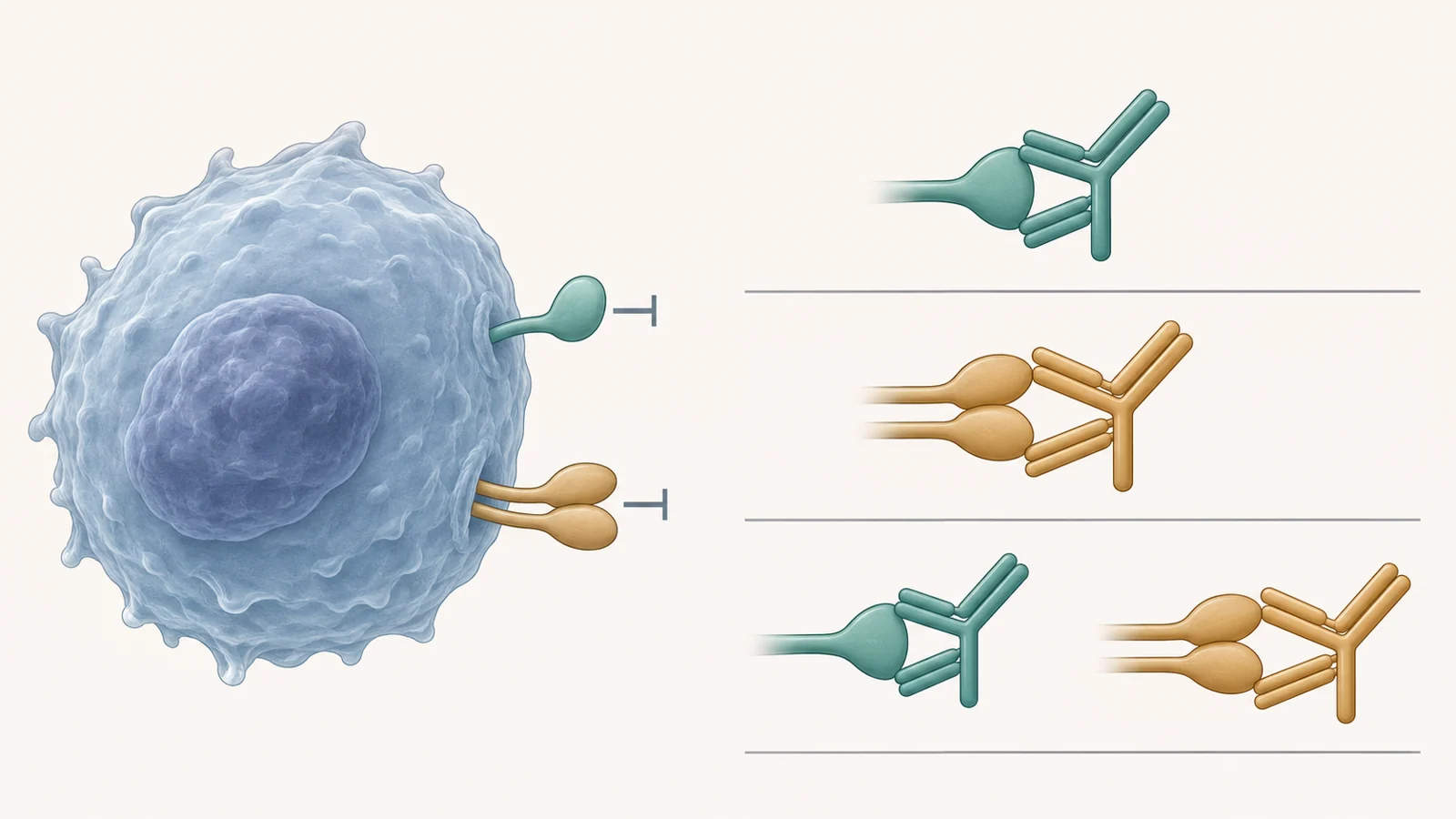
Nivolumab and ipilimumab both help immune cells act against cancer, but they interfere with different restraints on immune activity. PD-1 is a checkpoint receptor on immune cells; nivolumab blocks it. CTLA-4 is another checkpoint that limits immune-cell activity; ipilimumab blocks that restraint. Combining the drugs therefore acts on two different checkpoints.
The review asked two related but distinct questions: what changed when nivolumab was added to ipilimumab, and what changed when ipilimumab was added to nivolumab? A reader considering “two drugs versus one” needs both comparisons, because the apparent size of the response difference was quite different depending on the single-drug comparator.
Across the included studies, the pooled odds of an overall tumor response were higher with the combination than with either drug alone: the odds ratio was 2.144. An odds ratio compares the odds of an outcome between groups. It is not a prediction that a particular person is twice as likely to respond. The combined estimate also covered studies whose results varied substantially, so it summarizes a mixed body of evidence rather than a uniform effect in every setting.
The response contrast depended on the drug used alone
When the combination was compared with nivolumab, the pooled odds ratio for overall response was 1.766. The estimate favored the combination, with a confidence interval of 1.324 to 2.355. But for complete response—when all detectable signs of cancer disappear—the result was less clear: its odds ratio was 1.284, with a confidence interval from 0.889 to 1.855. Because that interval includes 1, the review did not show a clear difference in complete response between these groups.
Against ipilimumab alone, the pooled contrast was larger. The odds ratio for overall response was 5.440, with a confidence interval of 2.896 to 10.220. For complete response, it was 5.169, with a confidence interval of 3.163 to 8.446. Both estimates favored the combination in the studies included.
These are not two measurements of one universal advantage. Each compares the combination with a different treatment group, and the studies contributing to the comparisons were limited in number and varied in their results. The review’s overall response analyses also showed substantial between-study variation: I² was about 80% for overall response and 70% for complete response. In plain language, the observed results differed considerably across studies, which makes the pooled average less representative of any one study or person.
Survival was discussed study by study
Tumor response is not the same outcome as living longer or delaying disease progression. The review described progression-free survival and overall survival from the individual studies, but it could not combine those outcomes into pooled estimates. It therefore does not provide a single pooled survival benefit for the combination.
The review reported that the included studies found longer progression-free and overall survival with nivolumab plus ipilimumab than with either monotherapy. One example was the CheckMate 067 study: the review cited median overall survival of more than 60 months with the combination, compared with 36.9 months with nivolumab and 19.9 months with ipilimumab. At five years, the reported overall-survival figures were 52%, 44%, and 26%, respectively. These are findings from an individual study discussed in the review, not a pooled result across all five studies.
That distinction matters because the meta-analysis could pool response odds, while the survival evidence remained a set of separate study findings. The two kinds of evidence can inform the same clinical question, but they do not establish the same thing.
The safety trade-off also varied by comparator
Treatment-related adverse events were more frequent with the combination than with nivolumab alone in the pooled comparison. The odds ratio was 4.044, with a confidence interval of 1.740 to 9.403. The analysis found substantial variation across these studies as well.
Compared with ipilimumab alone, the estimate also pointed toward more treatment-related events with the combination, but it was less conclusive: the odds ratio was 2.465, with a confidence interval of 0.839 to 7.236. That interval includes 1, so this pooled comparison did not establish a clear difference.
Individual studies show why event severity needs to be kept explicit. In the Larkin study, grade 3 or 4 treatment-related side effects were reported in 59% of people receiving the combination, 23% receiving nivolumab, and 28% receiving ipilimumab. In the Hodi study, grade 3 or 4 adverse events occurred in 54% with the combination and 20% with ipilimumab. These figures describe severe events in particular studies; they are not the pooled odds for any treatment-related event.
What the average leaves unresolved
The pooled comparisons used unadjusted data. They did not account for patient differences that could affect outcomes, including age, BRAF mutation status, prior systemic treatment, PD-L1 status, and sex. With only five included studies, the review had limited scope to examine how such characteristics might change the comparison. Its averages therefore cannot identify which treatment is preferable for a particular person after those factors are considered.
The evidence base also mixed three randomized trials with two retrospective cohorts. The review identified concerns about selection, performance, and detection bias in some included reports; random sequence generation was not used in two publications. It included English-language full-text original papers, which also narrowed the material considered. These design and selection limits matter when interpreting a pooled estimate, especially when the study results vary widely.
Where this research could lead
A more dependable comparison could help a person with advanced melanoma and their clinician weigh the added tumor-response possibility of a second checkpoint drug against the added burden of adverse events for that person’s circumstances. This review contributes an early comparator-specific picture: the response contrast looked different against nivolumab than against ipilimumab, and the pooled harm findings were also not equally conclusive. Turning those broad averages into more reliable individual comparisons would require patient-level evidence and prospective comparisons that account for relevant differences among people.
A useful nearer milestone would be evidence that reports survival and serious adverse events alongside response for clinically relevant patient groups, including groups distinguished by the factors this review could not adjust for. That could make the trade-offs clearer. Until then, this synthesis describes what the included studies found; it is not a treatment rule.
Key Sources
- Primary source: PD-1 and CTLA-4 inhibitors in combination vs. alone for the treatment of advanced melanoma: A systematic review and meta-analysis.
DOI or Journal Page · Review or Meta-Analysis · 2022-10-14