
Research Signal – Source date 2021-01-01
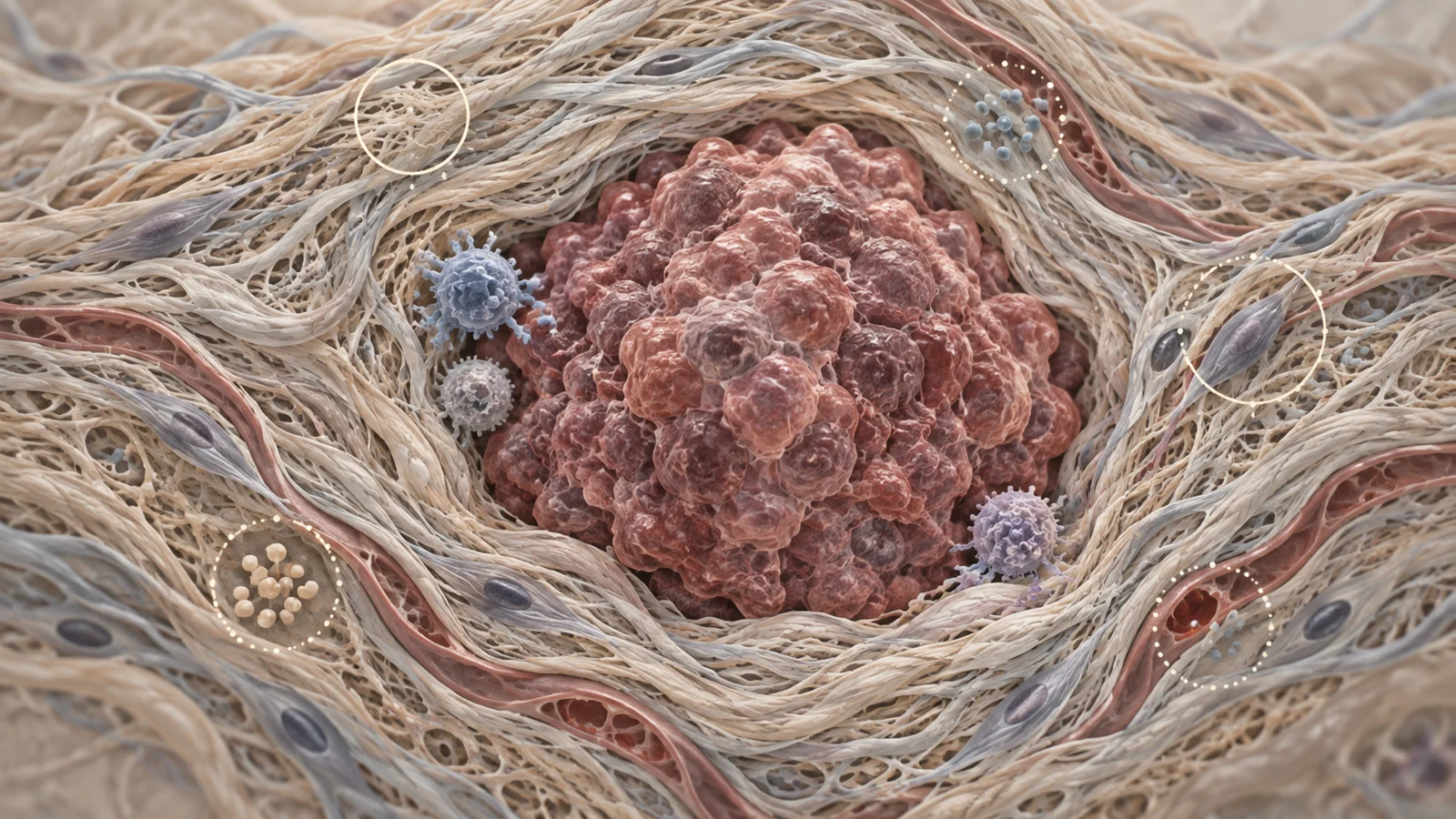
Immunotherapy is often discussed as a way to help the immune system attack cancer. But the tissue surrounding a tumor may also influence how well that approach works. A 2021 paper, “Current Challenges in Targeting Tumor Desmoplasia to Improve the Efficacy of Immunotherapy,” considers ways to alter desmoplasia: the fibrous tissue response around a tumor that the authors associate with immune-resistant malignancies.
The paper discusses several proposed targets, but they point to different parts of the problem. Some approaches aim to change fibrosis or immune suppression around a tumor; others are linked to T-cell activity, blood-vessel changes, or resistance to particular treatments. The findings described in the abstract come from different research settings, so they do not offer a direct comparison of which approach works best for patients.
A signal linked to fibrosis and immune suppression
One proposed route is to inhibit the CXCL12/CXCR4 axis, a signaling pathway discussed in relation to the tumor’s surrounding tissue. The abstract says inhibition reduces fibrosis and alleviates immune suppression, while also enhancing the efficacy of PD-1 immunotherapy. PD-1 treatment is a form of immune therapy; the proposed combination therefore links a change in the surrounding tissue environment with an immune-directed treatment.
The abstract does not specify the setting for this reported effect. It presents the pathway as a promising strategy, but the supplied evidence does not establish improved outcomes for patients or identify which tumors might benefit.
Different targets, different reported effects
CD40L substitute therapy is presented as a possible way to increase T-cell activity. T cells are immune cells involved in recognizing and attacking threats. This proposal focuses on their activity, rather than describing the same fibrosis and blood-vessel changes reported for another approach.
The paper also describes FAPα antagonists, which were tested in preclinical models. The abstract reports changes in desmoplasia and a decrease in angiogenesis, the formation of blood vessels, alongside alleviation of immune resistance. Those changes did not produce a permanent cure in the models. The result suggests that altering features of the tumor environment may affect resistance without, by itself, eliminating the cancer.
These approaches are not interchangeable based on the abstract. A proposed increase in T-cell activity, changes observed in preclinical models, and an effect reported in cell lines each describe a different kind of evidence and a different proposed role.
DDR2 and treatment adaptation
DDR2 appears in a separate resistance context. The abstract links targeting DDR2 to stronger anti-PD-1 treatment effects in multiple cancer cell lines. It also says DDR2 targeting may overcome adaptation to BRAF-targeted therapy in melanoma. These are two reported connections: one involving anti-PD-1 effects in cell lines, the other involving adaptation to a targeted treatment in melanoma.
Cell-line findings can help identify a possible treatment relationship, but they do not show whether the same effect occurs in people. The abstract also does not provide a head-to-head comparison with the other proposed targets, or establish which cancers or patients should receive any of them.
What the evidence can and cannot tell us
The paper brings together proposed strategies, but the evidence described is not all at the same stage. The FAPα findings are explicitly from preclinical models, and the DDR2 anti-PD-1 finding is explicitly from cancer cell lines. For CXCL12/CXCR4 inhibition and CD40L substitute therapy, the supplied abstract describes potential effects without giving enough detail to establish a comparable study setting or patient outcome.
That matters because a change in a model or cell line is not the same as a demonstrated clinical benefit. The available material does not provide validated full text, study-level methods, effect sizes or safety findings for these approaches. It also cannot determine which target is most promising for a particular tumor. The proposals are reasons to investigate how tumor surroundings relate to treatment resistance, not evidence that changing those surroundings already improves immunotherapy for patients.
What changing a tumor’s surroundings could add to immunotherapy
If future research identifies a tissue-directed intervention that works in particular resistant cancers, and shows that it can be combined safely with immune therapy, clinicians might gain another way to address treatment resistance. That possibility depends on establishing which intervention helps which tumors and whether patients experience meaningful benefit. The 2021 discussion outlines candidate strategies; it does not establish that this combined capability is ready for clinical use.
Key Sources
- Primary source: Current Challenges in Targeting Tumor Desmoplasia to Improve the Efficacy of Immunotherapy.
DOI or Journal Page · Peer-Reviewed Paper · 2021-01-01
Keep exploring