
Research Signal – Source date 2022-04-07
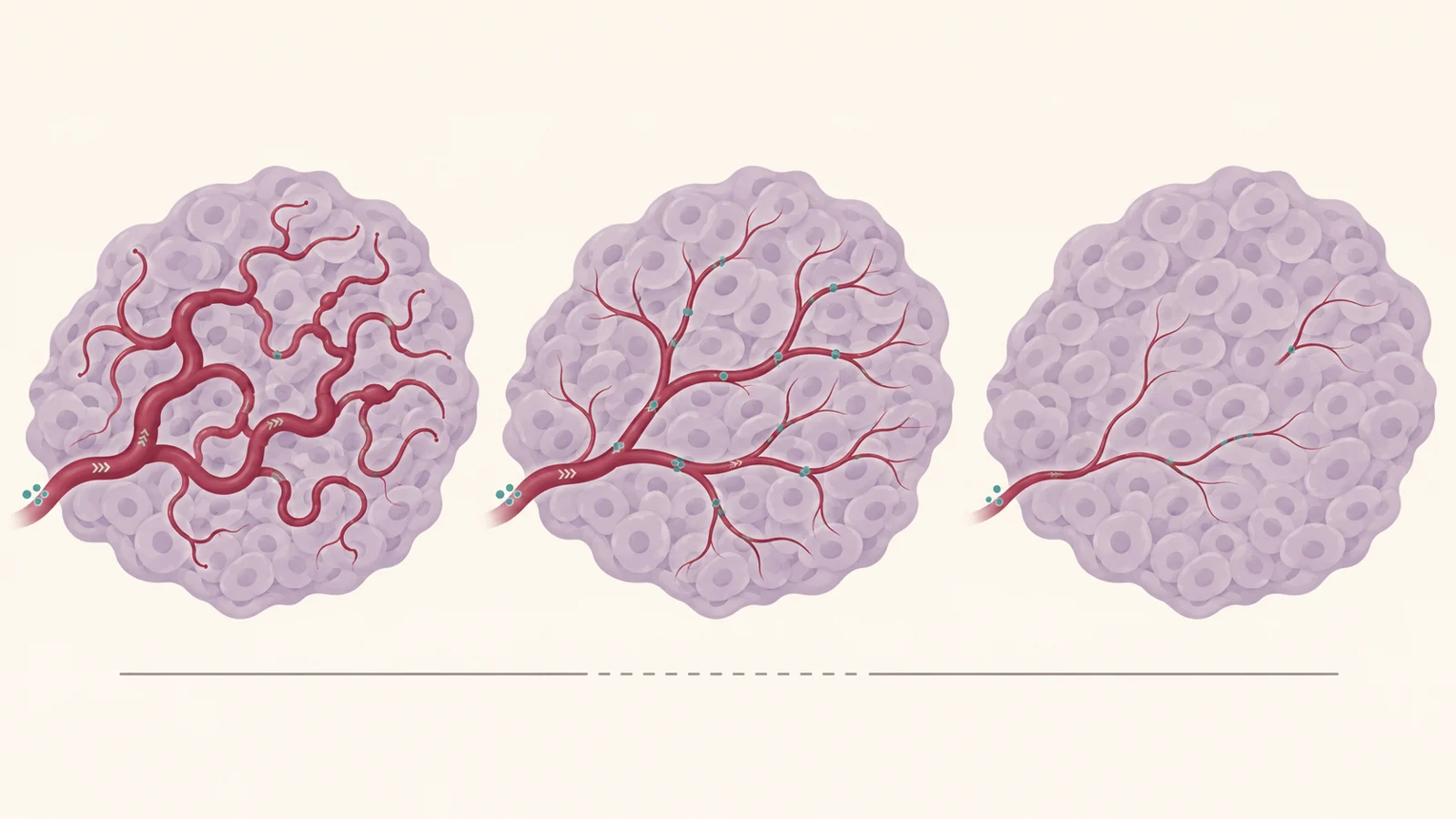
A drug that blocks the blood vessels feeding a tumor can sometimes make another treatment work better, then make it harder for that treatment to reach the cancer. The difference may depend on what happens to the vessels, which drugs are paired, and when they are given.
A 2022 review, “Cancer combination therapies by angiogenesis inhibitors; a comprehensive review,” brings together research on these combinations. It describes a central tension: abnormal tumor vessels can hinder immune activity, while suppressing those vessels for too long may also restrict the delivery of chemotherapy. The review draws on mechanistic studies, animal experiments, and human studies across different cancers and treatments. It is not one controlled comparison of every combination, so its examples show why the answer can vary rather than establish a universal regimen.
Tumor vessels can disrupt more than blood flow
Angiogenesis is the growth of new blood vessels. As a tumor develops, cancer cells and nearby support cells release signals that encourage this growth. The review identifies VEGF as a major signal, alongside other factors that can also influence vessel formation. These signals act on cells lining blood vessels and help drive the growth of new vessels.
The resulting network can be disorganized. Its effects extend beyond carrying oxygen and nutrients: the local tumor environment can also interfere with immune cells’ movement and activation. That matters because immune treatments rely on the body’s defenses being able to act against cancer cells. A vessel-targeting treatment may therefore affect both a physical route into the tumor and conditions that shape local immune activity.
The aim of angiogenesis blockade is not always simply to destroy vessels. The review describes a goal of making abnormal vessels more functional and mature. During a temporary period of normalization, the tumor may be more accessible to another treatment. If vessel suppression is sustained, however, fewer drugs may reach the tumor. The useful window is not guaranteed to be the same for every drug combination or cancer.
Chemotherapy access can change with the schedule
One animal experiment in the review makes the delivery problem concrete. In rats bearing 9L glioma tumors, researchers combined axitinib, an angiogenesis inhibitor, with metronomic cyclophosphamide, chemotherapy given on a regular, low-dose schedule. The combination suppressed tumor growth. But axitinib also reduced the tumor’s uptake of 4-hydroxy-cyclophosphamide, an activated form of cyclophosphamide, by 30–40%. The lower uptake was associated with less chemotherapy-driven tumor-cell elimination, and the combination did not produce complete tumor regression in that experiment.
That result points to two effects happening at once: the combination could restrain tumor growth while making less activated chemotherapy available inside the tumor. It came from rats, so the percentage does not tell us what happens in people or identify an optimal human schedule. It does show why timing and dose matter when one drug changes the vessels through which another drug must travel.
The review describes intermittent treatment schedules as an important subject for further study. More broadly, a treatment that briefly changes vessel function could create different conditions from one that keeps suppressing vessels. The review also summarizes human combinations with differing results, so the rat finding should be read as a mechanistic example, not a forecast of the outcome for every patient or chemotherapy pair.
Immune combinations have a different rationale
Pairing vessel-targeting drugs with immune checkpoint inhibitors is not just another way to improve chemotherapy delivery. Checkpoint drugs act on inhibitory signals that can restrain T-cell activity. In the review’s account, vessel blockade and checkpoint inhibition can affect different parts of the tumor environment: one can alter tumor blood vessels, while the other can release a brake on immune-cell activity.
In mouse experiments summarized in the review, combining a VEGFR2-blocking antibody with a PD-1-blocking antibody inhibited tumor growth more strongly than either alone in a colon adenocarcinoma model. The vessel-targeting treatment reduced the frequency of tumor microvessels; the PD-1 treatment was associated with more T cells entering tumors and signs of stronger local immune activity. In a separate small-cell lung cancer mouse model, adding VEGF blockade to PD-L1 blockade produced a stronger reported outcome than either treatment alone. The review describes a change in an exhausted T-cell pattern in that experiment.
These animal findings suggest that vessel and immune-targeting drugs may complement each other through distinct effects. They are not human treatment results. The review also reports human combinations, but their outcomes vary by cancer and treatment partners. The mouse mechanisms help explain why researchers might test the pair; they cannot settle whether a particular combination benefits people.
Human results depend on the cancer and the outcome
The review summarizes both encouraging and disappointing clinical findings. In ovarian cancer, one cited study of bevacizumab with atezolizumab and chemotherapy in newly diagnosed disease did not achieve the desired effect. In another ovarian cancer setting, bevacizumab with paclitaxel and carboplatin was reported to improve median overall survival—the time by which half a study group had died—among people with platinum-sensitive recurrent disease. These are different treatment settings and combinations, so their outcomes cannot be reduced to a single verdict on vessel-targeting drugs.
Other examples in the review also differ. In colorectal cancer, a bevacizumab combination with radiotherapy and FOLFIRI chemotherapy was reported to produce an objective response—measurable tumor shrinkage—in about 39% of patients. By contrast, a bevacizumab and oxaliplatin combination in colorectal cancer was summarized as having no effect on disease-free or median overall survival. In non-small-cell lung cancer, the review lists a bevacizumab-containing chemotherapy combination with no significant effect on median overall survival. These examples measure different outcomes and involve different regimens; they do not amount to a head-to-head test of one shared approach.
Safety also matters alongside tumor response. The review describes treatment-related toxicities as a barrier to using combinations in the clinic and notes a concern about cardiac ischemia with bevacizumab, including in colorectal cancer patients. A combination’s value depends on more than whether it can affect a tumor: its risks and tolerability are part of the clinical tradeoff.
Suppression can prompt resistance in some models
Blocking blood-vessel growth can leave parts of a tumor with less oxygen. The review describes animal and mechanistic findings in which this oxygen deprivation was associated with signals linked to more invasive behavior, including changes related to epithelial-to-mesenchymal transition, a process in which cells take on features associated with movement and invasion.
The pattern was not consistent across all treatments in the reviewed models. Some drug types and schedules were associated with increased invasiveness or metastasis, while an anti-VEGFR2 antibody reduced lung nodules in one mouse comparison. High-dose, short-term sunitinib produced harmful findings in certain animal experiments, while lower doses in other experiments did not support metastasis in the same way. These results make drug choice, dose, and schedule central to interpreting the risk. They do not establish that vessel blockade generally causes greater invasion or metastasis in treated patients.
Tumors may also respond by relying on other growth signals, one reason the review discusses resistance and interest in targeting more than one pathway. The biological response is complex, and the reviewed findings do not point to one mechanism or adjustment that solves resistance across cancers.
Choosing patients and schedules remains difficult
The review discusses possible measurements that could help predict or track response: blood pressure changes, circulating VEGF, genetic variation, certain blood-cell counts, tissue measurements, and imaging estimates of vessel permeability. It also describes associations between some blood markers and outcomes in patients receiving bevacizumab combinations.
These are candidate indicators, not a validated routine rule for deciding which patient should receive a vessel-targeting combination or when to give it. A useful selection method would need to reliably connect a measurement to benefit or harm for a particular cancer and regimen. Without that dependable link, the same proposed marker cannot settle the scheduling question raised by the chemotherapy-delivery experiment or predict the outcome of an immune combination.
What this could change
If researchers can identify when a tumor’s vessels are temporarily more functional, and match that window to a suitable partner treatment, some combinations could deliver therapy more effectively while avoiding excessive vessel suppression. For patients, the longer-term possibility is a treatment plan better matched to the cancer and its response, with fewer situations where one drug undermines the delivery or tolerability of another.
The bridge from this review to that capability is still a set of varied animal and human findings, not a proven timing rule. A meaningful milestone would be a dependable way to identify which patients and regimens benefit from a particular vessel-targeting schedule, while measuring both tumor outcomes and treatment harms. The review’s evidence makes the potential practical value clear; establishing that milestone would be needed before the promise could guide care consistently.
Key Sources
- Primary source: Cancer combination therapies by angiogenesis inhibitors; a comprehensive review.
DOI or Journal Page · Review or Meta-Analysis · 2022-04-07
Keep exploring