
Research Signal – Source date 2025-05-14
In a laboratory column test with a mixture resembling biogas, carbon dioxide began to emerge from the copper-based porous material at a reported breakthrough interval of 80.9 minutes per gram of material. The corresponding interval for its cadmium-based counterpart was 47.9 minutes per gram. Methane and nitrogen emerged earlier from both columns, though at different times.
Those numbers are breakthrough intervals: they show when gases began leaving a packed test column under the reported conditions. They are not a measure of how much carbon dioxide a full facility could capture. Still, the contrast raises a useful materials question: could changing a pore by less than an ångström alter how gases move through it?
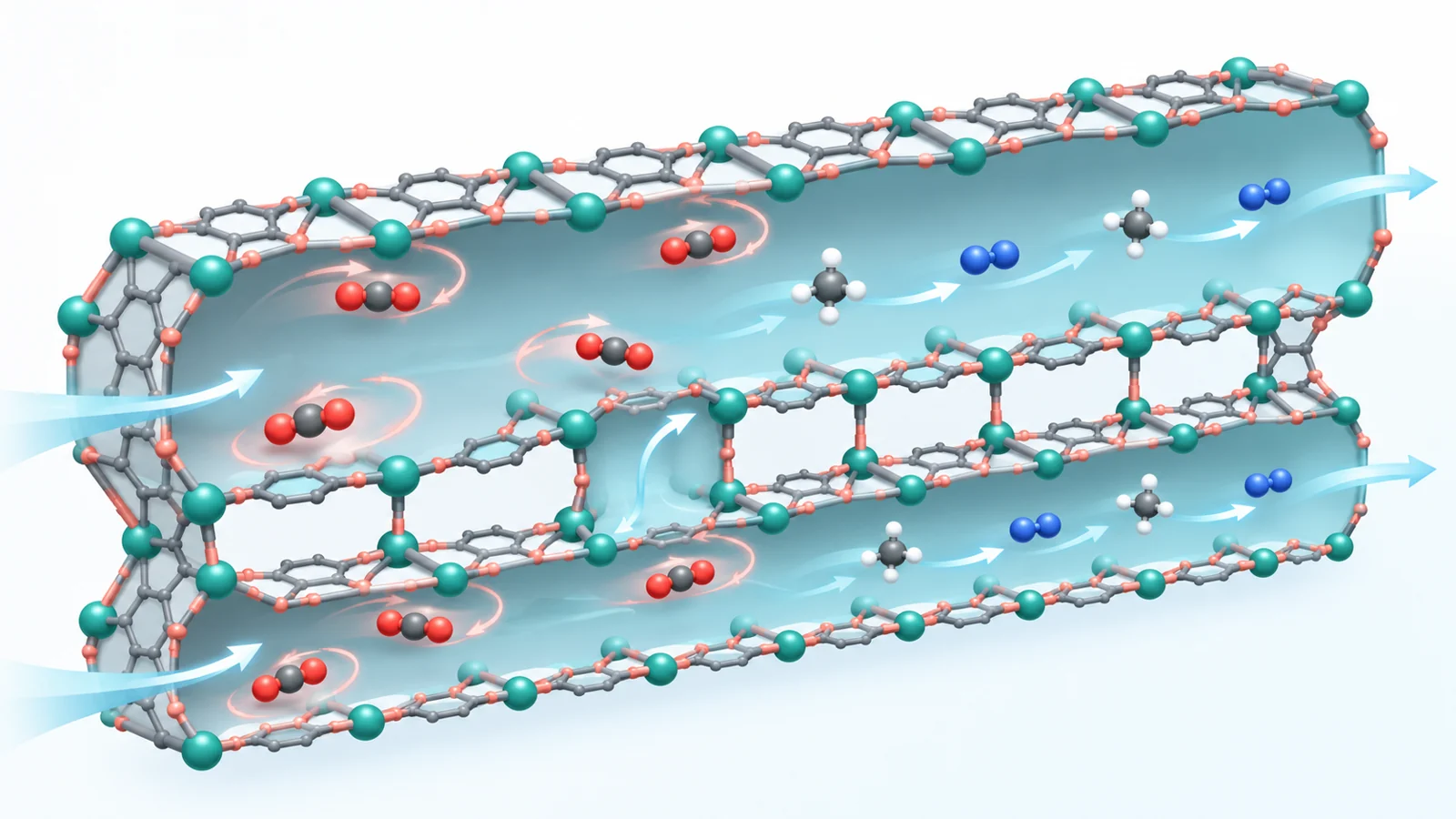
The study compares two metal–organic frameworks, or MOFs: porous solids built from metal atoms and connecting molecules. In this pair, the copper version has narrower channels and captures carbon dioxide more strongly in the reported experiments. The researchers tested it against several gas mixtures, each posing a different separation challenge.
The channel changed as the metal changed
The frameworks are made from clusters of eight metal atoms joined by tetrazolate molecules. Neighboring clusters connect directly; there are no organic linkers between them. This arrangement matters because the small difference in the bonds inside each cluster can carry through to the channel size.
A bond between cadmium and nitrogen is about 2.3 ångströms long, compared with about 2.1 ångströms for copper and nitrogen. The cadmium clusters measure roughly 6.5 by 6.5 by 6.7 ångströms; the copper clusters are smaller, at about 6.2 by 6.2 by 6.3. In the crystal structures, the resulting channels are about 5.5 ångströms wide for SNNU-98-Cd and 5.1 for SNNU-98-Cu.
An ångström is one ten-billionth of a meter. A difference of 0.4 ångströms is tiny, but it is meaningful at the scale of these pores and gas molecules. The researchers also calculated pore-size distributions from gas-adsorption measurements. Those distributions were 5.1 ångströms for the cadmium material and 4.8 for the copper one. These are a separate measurement from the channel widths derived from the crystal structures.
The design avoids a common complication in comparing porous materials: a connecting linker can flex or change and make the final pore respond by more than the intended small adjustment. Here, the clusters touch directly, so the difference in metal–nitrogen bond lengths is transmitted through the framework. The result is a way to tune pore dimensions at a sub-ångström scale.
Carbon dioxide found a stronger hold
Adsorption is the accumulation of gas molecules on or inside a solid. At 298 K (about 25 °C) and 1 bar, the copper material adsorbed 124.1 cubic centimeters of carbon dioxide per cubic centimeter of material, compared with 109.1 for the cadmium version. At the lower pressure of 0.15 bar, the difference was larger: 80.1 for copper and 42.5 for cadmium.
The paper links that stronger uptake to the narrower pores and exposed nitrogen atoms in the tetrazolate clusters. Its molecular analysis indicates that carbon dioxide interacts more strongly with those nitrogen sites in SNNU-98-Cu. The reported heat of adsorption at zero coverage was 34.6 kilojoules per mole for carbon dioxide in the copper material, versus 25.2 in the cadmium material. These measurements help explain why the copper framework can retain carbon dioxide at relatively low pressure.
Methane and nitrogen behaved differently. Their measured uptakes were lower than carbon dioxide’s; in the copper framework, the calculated adsorption heats also indicate weaker binding for methane and nitrogen than for carbon dioxide. Methane also moves more slowly through the narrow pores, an effect the researchers describe as kinetic sieving: differences in how quickly molecules pass through a pore help separate them. This movement effect is distinct from the stronger attraction that favors carbon dioxide. The separation reflects both how molecules interact with the pore surface and how they travel through its tight space.
Three mixtures, three column challenges
The fixed-bed experiments tested different mixtures separately. For a flue-gas mixture of 15% carbon dioxide and 85% nitrogen at 298 K, nitrogen emerged first. Carbon dioxide remained in the column until 64.4 minutes per gram for SNNU-98-Cd and 82.6 for SNNU-98-Cu. At 273 K (about 0 °C), the reported intervals increased to 109.8 and 127.1 minutes per gram, respectively. In tests at 50% and 98% relative humidity, the copper material’s carbon dioxide–nitrogen separation effect remained unchanged.
The biogas test added methane: the mixture was 5% carbon dioxide, 5% methane and 90% nitrogen. For SNNU-98-Cd, nitrogen began exiting at 12.9 minutes per gram, methane at 22.4, and carbon dioxide at 47.9. With SNNU-98-Cu, nitrogen appeared at 9 minutes per gram, methane at 18.3, and carbon dioxide at 80.9. A plateau in the methane curve indicated that methane was both adsorbing and desorbing while carbon dioxide continued to load onto the material. The copper material’s longer carbon dioxide interval did not mean every gas stayed away for longer.
In a coal-gas test that included water vapor, nitrogen, carbon monoxide, methane and hydrogen emerged together at about 10 minutes per gram. Carbon dioxide followed at 21.5 minutes per gram for the cadmium material and 58.9 for copper. The study also simulated two other biogas-like compositions for the copper framework: carbon dioxide did not emerge until 88 and 80 minutes per gram. These tests show adaptability across unlike mixtures, but they are separate laboratory challenges, not one combined process handling every stream at once.
What the numbers can and cannot tell us
The paper reports an ideal adsorbed solution theory (IAST) selectivity of 1509.3 for carbon dioxide over nitrogen in SNNU-98-Cu at 298 K and 1 bar. IAST estimates how a material might favor one gas in an idealized mixture, based on adsorption measurements. That large value describes a calculated comparison between gases; it is not the observed result of a working column.
Breakthrough intervals come from gases passing through a packed bed under specified test conditions. They show the order and timing of gas emergence in that experiment. Neither measure on its own establishes performance at industrial flow rates or scale, operating cost, energy needed to regenerate the adsorbent, or a reduction in facility emissions.
There are practical signs the material merits further study. The researchers produced 10.8 grams of SNNU-98-Cu in a reported 30-minute reflux synthesis, at a yield of about 85%. The copper framework retained high crystallinity after exposure tests spanning pH −0.5 to 13 for up to seven days and after six months in solutions from pH 1 to 12. Its adsorption capacity remained unchanged after the six-month pH 12 exposure, though the reported pore-size distribution changed slightly. Cycling tests also showed stable separation in the reported carbon dioxide–nitrogen and three-gas tests.
These are useful early checks on production, chemical exposure and repeat use. They do not answer how a bed would perform over extended operation as humidity and gas composition change, or how much energy repeated regeneration would require. A reported gram-scale synthesis and controlled stability tests are a starting point for development, not evidence of commercial readiness.
What this could change
Facilities that handle different exhaust and fuel-gas streams could eventually use a common family of pore-tuned adsorbent beds to recover carbon dioxide from those separate streams. Existing capture methods already separate carbon dioxide in other ways; the potential advance here is a material design that performed across several unlike mixtures in laboratory columns. The structural link between metal–nitrogen bonds, cluster size and channel width gives researchers a concrete way to tune that behavior.
That possibility depends on durable operation and practical regeneration being worked out. A useful nearer milestone would be an extended, independently reproduced column test using changing humid mixtures and reporting carbon dioxide breakthrough through repeated regeneration cycles. Such a result would help show whether the material’s laboratory performance can persist under conditions closer to the varied streams it is intended to address.
Key Sources
- Primary source: Inter-cluster-linker-absence-enabled sub-Ångstrom pore modulation in a metal-organic framework for multi-scenario CO 2 capture.
DOI or Journal Page · Peer-Reviewed Paper · 2025-05-14
Keep exploring