
Research Signal – Source date 2023-12-01
Sleep disruption is common in Alzheimer’s disease, and it can affect mood, behavior, cognition, quality of life, and the burden carried by caregivers. That makes sleep an important place to test practical support. But an intervention also has to work in the setting where sleep actually happens: at home, across repeated nights, with people who may have cognitive impairment.
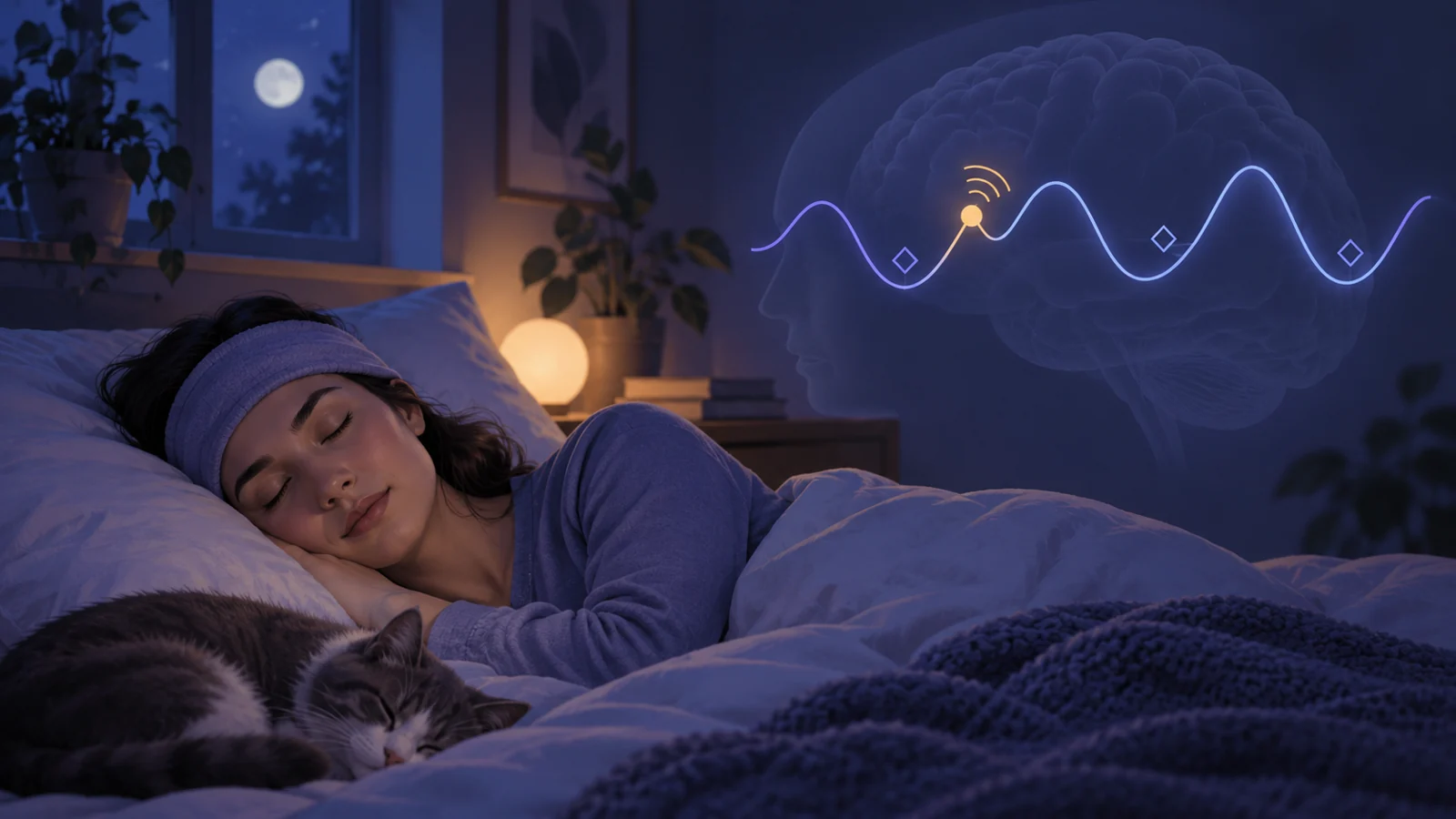
A study published on December 1, 2023, tested whether a commercially available headband could deliver precisely timed sounds during deep sleep for people with mild to moderate Alzheimer’s disease. This was a phase 1 human feasibility study, not a test of an established treatment. Its central question was whether the approach could be used at home and whether recordings would suggest a change in slow-wave sleep, also called N3, the deepest conventional sleep stage.
Why deep sleep became the target
Slow-wave sleep is marked by large, slow patterns of brain activity. In Alzheimer’s disease, reduced slow-wave activity is one of the most notable sleep-related changes. The study authors were interested in whether carefully timed sound could strengthen this stage without using a sleep-inducing medication.
The rationale is biologically plausible but still incomplete as a clinical argument. Slow-wave sleep has been linked to processes involved in brain health, and disrupted sleep is associated with problems that matter to patients and families. Those relationships make N3 worth studying. They do not mean that increasing a measured sleep stage will automatically improve memory, daily functioning, caregiver experience, or the course of Alzheimer’s disease.
The December 2023 paper therefore focused on a narrower first step: could people with Alzheimer’s use a feedback-controlled acoustic stimulation device at home, and would the recordings show more N3 by the end of the study period?
How the headband worked across two weeks
Thirteen people with mild to moderate Alzheimer’s disease enrolled, with the involvement of partners to help make home use more reliable. Each participant first wore the DREEM 2 headband for two consecutive nights with stimulation turned off. These nights provided the baseline recordings.
The next stage involved 14 consecutive nights at home. The headband used built-in sensors, including dry electroencephalography electrodes, an accelerometer, and a pulse oximeter, while its machine-learning system scored sleep stages in real time. When it detected suitable slow-wave sleep and sufficiently good signal quality, it could deliver 40-decibel pink-noise stimulation through bone-conduction transducers.
The timing was the key feature. Rather than playing sound continuously, the device aimed to deliver stimulation at a selected point on the rising phase of a slow wave. On other randomly interspersed occasions, it used a silent SHAM event that marked the wave without delivering the acoustic stimulus. STIM and SHAM events were mixed within the stimulation nights, not assigned as two separate groups of participants.
That design allowed the researchers to test the practical operation of a closed-loop system: record the brain signal, identify a suitable sleep pattern, and respond at the intended moment. It also meant that the headline comparison later reported in the paper was a beginning-to-end comparison between nights, rather than a simple isolated comparison of sound versus silence.
What the comparison in seven participants showed
Eleven of the 13 participants completed the full protocol. Two stopped after three recording nights: one experienced pain behind the left ear, and the other had increased agitation during the day. Some recordings were also lost or excluded because of unusually short recording time after the device was removed or dislodged, an internal storage problem, or a participant declining to wear it on a particular night.
For the paired comparison between night 2 and night 16, only seven participants had sufficient data. That denominator is essential to understanding the result.
The headband’s automated scoring estimated that mean N3 duration rose from 35.07 minutes on night 2 to 68.64 minutes on night 16, with a reported P value of .019. On those two compared nights, the automated estimate was therefore close to twice as many minutes of N3 at the end as at the beginning.
A separate consensus scoring of the raw electroencephalography data pointed in the same direction, but produced different numbers: mean N3 duration rose from 40.86 minutes to 66.93 minutes, with a reported P value of .053. The two scoring approaches both estimated more N3 on the later comparison night, while their statistical results were not identical.
The result is interesting because it is consistent with the possibility that the intervention period was associated with more measured deep sleep. It is not, by itself, a demonstration that the sound caused the increase. The analysis compares two nights in seven people after a period that included both stimulation and silent SHAM events, along with the practical variability of sleeping at home.
Home use was part of the test
Feasibility was not a side issue in this study. A device intended for nightly use must stay in place, remain understandable to the person using it or to a helper, and produce recordings that can be interpreted.
In debrief interviews, the 11 completers reported no severe side effects, and the headband was generally described as comfortable. At the same time, the experience exposed several practical obstacles. The headband became loose overnight at least once for 60% of participants. Four nights out of 176 involved nonuse because a participant refused to wear it. Eighty percent of patients wanted clearer guidance for pairing the headband with a personal device through Bluetooth and suggested a simpler setup.
Those details make the study more informative than a result reported only as a change in average sleep minutes. They show what participation required and why home measurements can become incomplete. The two discontinuations also remain part of the feasibility picture. A generally manageable experience for completers does not establish universal tolerability, long-term safety, or suitability for people who would not have the support available in this study.
What the comparison can and cannot tell us
The near-doubling belongs specifically to the automated estimate of N3 minutes on night 2 compared with night 16 among the seven participants with usable paired recordings. It does not mean that total sleep doubled, that every participant experienced the same change, or that the effect would persist beyond the measured comparison.
The silent SHAM events are important for interpreting the protocol, but they do not turn the reported night-2 versus night-16 result into a clean estimate of the sound’s independent effect. The study was designed as an early feasibility test, and the authors presented the findings as a reason to conduct a larger randomized controlled trial that could test and optimize the approach more rigorously.
There is also a difference between a sleep-stage estimate and a meaningful improvement in a person’s life. The supplied findings do not establish improved cognition, daily functioning, caregiver outcomes, amyloid or tau clearance, or slowed Alzheimer’s progression. Nor does using a commercially available headband establish acoustic stimulation as a validated Alzheimer’s treatment. The useful conclusion at this stage is narrower: a feedback-controlled sound intervention could be used across multiple home nights, and two scoring methods estimated more N3 at the end of this small paired analysis.
What better sleep at home could mean for Alzheimer’s care
A reproducible way to support deep sleep without relying on a sleep-inducing medication could eventually give people with Alzheimer’s disease and their caregivers another practical option for nightly care. The prospect is especially relevant if the approach can remain comfortable, simple to pair, easy to keep in place, and manageable for households supporting someone with cognitive impairment.
That benefit remains conditional on larger studies confirming the sleep effect and showing that it translates into meaningful improvements in daily functioning, mood, quality of life, or caregiver experience. For now, the pilot’s most human contribution is to show both sides of the possibility: a home routine may be able to target deep sleep, but the routine itself has to fit the lives of the people expected to use it.
Key Sources
- Primary source: Acoustic stimulation as a promising technique to enhance slow-wave sleep in Alzheimer's disease: results of a pilot study.
DOI or Journal Page · Clinical Trial · 2023-12-01
Keep exploring