
Research Signal – Source date 2026-08-14
Some thyroid cancers that stop taking up radioactive iodine may regain that ability after a short course of targeted treatment. The possibility comes from earlier research summarized in a review of high-risk, treatment-resistant thyroid cancer. Small patient groups have shown restored iodine uptake, but the results vary with tumor genetics, and an imaging change is not the same as lasting control of the cancer.
The review brings together several different diseases under the label “high-risk refractory thyroid cancer”: differentiated thyroid cancer that no longer responds to radioactive iodine, poorly differentiated thyroid cancer, anaplastic thyroid carcinoma, progressive or high-risk medullary thyroid carcinoma, and locally advanced tumors that cannot be removed with curative surgery. These cancers do not share one outlook or one treatment. Their common feature is that conventional options may not be enough.
The difference between papillary and anaplastic thyroid cancer shows why results must be read within their own subtype. In Swedish registry data summarized by the review, five-year relative survival among women was 93.4% for papillary thyroid carcinoma and 6.1% for anaplastic thyroid carcinoma; among men, it was 92.6% and 5.4%, respectively. These figures describe different groups of patients, not an individual’s prognosis. They also show why a promising result in one type of thyroid cancer cannot be assumed to apply to all the others.
When a tumor loses its ability to handle iodine
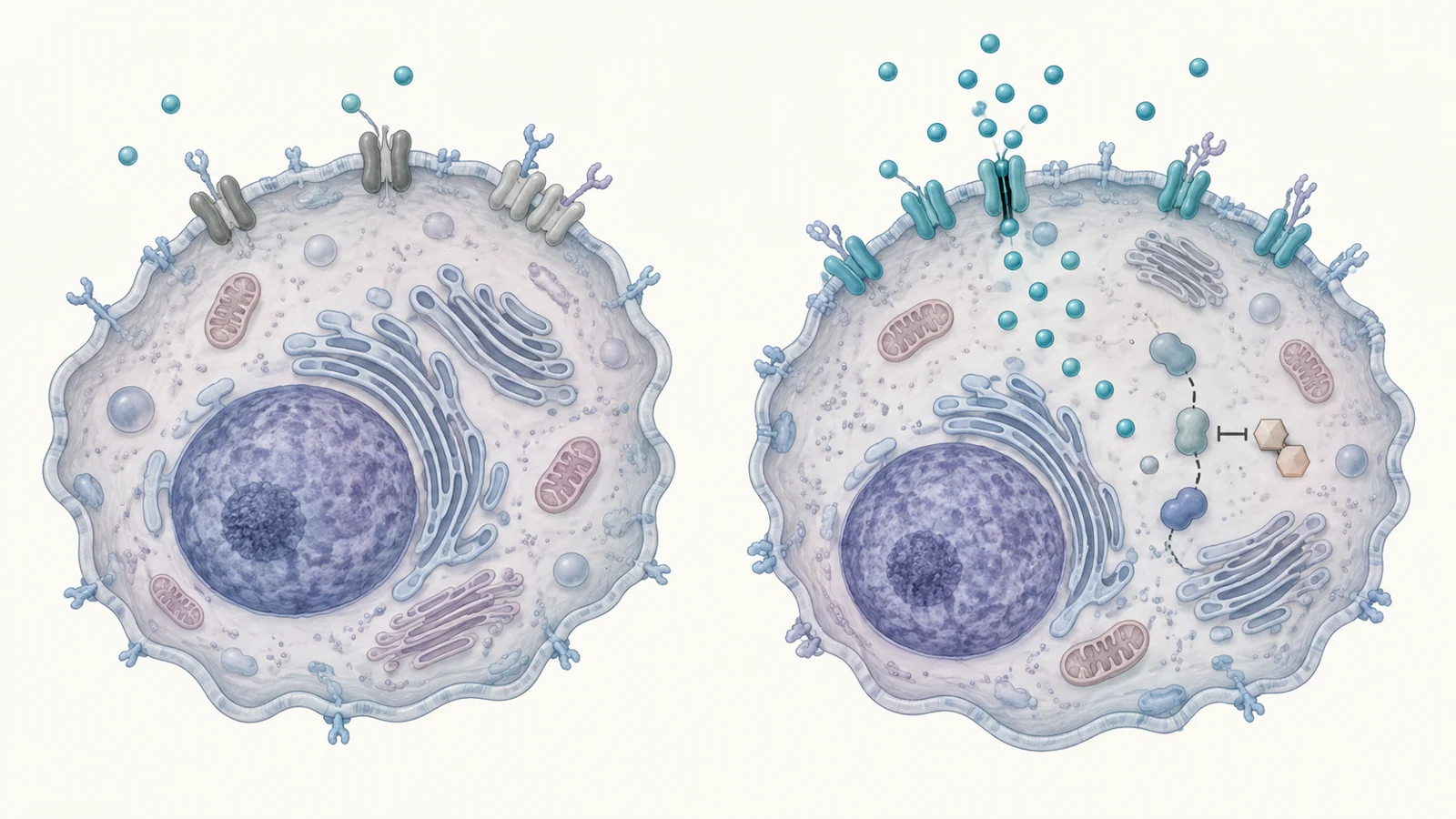
Radioactive iodine treatment depends on cancer cells taking iodine inside. The cells need working thyroid-specific machinery to do that, including the sodium-iodide symporter, a transporter that moves iodide into the cell. They also need to retain other features of thyroid cells, such as producing thyroglobulin and responding to thyroid-stimulating hormone.
In some tumors, persistent activity in the MAPK signaling pathway suppresses these thyroid-specific genes. As the cells lose their differentiated identity, they may take up less iodine or none at all. This loss of uptake is one route to radioactive iodine-refractory disease: the treatment cannot reach cancer cells effectively if they no longer concentrate the radioactive iodine.
That mechanism gives researchers a reason to test whether the loss can sometimes be reversed. Briefly inhibiting the MAPK pathway may release some of the suppression, restore the iodine transporter, and allow iodine to enter again. This is called redifferentiation because the goal is to recover some of the cell features that make radioactive iodine treatment possible. The review describes this as a strategy emerging from prior studies, not as a new trial conducted by the review’s authors.
Small studies show that uptake can return
A real-world study cited in the review used tumor-genetic information to guide MAPK-inhibitor treatment before checking for iodine uptake. Ten of 11 patients with radioactive iodine-refractory differentiated thyroid cancer regained uptake, and eight had a partial response. No severe adverse events of grade 3 or higher were reported in that group during a median follow-up of 39 months.
A separate retrospective study found a striking difference between genetic groups: all 11 patients with RAS-mutant tumors regained uptake after MEK-inhibitor therapy, compared with 7 of 18 patients with BRAF-mutant tumors treated with dabrafenib plus trametinib. These are small groups treated in different ways, so the percentages are not a head-to-head test of therapies. They do suggest that the mutations driving a tumor can matter to whether iodine uptake returns.
The distinction between uptake and clinical benefit matters. A scan showing iodine in a tumor means radioactive iodine may once again reach it; it does not by itself show how long the cancer will remain controlled or whether a patient will benefit from another treatment. In one cited analysis, targeted drugs alone produced about 12% tumor shrinkage in patients who regained uptake, while shrinkage after radioactive iodine was added reached 30%. That observation supports a possible two-step benefit, but it comes from a retrospective group and does not establish a durable outcome for all patients.
Drugs can slow disease even when iodine no longer works
Redifferentiation is one research direction. For radioactive iodine-refractory differentiated thyroid cancer, systemic drugs can also act directly against tumor growth without relying on iodine uptake. Sorafenib and lenvatinib are multikinase inhibitors, drugs that block several growth-related signals at once. Large randomized trials compared each drug with placebo in separate patient groups.
In the DECISION trial, median progression-free survival—the time before cancer worsened—was 10.8 months with sorafenib and 5.8 months with placebo. The SELECT trial found median progression-free survival of 18.3 months with lenvatinib and 3.6 months with placebo. The response rates also differed between the trials: 12.2% with sorafenib and 64.8% with lenvatinib. Because these were separate trials, those numbers do not establish which drug is better for the same patients. They show that both trials found longer progression-free survival than their own placebo groups.
These treatments can also impose a substantial burden. The review describes high blood pressure, protein in the urine, fatigue, and hand-foot skin reactions among adverse effects associated with multikinase inhibitors. The effects can interfere with quality of life, so treatment decisions and toxicity management need to account for the person as well as the tumor.
For anaplastic thyroid cancer with a BRAF V600E mutation, a different approach targets that specific genetic change. In the phase II ROAR basket trial, dabrafenib, which blocks BRAF, was combined with trametinib, which blocks MEK downstream in the same pathway. The review reports an objective response rate of 56% in the anaplastic thyroid cancer group. This result applies to patients with the relevant mutation and cannot be transferred to other thyroid cancer subtypes or to tumors without it.
Tumors can find ways around a targeted drug
Blocking a growth pathway can put pressure on cancer cells, but some may adapt. In one small report summarized by the review, all four thyroid cancer patients treated with BRAF inhibitors acquired new RAS mutations while retaining the original BRAF V600E mutation. A separate real-world study found a pathogenic NRAS mutation in one of nine patients with BRAF-mutant anaplastic thyroid cancer whose disease progressed after dabrafenib plus trametinib. These observations point to a possible route of resistance: a new mutation may help restore growth signaling despite the original target still being present.
Resistance can also involve signals from the tumor’s surroundings. The review describes research in which pericytes, cells that surround small blood vessels, released factors that activated both the MAPK pathway and a second growth pathway called PI3K/AKT in thyroid cancer cells. When both pathways remain active, blocking one route may not be enough. This helps explain why researchers are exploring combinations that shut down more than one source of growth support.
These resistance findings concern targeted treatment. They do not show that redifferentiation will fail, or succeed, in a particular patient. They help explain why response can change over time and why a tumor’s biology may matter both before and after a treatment begins.
In anaplastic cancer, treatment may be planned in stages
The review also describes efforts to combine targeted drugs with immunotherapy and to sequence treatment around surgery and radiation in selected anaplastic thyroid cancers. The rationale is practical: a tumor that shrinks with initial drug treatment may become operable, while later treatment may help manage disease in other ways. This approach is sometimes described as “total therapy,” with induction, consolidation, and maintenance phases.
Early findings are encouraging but come from nonrandomized or retrospective studies. In a phase II nonrandomized study of 43 people with unresectable anaplastic thyroid cancer, the group with BRAF V600E tumors treated with vemurafenib, cobimetinib, and atezolizumab had a median overall survival of 43 months. The review compares this with a historical figure of five months, but the study did not randomly assign patients to the combination or to that historical comparison. The result is promising evidence for further study, not proof that the combination caused the survival difference.
Surgery after initial targeted treatment is another sequence under study for selected patients with BRAF-mutant anaplastic cancer. One retrospective study reported 12-month overall survival of 93.6% among patients who had surgery after neoadjuvant therapy, compared with 38.5% among those who did not. A prospective single-arm study reported an R0 or R1 resection in 88.9% after neoadjuvant targeted therapy. These observations describe selected patients and do not settle how much the treatment sequence itself contributed to the outcomes. Larger prospective studies are needed to clarify who may benefit.
What restored iodine uptake could change
For some people with differentiated thyroid cancer, restoring iodine uptake could reopen the possibility of using radioactive iodine after the tumor has stopped responding to it. The potential benefit depends on more than a scan: targeted treatment would need to restore enough uptake, and the subsequent radioactive iodine treatment would need to produce meaningful, lasting disease control. The small studies reviewed so far show why this route is worth investigating and why tumor genetics may shape its prospects. They do not establish a general success rate across refractory thyroid cancers.
Key Sources
- Primary source: Signaling pathways and targeted therapy in high‑risk refractory thyroid cancer: From bench to bedside (Review).
DOI or Journal Page · Review or Meta-Analysis · 2026-08-14
Keep exploring