
Research Signal – Source date 2022-03-18
A vaccine can help prevent some cancers by protecting against infections that cause them. A treatment vaccine faces a different task: it must direct the immune system toward cancer cells that are already present, even though those cells arise from the body’s own tissue and may actively resist an attack.
A review published on 18 March 2022 describes four ways researchers have tried to deliver tumor targets and explains the immune steps a vaccine is meant to set in motion. Its examples span different cancers, platforms and trial settings. They show why a vaccine can prompt a measurable immune response without that measurement alone answering whether patients benefit.
A target must distinguish tumor from healthy tissue
A therapeutic vaccine starts with a choice: which feature of the cancer should the immune system learn to recognize? The review groups these targets into tumor-associated antigens, which can also appear in normal tissue, and tumor-specific antigens, which are limited to tumor cells.
Some shared targets are proteins made in unusually large amounts by cancer cells. Others are associated with a tissue type. A prostate-related target, for example, may be found in both prostate cancer and normal prostate tissue. These targets can be useful across patients, but the immune system may treat them as “self.” During immune development, strongly self-reactive T cells can be removed, a process called central immune tolerance. A vaccine using a shared target may therefore have to overcome a restraint that helps prevent attacks on healthy tissue. Because the same target can exist outside the tumor, there is also a risk of unwanted immune effects.
Mutation-derived targets, often called neoantigens, offer a different possibility. They are proteins produced when mutations alter a tumor cell’s instructions. Since these altered proteins can be specific to the tumor, immune cells may recognize them without the same history of tolerance to normal “self” proteins.
Finding a mutation, however, does not automatically produce a useful target. The altered protein must be made by enough cancer cells and its fragments must be displayed in a form that T cells can recognize. Tumors also differ from one another, so a personalized vaccine may require sequencing and prediction to identify candidate neoantigens for each person. The review notes that many predicted targets elicit few actual anti-tumor responses, and it describes no established ideal number to include. The design problem is not just to find mutations, but to select targets that are visible to the immune system and matter to the tumor.
The vaccine has to start a chain of immune events
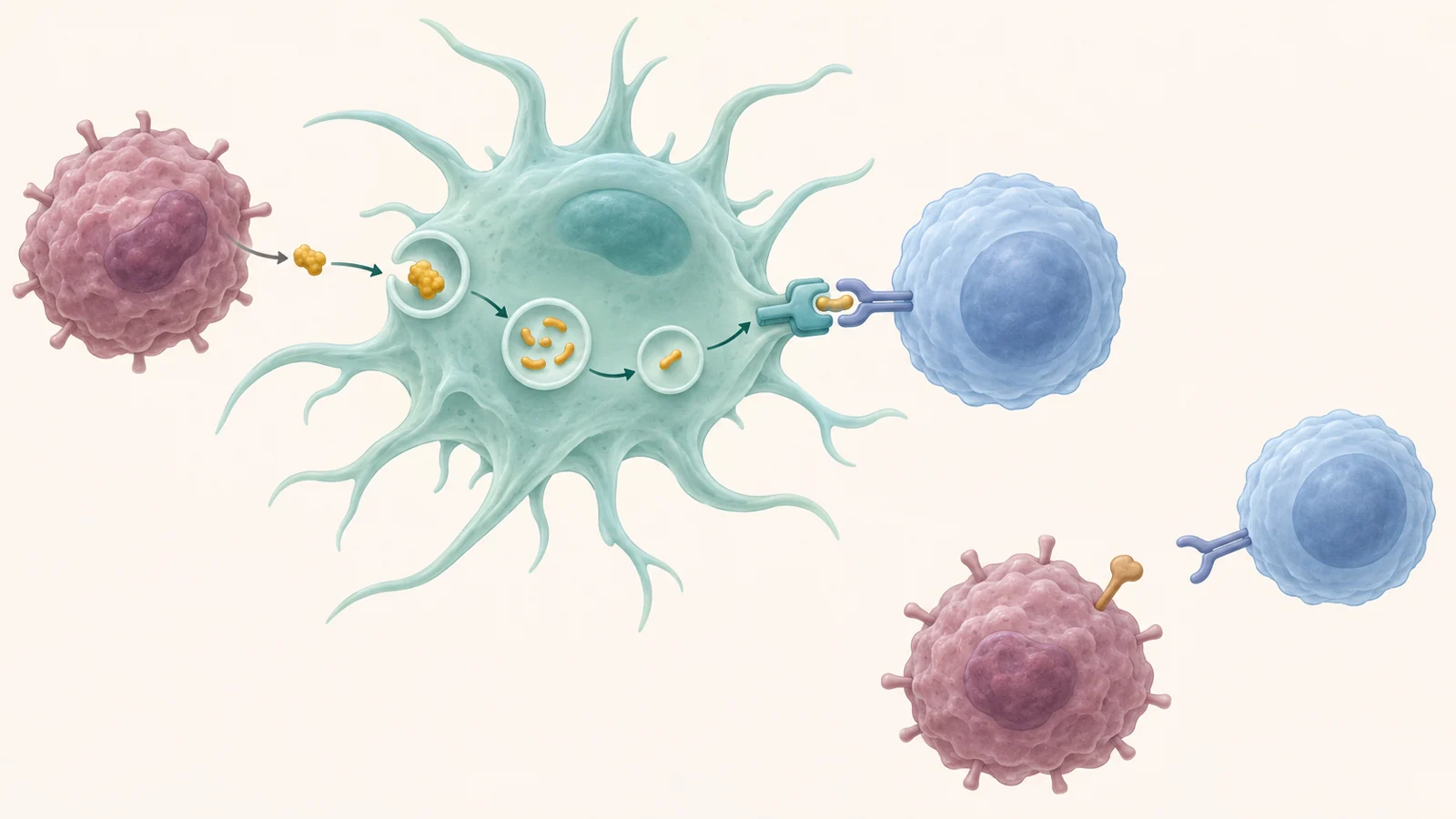
After a vaccine supplies tumor antigens, antigen-presenting cells collect them and display small pieces on their surface. Dendritic cells are especially important in this role. They travel to lymph nodes, where they present the pieces to T cells and provide additional activation signals.
Activated CD8 T cells can become cytotoxic T cells, which identify cells displaying the matching target and damage them. CD4 T cells help sustain and coordinate the response. The review also describes B cells and antibodies as possible contributors. When tumor cells are damaged, they can release more antigens, which other antigen-presenting cells may display. This can broaden the immune response beyond the first target—a process sometimes called antigen spreading.
The sequence matters because delivering an antigen is only its first step. It must be taken up, displayed, recognized by T cells, and followed by an effective response in the tumor. A vaccine platform determines how the target reaches that sequence; it does not by itself guarantee that every step will work.
Four platforms deliver tumor targets in different ways
Cell-based vaccines use whole tumor cells, tumor material or immune cells as part of the vaccine. A dendritic-cell vaccine can load antigens into these professional antigen-presenting cells so they can display them to T cells. Sipuleucel-T, a dendritic-cell-based treatment for prostate cancer, was an important demonstration that this approach could reach clinical use. The review also describes dendritic-cell-derived vesicles, which can carry antigen-presenting and costimulatory molecules, while noting that clinical benefit had not been clear in the studies it discusses.
Viral platforms use viruses as carriers for tumor-related material. Peptide vaccines instead supply selected pieces of tumor proteins. Choosing a defined peptide can focus the immune response on particular targets, but these small pieces often stimulate immunity weakly and are commonly paired with adjuvants—substances intended to strengthen immune activation. Their use also depends on whether a person’s immune system can display and recognize the chosen peptide.
Nucleic-acid vaccines provide DNA or messenger RNA instructions for making tumor antigens. Cells that take up the instructions can produce the antigen for immune presentation. The review highlights mRNA’s flexibility: one vaccine can encode several targets, an attractive feature when tumors vary or when a personalized set of neoantigens is being considered. But mRNA is unstable and can be difficult to deliver efficiently inside the body. Each platform makes a different tradeoff in what it carries, how it is presented and what obstacles stand between the target and an immune response. The review does not establish one approach as best across cancers and settings.
Tumors can hide targets or restrain the response
Even a well-chosen target can become less useful as a cancer changes. If tumor cells lose or alter the antigen, or the machinery that displays it, immune cells may no longer recognize some of them. A response focused on one target could then leave other tumor cells less visible. This is one reason the review discusses vaccines containing multiple neoantigens, or combinations of shared and mutation-derived targets. Broadening the target set is a proposed way to reduce the chance that a single change defeats recognition; it is not a demonstrated solution to immune escape.
Resistance can also come from the tumor’s surroundings. Tumors may contain immune-suppressing cells and signals that interfere with dendritic cells or limit T-cell activation and movement into the tumor. The review describes, among other examples, regulatory T cells, suppressor cells and cancer-associated fibroblasts. These surrounding conditions can blunt an immune attack even when vaccine-specific T cells have been activated. Combining a vaccine with other treatments is therefore a research strategy aimed at more than target selection: it may also need to address barriers that keep immune cells from doing their work.
A T-cell response and a patient outcome answer different questions
The review’s table of completed clinical studies illustrates why researchers measure both immune activity and disease outcomes. For study NCT01706458, it reports that vaccine-specific T-cell responses were detected in 11 people who completed treatment. It also reports that median time to progression was less than six months and was not statistically different between the study arms.
The T-cell measurement asks whether the vaccine was associated with a detectable response against its target. Time to progression asks whether the disease took longer to worsen. One result cannot stand in for the other: an immune response can show that a vaccine engaged part of the intended biology, while the clinical measure tests whether that activity made a difference to disease progression in that comparison. The review brings together such examples; it does not run a new comparative trial or establish a common effect across vaccine types.
The treatment setting may change the question
The review observes that many therapeutic-vaccine trials involve people whose cancer has progressed after other treatments. The authors propose that a vaccine may be better suited to people with a functioning immune system, a smaller tumor burden or a greater risk of recurrence. They present this as a possibility for future study, not an established indication.
Those settings ask different questions. In advanced, progressing disease, a trial tests whether vaccination can make a meaningful difference while a substantial cancer is already present. After treatment, or when tumor burden is smaller, a trial could instead ask whether immune activity helps keep cancer from returning. The review does not establish that a vaccine prevents recurrence in that setting, but the distinction matters when interpreting results: the people enrolled and the point in their illness shape what an outcome can tell us.
What this could make possible
If researchers can identify targets that remain visible across a person’s cancer cells and deliver them in a way that overcomes local immune suppression, therapeutic vaccines could eventually give the immune system a more durable role in controlling cancer. One potential use, raised by the review’s authors, is for people with less tumor burden or a high risk of recurrence, where an immune response might be tested before disease has advanced. That future depends on a difficult bridge: vaccine-induced recognition must translate into meaningful patient outcomes in the specific cancer and treatment setting being studied.
Key Sources
- Primary source: Cancer vaccines as promising immuno-therapeutics: platforms and current progress.
DOI or Journal Page · Review or Meta-Analysis · 2022-03-18
Keep exploring