
Research Signal – Source date 2022-03-02
For metastatic uveal melanoma, a rare cancer that starts in the eye, immune checkpoint drugs had produced disappointing responses. A 2022 review describes a different approach with a striking reported result: tebentafusp, a treatment designed to bring a T cell into contact with a cancer cell, showed an overall-survival benefit compared with investigator’s choice.
The result matters because it suggests immune cells might be enlisted against this cancer in a different way. The review presents the survival comparison as evidence for tebentafusp; it does not make it a direct comparison with checkpoint drugs or a result for every treatment built on the same general idea.
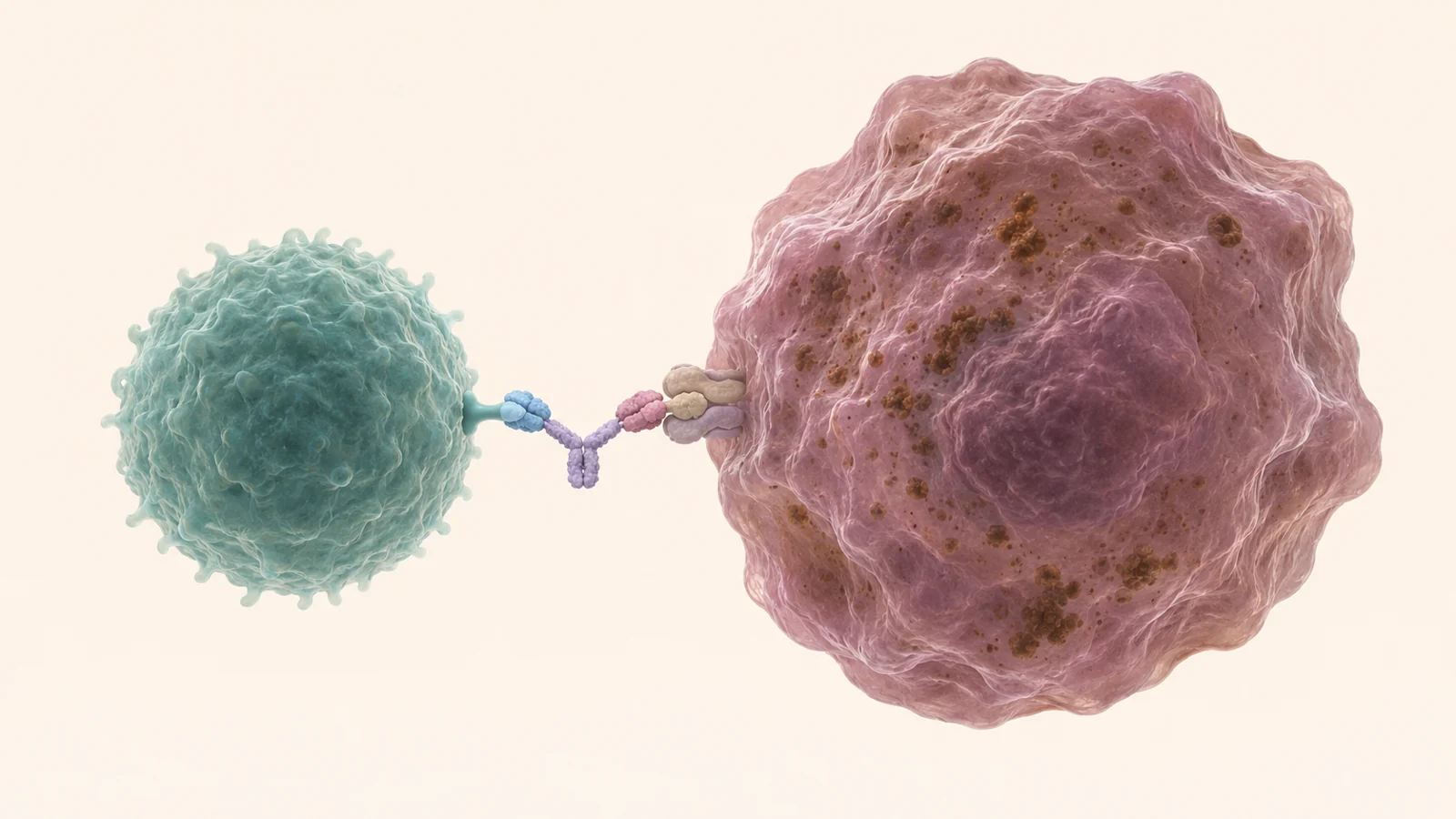
A physical link between immune cell and cancer cell
A bispecific T-cell engager is designed to connect two targets at once: one on a T cell, an immune cell, and one on a cancer cell. By physically bridging them, the treatment aims to bring the T cell close enough to engage the targeted cancer cell. The strategy offers a different route to mobilizing immunity than checkpoint inhibition, which had disappointed in uveal melanoma.
The review identifies tebentafusp as the first in a class of T-cell-engaging fusion proteins called ImmTACs.
The reported comparison was about survival
The review reports that tebentafusp showed an overall-survival benefit compared with investigator’s choice, a treatment selected by an investigator for comparison. Overall survival concerns how long people live, so this is a clinically meaningful kind of result to report. It is the review’s account of prior clinical evidence, rather than a new trial result from the review itself.
The supplied summary does not give the size of the benefit, details of the trial population, or safety findings. Those details matter when judging how large the difference was and which patients it may apply to. The comparison also does not show that tebentafusp outperformed checkpoint inhibitors: the review describes disappointing checkpoint-inhibitor responses as background, while naming investigator’s choice as the comparator for the reported survival result.
One drug’s result does not settle the wider strategy
The review uses tebentafusp’s result to highlight bispecific therapies as a treatment strategy worth attention in uveal melanoma. That is a broader scientific interest than the evidence reported for any single drug. A survival benefit for tebentafusp cannot establish that other bispecific treatments will produce the same outcome. Each would need its own clinical evidence.
The biological differences between uveal and cutaneous melanoma—the more familiar skin form—may help explain why checkpoint inhibition has been less successful in the eye cancer, the review suggests. It presents those differences as a likely explanation, not a settled account of why responses differ. The bridge approach is promising in this setting because it offers another way to direct immune activity, while the reported survival comparison remains specific to tebentafusp.
Where this research could lead
If further treatments can use this T-cell bridge approach and earn their own survival evidence, clinicians discussing metastatic eye melanoma with patients could eventually have a wider choice of treatments supported by survival comparisons. Tebentafusp’s reported result offers a starting point for that possibility, not proof that other drugs will share its benefit. A nearer observable milestone would be a controlled survival comparison for another bispecific treatment in uveal melanoma. Such a result could show whether the approach extends beyond the first drug, one treatment at a time.
Key Sources
- Primary source: Review of bi-specific therapies in uveal melanoma.
DOI or Journal Page · Review or Meta-Analysis · 2022-03-02
Keep exploring