
Research Signal – Source date 2025-07-01
A review of tebentafusp in metastatic uveal melanoma pooled a 7% overall tumor response across four studies, yet estimated that 68% of patients in three clinical trials were alive at one year. Those figures can seem to tell different stories, but they come from different study pools and measure different outcomes. Neither alone tells us whether a person whose tumor did not shrink lived longer because of the drug.
The review, published July 1, 2025, combined two phase 2 trials, one phase 3 trial and one retrospective study, involving 475 patients. Its search covered research through January 18, 2024. The paper brings together early evidence about a difficult cancer and an immune-cell-directing treatment; it does not report a new trial or create an individual prediction tool.
A cancer that begins in the eye can become a wider threat
Uveal melanoma starts in melanocytes, the pigment-producing cells in the uvea, the eye’s middle layer. It is uncommon among melanomas, but it can spread beyond the eye, particularly to the liver. Treatments for the original eye tumor aim to control it while preserving useful vision when possible. Once the disease has spread, the challenge is different: controlling cancer elsewhere in the body.
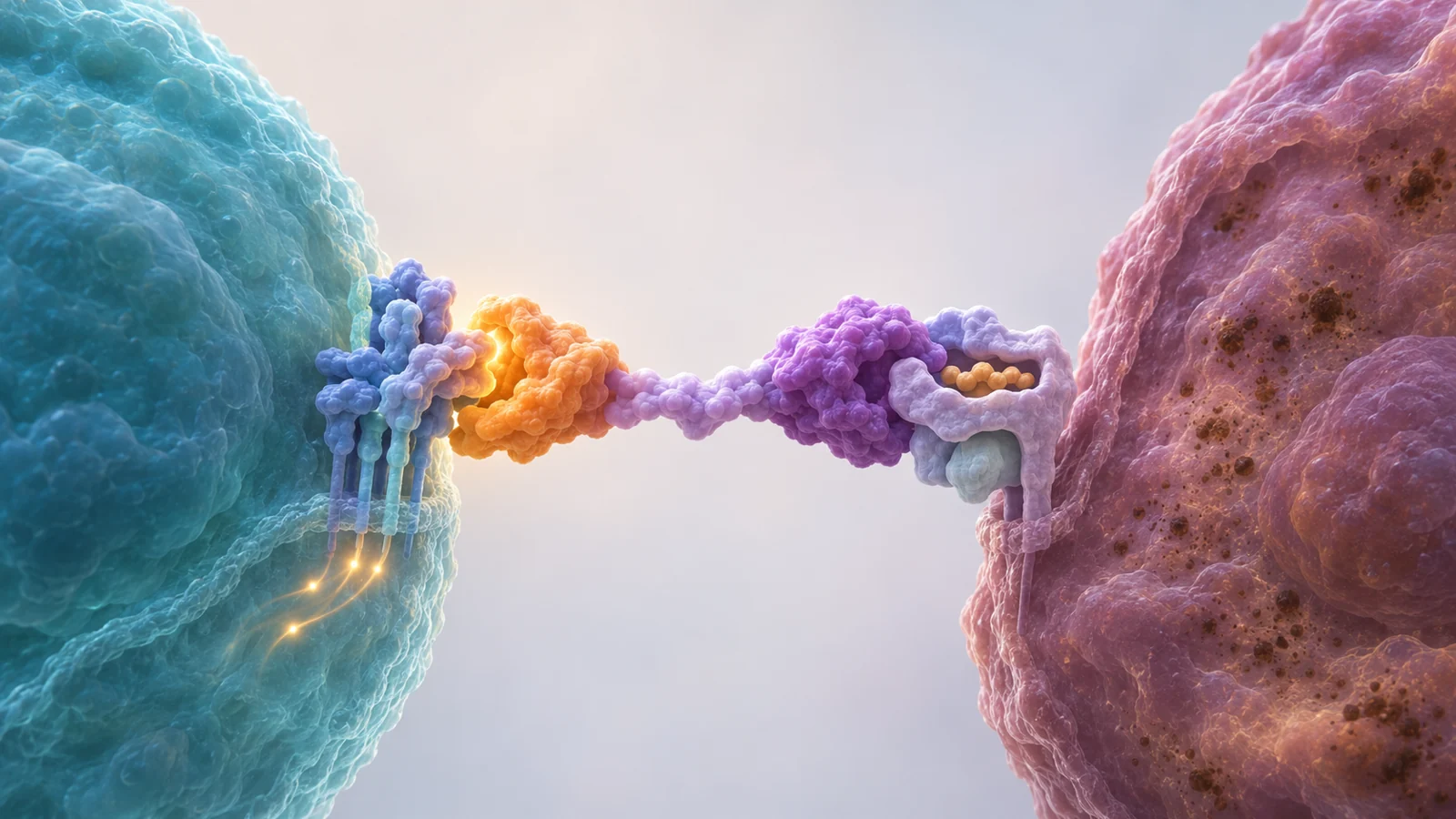
Tebentafusp is designed to help T cells recognize melanoma cells. It connects gp100, a protein associated with melanocytes, to CD3, a receptor on T cells. That bridge is intended to bring immune cells into contact with tumor cells and activate an attack. The same immune activation makes inflammatory reactions relevant when weighing the treatment’s possible activity and its risks.
Tumor assessments show several different outcomes
Across all four studies, the pooled overall response estimate was 7%. “Response” here refers to tumors meeting the studies’ criteria for shrinking; it does not include every possible form of disease control. A separate pooled estimate put stable disease at 37%, meaning tumors were assessed as neither shrinking enough to count as a response nor progressing at that assessment. Progressive disease was estimated at 52%.
These are separately pooled categories, not a single headcount that can be added up to reconstruct what happened to every patient. The review’s clinical-trial subgroup also had a 7% pooled response estimate. Its stable-disease estimate in the three trials was 40%, while progressive disease was estimated at 50%. The categories help describe what tumor assessments looked like across the studies, but the summaries do not show how each person’s tumor course related to their later survival.
The survival estimate came from three trials
The 68% one-year overall survival estimate was pooled from the three clinical trials, rather than all four studies. The review reported moderate between-study variation for this estimate, with I² of 56%. When the researchers omitted one trial at a time, heterogeneity fell to 0% when either of two trials was excluded, but rose to 77% when the third was excluded. These shifts show that the pattern across studies depended on which trial was included.
Overall survival at one year is the share estimated to be alive at that time point. It is not the same measure as tumor shrinkage, and these pooled percentages do not connect the response status of particular patients to their survival. Because the estimate is a pooled proportion from studies without a shared comparison group in this analysis, it cannot by itself quantify how survival differed because of tebentafusp versus another treatment or no treatment. It is a summary of what the included trial populations experienced, not a treatment-versus-control effect.
Frequent immune reactions varied across studies
Cytokine release syndrome, or CRS, is an inflammatory reaction associated with immune activation. The review estimated that it occurred in 83% of patients across three studies, with substantial variation between them (I² of 79%). In the two-trial subgroup, the pooled estimate was 88%, with no measured heterogeneity in that smaller pool. The differing estimates underscore that a pooled rate depends on which studies contribute data.
Fatigue offers another example. Its pooled estimate was 32% across three studies, but the review reported very high heterogeneity (I² of 99%); the two-trial estimate was 46%, also with considerable variation. These percentages describe how often events were recorded in the study groups. Incidence alone does not say how severe an event would be for a particular patient, and a group estimate cannot predict an individual experience.
A small evidence base leaves room for uncertainty
Four studies and 475 patients provide a limited base for pooling results. The evidence also combines clinical trials with a retrospective study, which draws on previously collected patient records. The authors point to the small number of studies, differences across them, variation in study quality and possible publication bias as limitations. Publication bias can arise when studies with notable findings are more likely to appear in the published literature.
Those limits matter differently for each result. The tumor categories and survival proportion answer distinct questions, while the survival estimate changes in how consistently it lines up across studies when individual trials are removed. The high variation in reported CRS and fatigue frequencies adds another reason to read pooled rates as summaries of these particular study groups, not forecasts for a specific person. The search date also sets the historical boundary: the review’s synthesis covers studies it found through January 18, 2024, even though the paper appeared in 2025.
Where this research could lead
For a patient facing metastatic uveal melanoma, the useful future payoff would be evidence that connects tumor assessments, survival and treatment-related reactions in the same clearly described populations. If larger, more consistent studies establish those links and clarify how outcomes compare across treatment options, clinicians and patients could weigh the chance of disease control against the burdens of immune reactions with a firmer basis. This review helps frame that need; its pooled rates alone cannot yet supply that patient-level picture.
Key Sources
- Primary source: Efficacy and Safety of Tebentafusp in Uveal Melanoma: A Systematic Review and Single-Arm Meta-Analysis.
DOI or Journal Page · Review or Meta-Analysis · 2025-07-01
Keep exploring