
Research Signal – Source date 2025-04-03
T cells are immune cells that can recognize and attack cancer. Some immunotherapies help them by blocking inhibitory signals that tumors exploit to suppress an immune response. Yet blocking those inhibitory signals does not resolve every obstacle. A T cell may also have lost the ability to divide, while the tissue surrounding it continues to undermine its function.
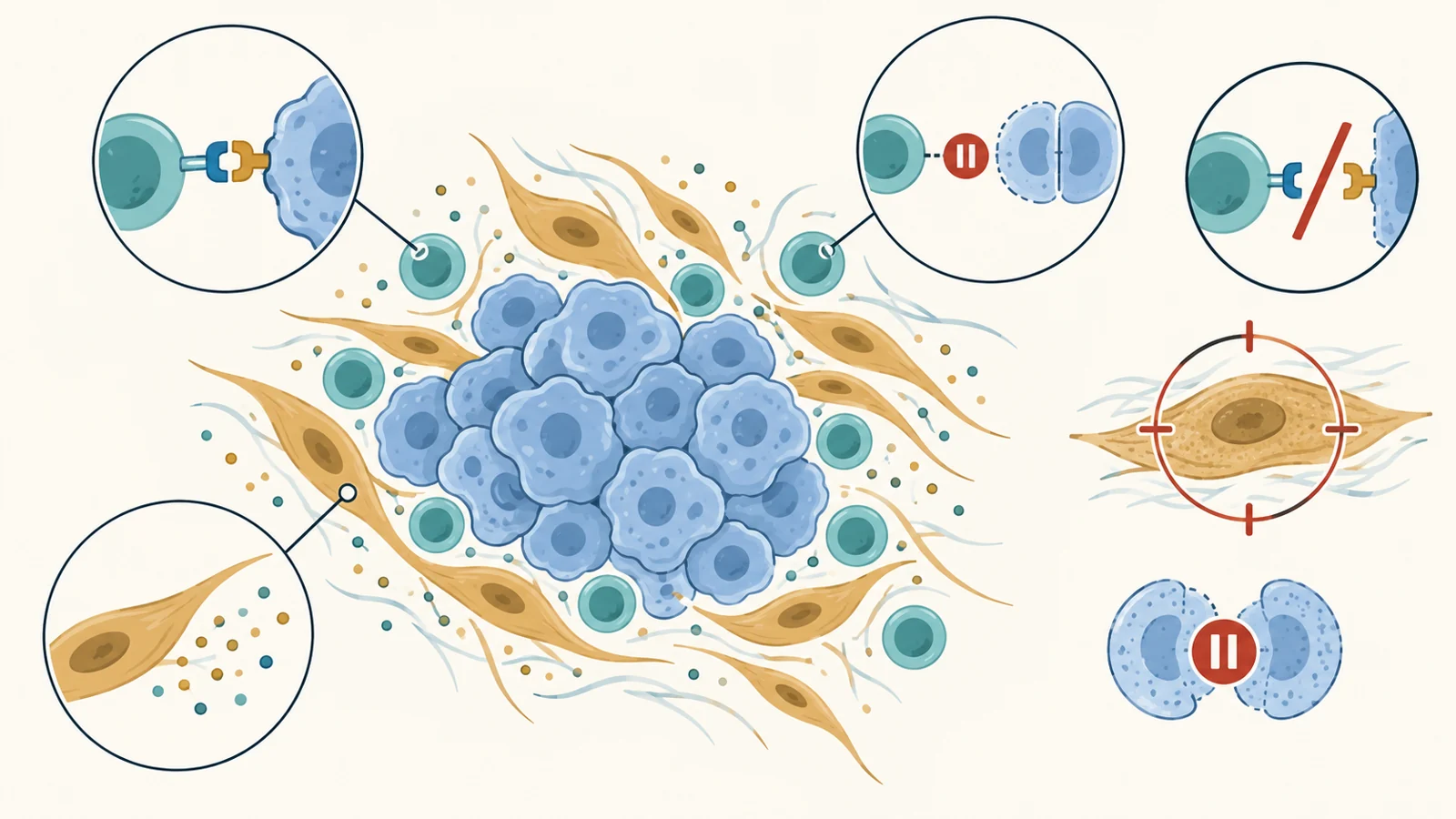
A review published April 3, 2025, examines how two forms of T cell dysfunction—exhaustion and senescence—complicate efforts to sustain an immune attack on cancer. It brings together research on cellular mechanisms, experimental treatments and clinical immunotherapy examples. Its contribution is to connect several reasons immune responses falter and examine interventions that act on different parts of the problem. Those interventions do not yet amount to a demonstrated way to secure durable clinical benefit across solid tumors.
Two forms of dysfunction with different implications
Exhaustion develops in association with persistent stimulation, including repeated exposure to cancer-associated targets. Exhausted T cells can become less effective at killing cancer cells, produce fewer immune signaling molecules and lose some capacity to multiply. They also express inhibitory receptors, including PD-1, that help regulate their activity.
Checkpoint inhibitors block selected inhibitory pathways and can restore some exhausted T cell function. That possibility is clinically important, but the label “exhausted” does not mean every affected cell can recover fully. It describes a state of dysfunction, not a guaranteed response to treatment.
Senescence involves a more stable loss of the ability to divide, together with changes in cellular metabolism, signaling and other functions. The review describes features such as increased activity of an enzyme associated with senescence and higher levels of p16 and p21, proteins involved in controlling the cell cycle. Senescent T cells can also accumulate dysfunctional mitochondria, the structures that help supply cellular energy.
A cell that stops dividing is not necessarily inactive. Senescent T cells can contribute to inflammation even while their useful immune functions are impaired. The distinction matters because the review describes a senescent-like T cell population associated with an aged tumor environment that resisted checkpoint inhibition. Relieving inhibitory signaling did not address all of that population’s dysfunction.
In practice, exhaustion and senescence share enough features to make identification difficult. Reduced proliferation or impaired killing alone cannot reliably separate them. Nor should senescence be treated as ordinary tiredness or simply as a consequence of a person’s age. Cellular stress and the surrounding tissue also help shape these states. Although the authors discuss possible flexibility in senescence, that discussion does not demonstrate routine rejuvenation of senescent human T cells.
The tumor neighborhood helps determine what cells can do
A solid tumor contains more than cancer cells. Support cells, blood vessels and multiple kinds of immune cells form a local environment that can either assist or obstruct an immune attack. The review emphasizes that this neighborhood can actively push T cells toward dysfunction.
Fuel competition is one pressure. When T cells become activated, their energy demands change as they prepare to multiply and carry out immune functions. Cancer cells and other cells nearby compete for nutrients, including glucose. Limited nutrient access can impair T cell activity, proliferation and survival. Poor blood supply also creates regions with low oxygen, while acidic conditions add further stress.
Neighboring senescent cells provide another source of pressure. They can release a mixture of inflammatory and other signaling molecules that changes the behavior of surrounding cells. The review describes how senescent cells accumulating after cancer treatment may promote senescence in nearby immune cells through secreted factors or direct contact.
This helps explain an otherwise puzzling observation summarized in the paper: an aged tumor environment can push even young, transferred T cells toward a senescent-like state. Supplying younger cells alone may therefore leave the forces that impaired the original cells in place. Strategies to improve immune function also have to account for the conditions those cells encounter after entering a tumor.
Restoring function, sustaining cells and removing cells
The approaches discussed in the review intervene at different biological levels. Checkpoint blockade changes signaling received by existing immune cells. Engineering T cells changes properties of the cells themselves. Senolytic treatment aims to eliminate selected senescent cells. Their intended actions should not be folded into a single idea of “rejuvenation.”
For checkpoint inhibitors, the immediate target is an inhibitory pathway. Blocking PD-1 or CTLA-4 signaling can allow stronger antitumor activity. The review places these established immunotherapy approaches alongside work on the local barriers that constrain their effects, including suppressive immune cells and unfavorable tumor conditions.
Cell engineering seeks to help therapeutic T cells persist and function after transfer into the body. CAR-T cells, for example, are T cells engineered to recognize a selected target. The review discusses adding or modifying internal signals that support activation and survival, as well as engineering cells to supply supportive immune signals. One example involves IL-15, a signaling protein studied for its ability to improve CAR-T cell expansion, persistence and antitumor activity.
These changes address the practical challenge of keeping an introduced cell population functional inside difficult tissue. More ambitious approaches discussed in the paper target processes involved in cellular aging and growth arrest. Such experiments investigate whether cells can retain useful functions longer; they do not establish that broadly reversing growth arrest is a dependable cancer treatment.
Senolytics take a different action. They aim to trigger death in senescent cells, often by interfering with pathways those cells depend on for survival. Removing a senescent cell does not restore that cell’s function. Any improvement in immune activity may instead come from reducing the suppressive influence of cells around the remaining T cells.
That distinction is visible in a mouse study summarized by the review. Removing senescent cancer-associated fibroblasts—support cells within the tumor— increased the presence of activated cancer-fighting T cells and strengthened the effect of checkpoint therapy. Here, the target for removal was a neighboring support cell population. The experiment illustrates how changing the environment can help immune activity without directly rejuvenating a T cell. These results support further investigation in particular tumor settings; they remain preclinical evidence.
Why senescent cells are not always the enemy
Selective removal sounds straightforward until the useful functions of senescence enter the picture. Growth arrest can prevent damaged cells, including cells with cancer-promoting changes, from continuing to multiply. Senescence can therefore help restrain tumor development.
Senescent cells can also make themselves more visible to the immune system and release signals that recruit immune cells. The review describes circumstances in which senescence supports immune surveillance and antitumor responses. Eliminating cells in those settings could remove part of a useful defense.
In other circumstances, their signals help build an environment that favors cancer. Persistent inflammation, recruitment of suppressive immune cells and support for blood vessel growth can all contribute. The review describes, for example, how signals from senescent cells can increase populations of cells that suppress T cell function.
Which role dominates depends on the cell population and disease setting. The authors point out that different organs, and even primary tumors and metastatic lesions, can have different local environments. “Senescent” alone is consequently too broad a description to tell researchers whether a cell population should be preserved, altered or removed. Its contribution to the particular tumor matters.
Making a selective strategy work inside a solid tumor
Identifying the relevant cells is a central obstacle. Researchers need reliable combinations of cellular features that distinguish senescence from exhaustion and reveal which populations are helping sustain immune suppression. A feature associated with senescence is not, by itself, a definitive clinical test. Overlap between states makes the connection between a measured marker and a useful treatment target especially important.
Even an appropriate target can be difficult to reach. Solid tumors often contain dense material between cells and abnormal blood vessels, both of which can obstruct treatment delivery. The review discusses approaches such as nanoparticle delivery systems and direct injection into tumors as ways researchers are exploring this problem. A treatment’s activity in an experimental system cannot ensure that it will reach the necessary cells throughout a solid tumor.
Clinical evaluation must then connect cellular effects to patient benefit. More activated T cells, better cell persistence or reduced tumor burden in an animal model can each provide useful evidence, but they answer different questions from whether a treatment controls a patient’s cancer for longer. The review brings together findings from different tumor settings and experimental approaches; those examples cannot be read as one intervention tested in a comparable patient population.
For combinations involving senolytics, this leaves a demanding task: establish that the intended cells are reached and affected, that useful functions of senescence are not lost in a way that undermines treatment, and that the resulting immune changes translate into clinical efficacy. As of this review, evaluation of senolytics specifically for solid tumors remains at an early stage.
What this could change
If researchers can selectively address dysfunctional immune cells and the neighboring cells that suppress them, while solving delivery and clinical-validation problems, patients with solid tumors could gain treatments that keep cancer-fighting T cells active for longer. Cells supported to persist would also need a local environment in which they can continue to work.
That combination could make an initial immune response more likely to become sustained tumor control. The practical promise is a cancer therapy whose effects last because both the immune cells and their surroundings remain compatible with an effective attack. Realizing it will depend on matching distinct biological actions to the particular barriers within a tumor.
Key Sources
- Primary source: Harnessing Immune Rejuvenation: Advances in Overcoming T Cell Senescence and Exhaustion in Cancer Immunotherapy.
DOI or Journal Page · Review or Meta-Analysis · 2025-04-03
Keep exploring