
Research Signal – Source date 2025-10-06
Can a familiar song at the end of the day help a person with Alzheimer’s settle into sleep? Sweet Night is a registered investigation built around that practical question in a protected living setting. Its premise is not that music has already been shown to work, but that a familiar evening routine can be studied with measures that go beyond an impression of a calmer room.
A bedtime routine under study
The study is connected to a registry entry dated October 6, 2025. The current record lists an actual start date of January 13, 2026 and a recruiting status. It estimates primary completion in November 2027 and overall completion in February 2028. These dates describe the study’s lifecycle, not an outcome.
The investigation concerns people aged 60 or older with Alzheimer disease or an associated disorder. Enrollment is estimated at 120 participants, but that figure is a plan rather than a verified count of people enrolled or completing the study. The registry classifies the work as observational.
Music and audiobooks shape different evenings
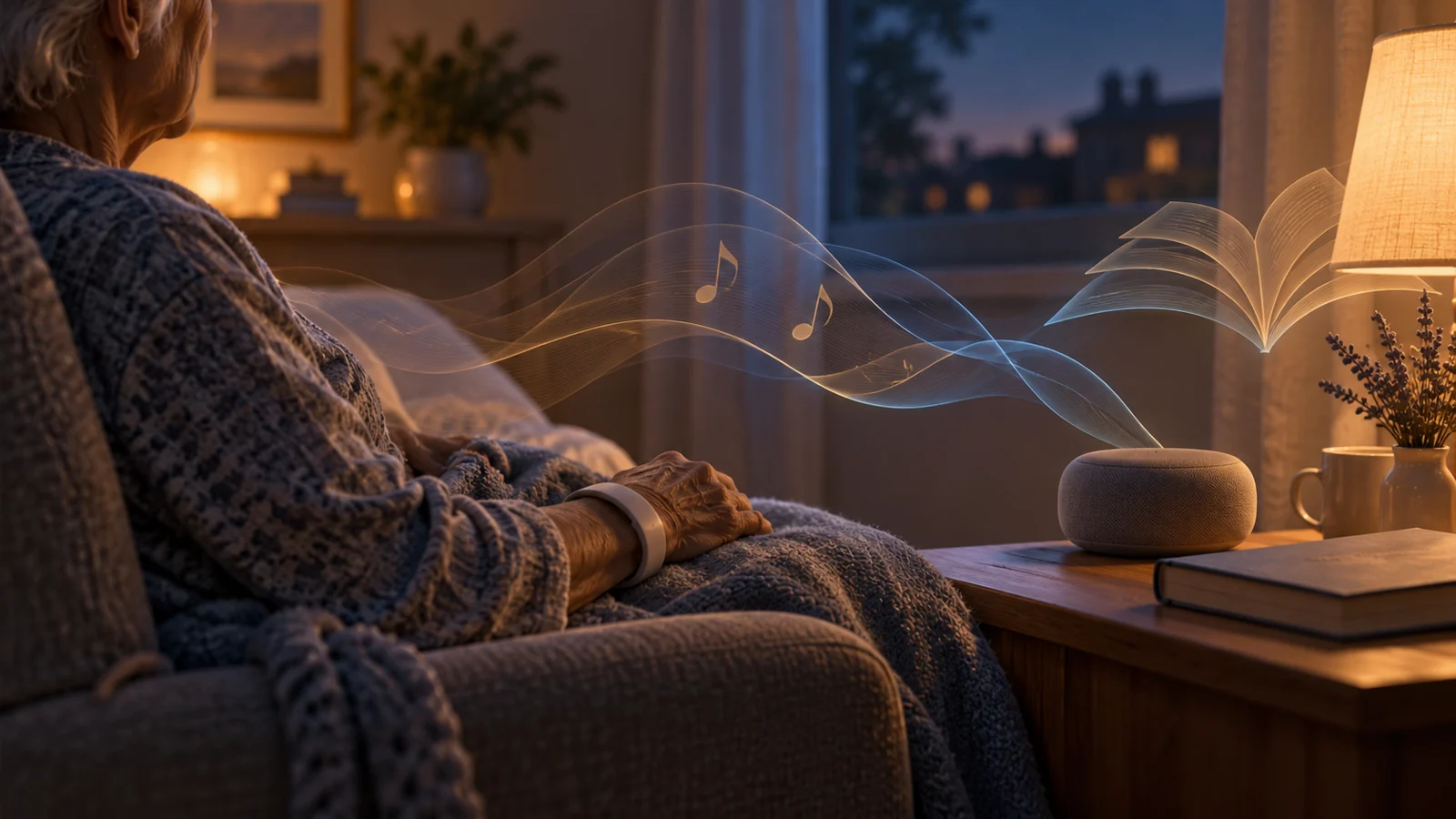
The music activity is passive and individual. A personalized playlist of familiar music is played before bedtime in bedrooms and the living room, with sessions supervised by nursing staff after meals. The listed music period lasts 10 days.
The comparison activity involves therapist-led audiobook listening over 10 evenings. It is described as active listening, requiring participants to concentrate on the audiobook while following the rhythm of the evening. The record therefore describes two distinct kinds of evening activity: one centered on familiar music played in the environment, and another involving guided attention to spoken material.
That difference matters when interpreting any later change. A shift observed during the music period could reflect the audio content, the passive format, the surrounding routine, or the contrast with therapist-led attention. The registration does not support treating music and audiobooks as interchangeable versions of the same intervention.
Each participant serves as their own reference
Sweet Night is designed to compare behavioral and actigraphic measurements before, during and after the listening periods. Each participant serves as their own control, so the central comparison begins with the person’s own earlier measurements rather than only with another group of residents.
This approach can make the evening pattern easier to follow for each individual, but it does not turn the registry entry into a treatment-effect estimate. The activities differ in content, level of attention and therapist involvement. A before-and-after change would still need to be interpreted in that context rather than attributed automatically to musical content alone.
The study separates sleep from daytime behavior
Sleep duration is the primary outcome, measured with actigraphy from a bracelet worn by participants. The registry also lists sleep-onset latency, meaning the time taken to fall asleep, and the number of nocturnal awakenings as secondary sleep outcomes. These measures are tracked across days 1 through 51.
The study also looks beyond the night. Daytime agitation is assessed with the Cohen-Mansfield Agitation Inventory, a 29-item measure covering physical and verbal agitation, including aggressive and non-aggressive behavior. Higher scores indicate more intense agitation. Caregiver questionnaires provide additional assessments of mood and agitation, along with the number of falls.
The distinction between these measures gives the study a more specific question than whether an evening seemed peaceful. Bracelet-based observations address sleep duration, sleep onset and awakenings. Caregiver reports address visible behavior, mood and falls. A useful result would need to show what changed, for whom and during which listening period rather than collapsing all of these outcomes into a single impression.
What a result would need to show
For readers, evidence that familiar bedtime music helps would require more than a report that residents appeared calmer. The listed outcomes create a concrete standard for the eventual findings: changes in sleep duration, time to fall asleep or nighttime awakenings would need to be examined alongside the recorded behavioral measures. Caregiver observations could add important context, but they would not substitute for the bracelet-based sleep measures.
The current record supplies a study plan, not an answer. No results are posted in the supplied registry record, so it establishes no improvement in sleep, agitation, mood or falls and provides no estimate of how large any eventual effect might be. It also does not show that music will outperform audiobooks, reduce medication or restraint use, slow disease progression or provide benefits outside the described population and setting.
What better evenings could mean for dementia care
If the eventual measurements show meaningful improvements in sleep and daytime behavior, and if staff can deliver the routine consistently, familiar music could give caregivers a practical way to shape more settled evenings for residents in protected living. Better sleep and fewer disruptive behaviors could make the daily care environment easier for residents and the people supporting them.
That possibility depends on two things the registration has not yet demonstrated: a meaningful benefit across the relevant outcomes and a routine that works reliably in real care. Until those results are available, Sweet Night is best understood as a careful test of whether a familiar evening activity can support sleep and behavioral regulation, not as evidence that music replaces medication or other forms of care.
Key Sources
- Primary source: Sweet Night (Musical Diffusion by Caregivers ): Effects of Musical Diffusion by Caregivers on Sleep Onset and Behavioral Regulation in a Protected Living
Government or Regulator · Clinical Trial · 2025-10-06
Keep exploring