
Research Signal – Source date 2025-05-24
A material that absorbs water can still be difficult to use well. It may swell impressively in a test, yet release liquid under pressure, take it up too slowly, or lose performance after repeated wetting and drying. A shell around an absorbent core offers one way to manage these competing demands. The coating can alter how water enters, how far the core swells, and what happens at the material’s surface. But the shell also becomes part of the path water must travel.
A review published on May 24, 2025, surveys how researchers have designed these core/shell composites, made them, and explored possible uses. Its examples span different materials and conditions, so they do not amount to a standardized comparison of which design works best. They do show why the arrangement of layers matters: the core and shell act as one material, even when each has a different job.
The core absorbs; the shell shapes the response
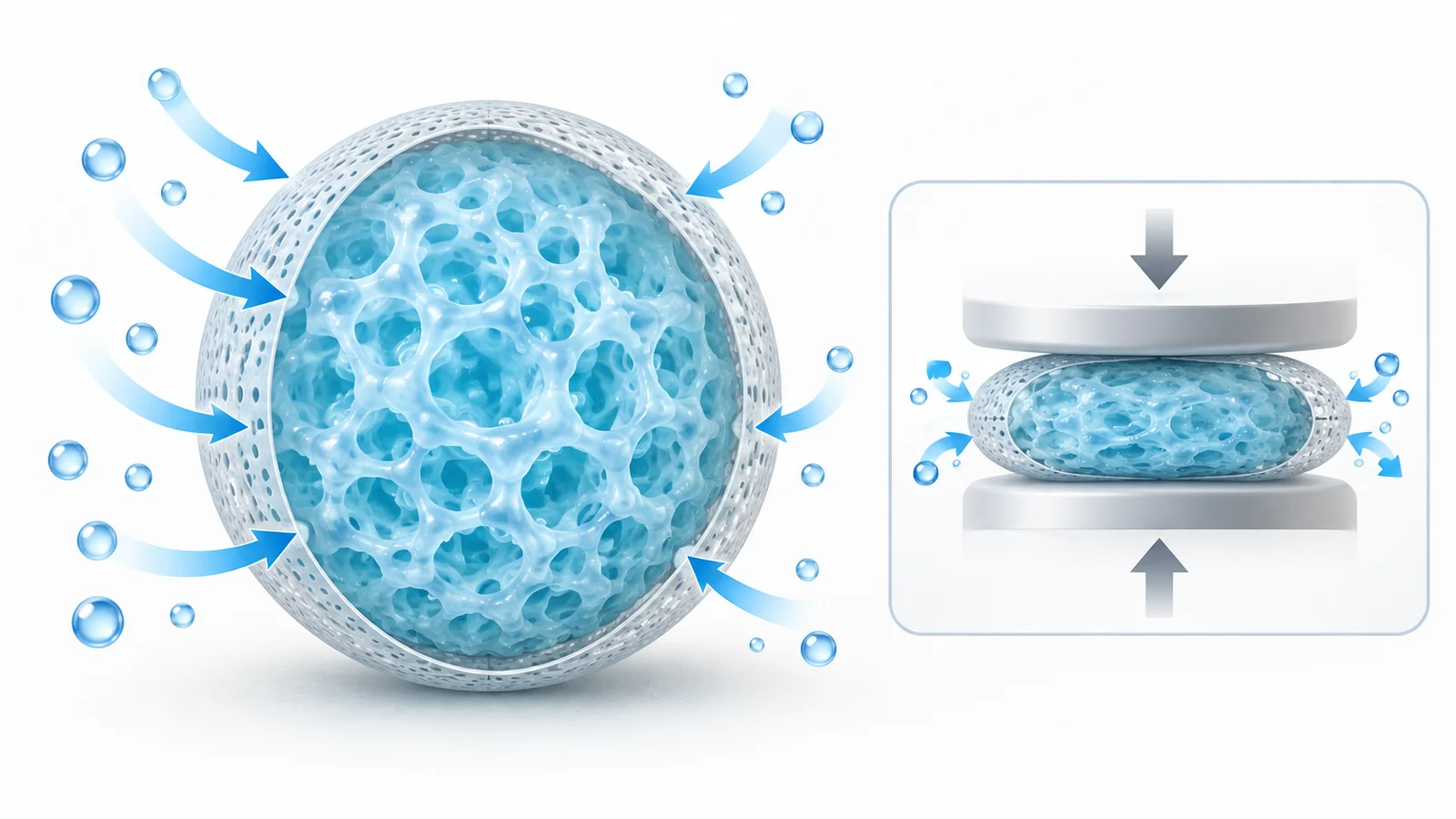
Superabsorbent polymers are materials that can take up and retain large amounts of water or biological fluid relative to their own weight. In a core/shell composite, the central material supplies much of that absorption capacity. Sodium polyacrylate and poly(acrylic acid) are among the types of hydrophilic polymers used for cores. The surrounding shell can be chosen to add strength, change surface properties, regulate swelling, or help control release.
This arrangement allows properties to be combined. A core can be selected for its ability to swell, while a shell may be made from an organic polymer, a polysaccharide, a biodegradable material, or another functional layer. Some designs aim to respond to conditions such as pH or temperature. The review describes the structure as a way to tune a material for a particular use, not as a guarantee that every function will improve at once.
The layers are coupled. A shell that helps contain or regulate a swollen core also affects the route water takes to reach it. Its thickness, uniformity, composition, and bond to the core all influence the behavior of the composite. Changing either layer can therefore change the performance of the whole structure.
Making a shell is a design choice
The review describes several ways to build core/shell materials, including emulsion polymerization, in situ and suspension polymerization, layer-by-layer assembly, sol–gel processing, and electrospinning deposition. The methods offer different kinds of control and bring different production demands; the review does not establish a universal best choice.
Emulsion polymerization is described as a common route for forming core/shell structures. Different monomers or polymers can be used in the core and shell, and the process can provide control over particle size, shape, and composition. The review also notes a practical drawback: residues may remain and affect the final material’s purity or performance.
Layer-by-layer assembly takes a more incremental approach. Materials are deposited in successive layers, which can help control shell thickness and structure under mild conditions. That precision comes with time and scale constraints: building up individual layers can be slow, and the method is described as difficult to use at industrial volumes. Electrospinning can also deposit a shell with controlled properties, though it requires high-voltage equipment. These contrasts illustrate a central manufacturing tradeoff: fine control over a layer has to be weighed against the time, equipment, consistency, and volume needed to make it.
Water must pass through the shell evenly
A core’s absorption capacity is useful only if liquid can reach it. A shell that is too thick, or whose thickness varies from place to place, can make uptake slower or uneven. Thin areas may take up liquid more quickly than thicker ones. If the shell and core are weakly bonded, water may not migrate evenly across their interface, leaving some regions of the core less accessible.
This transport issue can separate a high absorption measurement from reliable behavior in use. A design intended to absorb quickly needs a shell that permits water to reach the core at a suitable rate. A design intended to regulate swelling or release also needs the shell to remain functional as the core expands. The review highlights shell thickness and bonding as factors that can alter both uptake and the distribution of liquid through the material.
One agricultural example discussed in the review makes the distinction between a measured capacity and field performance concrete. Researchers made a slow-release fertilizer composite using a wheat-straw-based superabsorbent layer, with urea and borax among the nutrients in the structure. The review reports water absorbency of 186 grams per gram in tap water for material synthesized under the stated ideal conditions. That result describes a measurement in tap water. It does not by itself tell a grower how reliably the material would retain moisture in soil, release nutrients under field conditions, or affect irrigation needs.
Pressure and repeated use test what capacity alone misses
Absorbed water can escape when an external force compresses the material. Under pressure, the core may be unable to expand fully, and liquid can leak out. A material with a large uptake capacity may therefore retain less water when squeezed or loaded. The review identifies this as a concern for uses where liquid must remain held over time or under force.
Repeated swelling and drying pose another challenge. Each cycle stretches and contracts the core and shell. Over many cycles, that mechanical fatigue can weaken the structure; a wet material may also become softer and more prone to tearing or deformation. Damage can reduce later absorbency and limit the material’s useful lifetime. These concerns matter especially where a design is expected to work repeatedly, rather than perform once in a simple absorption test.
The shell’s role is therefore more demanding than simply covering the core. It has to accommodate the core’s movement while maintaining the structure and liquid pathways the application requires. A shell that controls swelling at first may still prove inadequate if it cracks, loses its bond, or changes the core’s access to water during repeated use.
Persistence, safety and production shape practical choices
Many superabsorbent designs use synthetic polymers that persist after use. The review discusses environmental concerns around long-lived polymer materials, including their potential to accumulate in landfills, soil, and water. It also describes work on biodegradable components and sustainability as part of the search for future designs. A material’s useful performance during service is only one part of the question; what happens to it afterward matters too.
Biomedical applications have additional requirements. The review discusses wound dressings and drug delivery among possible areas of use, but the supplied evidence does not establish a clinical benefit for a particular core/shell material. It also notes that synthetic components or additives may not be fully biocompatible and that increasing absorbent-polymer content can raise concerns about leaching. The balance between fluid retention and safety depends on the intended medical use and the specific material.
Making the shell consistently is another practical hurdle. Nanoscale structures require control over shell thickness and uniformity, specialized equipment, and quality checks across production. More steps and energy may be required. A design that depends on precise layer structure must be reproducible at the intended scale before its laboratory properties can translate into dependable use.
What controlled water release could enable
For growers, a dependable water-retaining material that also releases nutrients at a useful pace could eventually help make agricultural inputs more targeted and reduce losses. That benefit would depend on more than a strong absorption result in tap water: the composite would need to retain and release water and nutrients reliably in soil, withstand use, and be produced consistently without creating unacceptable environmental or safety costs. The review describes a design direction with that potential, while leaving its practical performance conditional on those unresolved demands.
Key Sources
- Primary source: Superabsorbent Core/Shell Composite Materials: A Review on Synthesis, Design and Applications.
DOI or Journal Page · Review or Meta-Analysis · 2025-05-24
Keep exploring