
Research Signal – Source date 2023-02-28
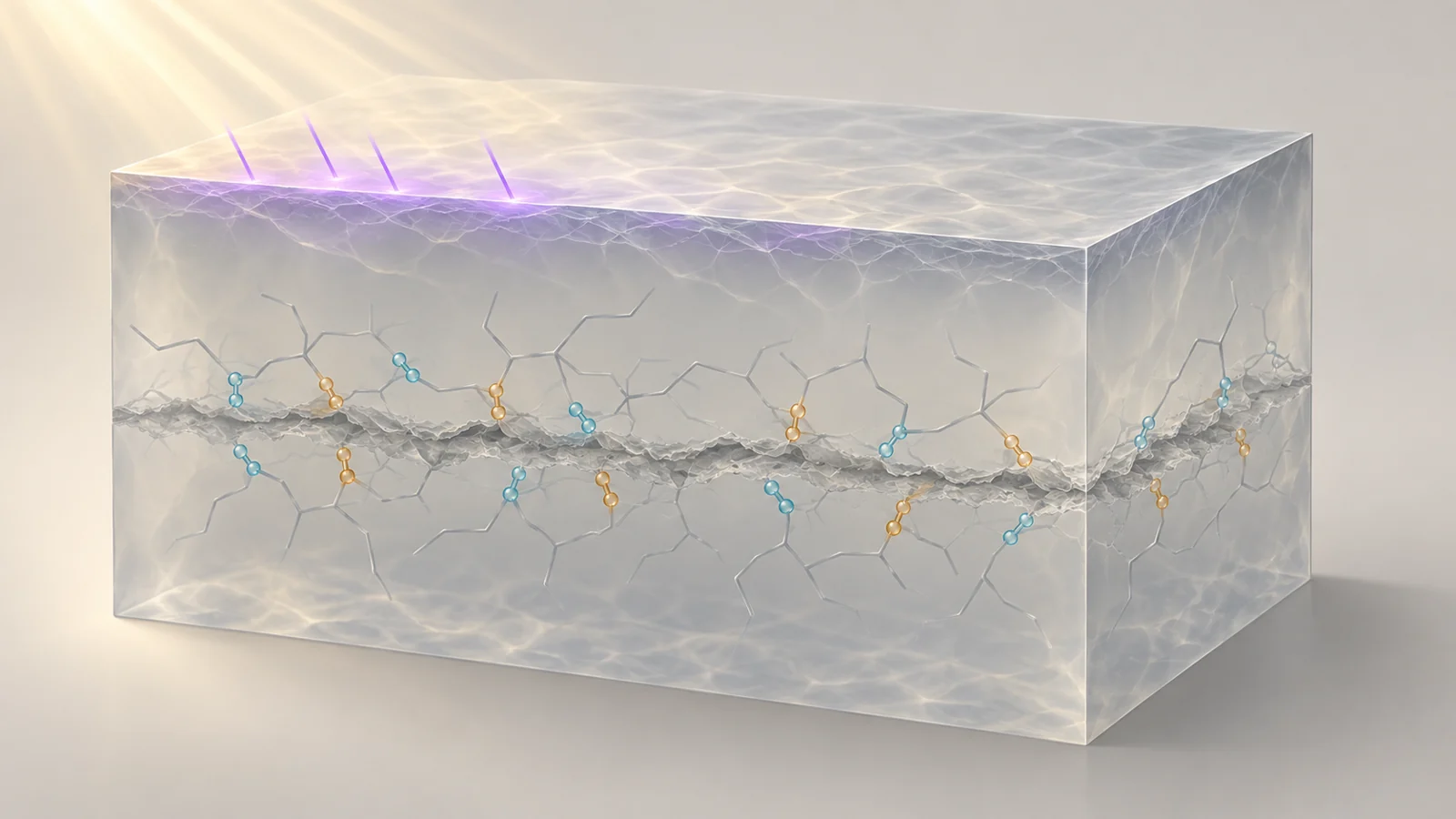
Sunlight can start a repair without directly illuminating the damaged spot, according to a research article dated February 28, 2023. Its authors report that a specially designed polymer could rebond damage up to one centimeter beneath its surface in sunshine. The ultraviolet component of the light, they explain, penetrates only hundreds of micrometers—a fraction of that depth.
The material is a self-healing polymer, meaning a plastic whose internal connections can rearrange to rebond damaged material. The study addresses two problems identified by the authors: the shallow reach of photochemical repair and the limited mechanical performance of previously reported photoreversible polymers. Alongside the repair result, they report substantial strength and stretch. Understanding what those figures measure is essential to judging the promise.
How the connections rearrange
A polymer consists of long molecular chains. Cross-links are connections between those chains, joining them into a network. In this study, the researchers designed cross-linked poly(urethane-dithiocarbamate)s with particular connections that can break and reform through light-triggered chemistry.
The design includes chromophores—light-absorbing molecular groups—called indole groups, together with benzyl groups attached to the reversible dithiocarbamate linkages. The authors describe this chemical arrangement as making carbon–sulfur bonds easier to cleave under light and helping the resulting reactive species take part in further reactions.
Their proposed sequence begins with light absorption and bond cleavage, which generates radicals: reactive species with unpaired electrons. Reactive activity can then transfer among dithiocarbamate linkages, allowing connections within the network to exchange and rearrange. The authors attribute this behavior to chemistry that favors both bond cleavage and radical addition at the sulfur-containing groups.
That transfer is the proposed explanation for the depth result. Light initiates activity near the exposed surface, while exchange among the reversible connections enables rearrangement farther inside. The explanation does not require sunlight itself to travel all the way to the buried damage. The abstract describes the mechanism, but it does not provide enough experimental detail to reconstruct the precise route or timing of that activity through a specimen.
Strength and stretch answer different questions
The abstract reports a tensile strength of 33.8 megapascals and a failure strain of 782.0%. Tensile strength describes the maximum pulling stress a material withstands during a tensile test; stress accounts for the force relative to the specimen’s cross-sectional area. Failure strain describes how far the material lengthens before breaking, relative to its starting length. A strain of 782% means an extension of 7.82 times the original length.
Both properties matter for a repairable material. A component needs to carry loads during use, and its ability to deform before breaking affects how it responds when stretched. The authors attribute their combination of properties to the choice of softer and harder polymer segments, multiple interactions within the material, and the arrangement of cross-links.
Crucially, these numbers do not establish how strong the material becomes after repair. The abstract does not identify them as post-healing measurements or connect them to a percentage of restored performance. A material’s strength, its stretch before failure, and its recovery after damage are distinct results. Measuring the last requires comparing damaged and repaired specimens against an appropriate reference.
The authors describe the mechanical figures as record-high relative to reported photoreversible polymers. That is their comparison within a particular class of materials. The abstract alone does not allow an independent assessment of the comparison’s scope or test conditions, and it does not support a ranking across all self-healing plastics.
What the reported repair establishes
The available account supports an attributed finding of effective recovery of damage at depths up to one centimeter under sunshine. Depth describes where damage lies beneath a surface. It does not mean that a centimeter-wide gap closed, that missing material regrew, or that ordinary plastics share the same capability.
For practical repair, several details would determine how useful the result is. The abstract available here does not specify exposure duration, light intensity, temperature, damage geometry, or whether damaged faces had to be held together. Nor does it give a numerical healing-efficiency measure that would let a reader translate “effective recovery” into a particular fraction of restored strength or another property. Those details cannot be assessed from this abstract; that does not establish that they are absent from the full paper.
The same evidence does not establish durability across repeated repair cycles, outdoor service life, manufacturing scalability, or commercial readiness. These are separate questions from whether the designed chemistry can produce the reported rebonding.
What this could change
If this interior rebonding repeatedly restores useful mechanical performance under workable sunlight exposure conditions, thicker polymer components could become repairable through illumination of their accessible surfaces. A damaged part might then return to service after a controlled repair instead of requiring replacement.
For users of such components, the potential benefit would be longer service life and fewer replacement parts, with corresponding reductions in discarded material. That possibility depends on combining the reported chemistry with dependable recovery in the shapes, loads, and environments a component actually encounters. The study offers a material design that could make that maintenance option possible; replacement savings remain a potential consequence rather than a measured outcome.
Key Sources
- Primary source: Sunlight Stimulated Photochemical Self-Healing Polymers Capable of Re-Bonding Damages up to a Centimeter Below the Surface Even Out of the Reach of the Illumination.
DOI or Journal Page · Peer-Reviewed Paper · 2023-02-28
Keep exploring