
Research Signal – Source date 2026-06-01
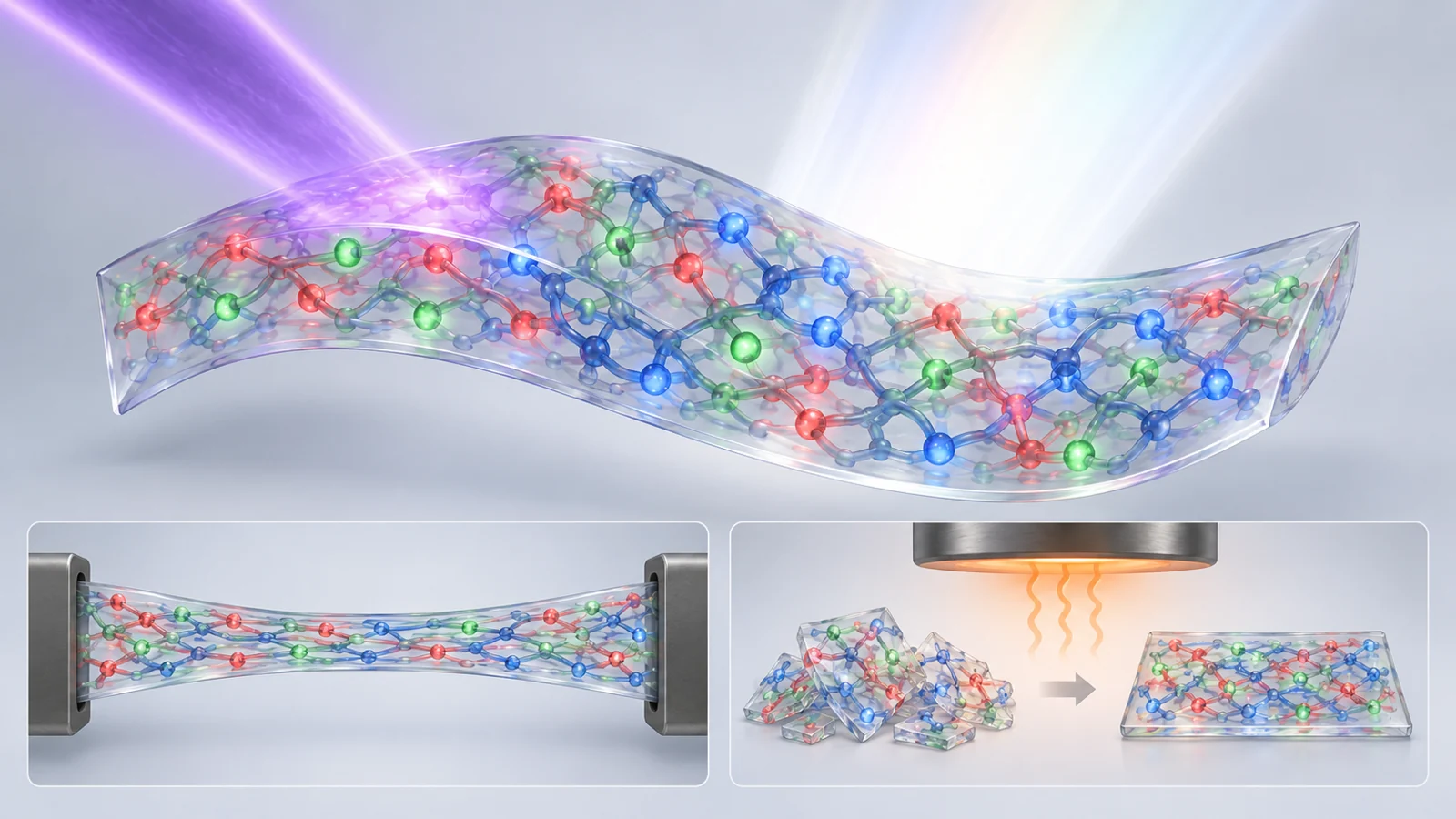
A thin polymer film in this study fluoresced white when illuminated with 420-nanometer light. Its reported white-fluorescence quantum yield was 58.1%. Quantum yield is the share of absorbed photons that are re-emitted as fluorescence. The film’s calculated luminance under that same excitation was 359 candelas per square meter. These figures describe an externally illuminated fluorescent material, rather than a lamp that produces light on its own.
The researchers also reported that the film could stretch, heal a scratch under heat, and be recycled with nearly unchanged measured mechanical and optical properties. The design addresses a stubborn materials problem: combining several colors in one flexible polymer can make the emitters dim and the resulting white harder to tune.
Mixing colors can make the light weaker
White fluorescence depends on combining emissions from different colors in a suitable balance. In polymer materials, that can mean bringing red, green and blue light-emitting ingredients together. Physical blends offer a straightforward route, but their components can separate into uneven regions or cluster. When fluorescent molecules aggregate, their light emission can be quenched, reducing brightness and complicating control of the color mix.
The challenge is therefore not just to put three colors into one film. The emitters need to remain dispersed well enough to contribute to the combined output, while the material still has the flexibility and strength expected of a polymer.
Two networks share the work
The researchers built the film from two polymer networks that interlock. One network carries groups that emit red and green light. A second, epoxy-based network carries blue-emitting side chains. In plain terms, the colors are distributed across connected structures rather than simply stirred together as free ingredients.
The networks are crosslinked by reversible covalent bonds: Schiff base bonds in the red-and-green network and boronic ester bonds in the blue-emitting network. The authors attribute the improved color performance to the interlocking structure’s ability to suppress phase separation. Keeping the emitters more evenly dispersed can reduce aggregation-related quenching and make the balance of colors easier to regulate.
This arrangement also gives the material a way to rearrange. The bonds can exchange under suitable conditions, allowing the network structure to change during heat-assisted repair or recycling. The reversible bonds are part of the light-emitting material itself.
The white output was assessed under light
The study characterized the film’s fluorescence using emission spectra, an excitation–emission map and chromaticity plots. These measurements describe the colors emitted and how their combined output sits in color space. The authors also prepared comparison materials without the interlocking architecture, including a non-crosslinked control and a control with an interpenetrating network. They report that the interlocked design suppresses phase separation and improves white-light regulation.
The 58.1% quantum yield and calculated 359 cd/m² luminance refer to white fluorescence under 420 nm excitation. The film also showed different fluorescence colors as the excitation wavelength changed. That is tunable fluorescence: the observed emission depends on the light used to illuminate the material. It is not evidence of an electrically controlled display, and the reported measurements do not establish electrical device efficiency or performance in a finished lighting product.
Stretching tests asked two different questions
The reported tensile strength was 5.5 megapascals, while elongation at break was 78.5%. Tensile strength describes the stress the sample withstands before breaking; elongation at break describes how far it stretches before that point. Together, the values characterize the film’s strength and stretch range in the reported test. Neither number alone says how it behaves across every kind of repeated or everyday use.
The paper also presents cyclic tensile testing at 50% strain, which probes how the material responds to repeated stretching at that specified extension. Separately, the researchers assessed the film’s white color after 20 stretches. The chromaticity plot records the white fluorescence after 20 stretches; it is separate from the measurements of tensile strength and elongation at break. The authors report that stretching left the original optical properties almost unaffected.
Heat gives the material a route to repair and recycling
To demonstrate scratch healing, the researchers made a scratch about 30 micrometers wide and heated the material at 80°C for six hours. The scratch was reported to close fully under those conditions. This is a heat-assisted repair result, not a demonstration of spontaneous healing at room temperature.
For recycling, the film was treated at 90°C for two hours under 10 megapascals of pressure. The reversible bonds can exchange, while the network topology rearranges. The researchers report that the recycled solid retained nearly unchanged mechanical and optical properties compared with the original material. The result shows recovery after a defined treatment; it does not establish how the film would hold up through a service life of ordinary wear, repeated damage and repair, or other use conditions.
Where a repairable white-light film could help
One possible use, if the optical and mechanical behavior holds up in larger films and real use, is a flexible color-converting layer for a display or lighting assembly that could be repaired with heat or recycled under controlled conditions. This is a proposed use for an externally illuminated material; the paper does not demonstrate a working device or production process.
Key Sources
- Primary source: Reversibly Interlocked Macromolecular Networks Unlock a Stretchable, Self-Healing Polymer With Ultra-High White-Light Quantum Yield.
DOI or Journal Page · Peer-Reviewed Paper · 2026-06-01
Keep exploring