
Research Signal – Source date 2021-03-23
A patient with advanced lung squamous cell cancer had stable disease while receiving pembrolizumab, an immunotherapy drug. After eight treatment cycles, the cancer progressed. At that point, a blood test newly identified a change in STK11, a gene that can be altered in tumors. The timing raises a question: did the change play a part in resistance, or was it unrelated to the progression?
The report, published in 2021, describes one patient and includes a literature review. Its findings offer a possible explanation to investigate, not a settled account of why the treatment stopped holding the cancer stable.
The treatment sequence raises a different resistance question
Stable disease was the patient’s best response to pembrolizumab. That classification does not mean the tumor shrank; it means the reported response did not reach the category of tumor shrinkage or progression. After eight cycles, the disease progressed.
Researchers had already associated STK11 mutations present in a tumor before treatment with lower response to immune checkpoint inhibitors, a group of drugs that includes pembrolizumab. That is a question of primary resistance: the cancer does not respond adequately from the outset. This case raises a separate possibility, acquired resistance, in which cancer that was initially controlled later grows during treatment.
The distinction matters because finding an STK11 mutation after treatment began does not show that it was present in the same form before therapy or that it drove the later progression. The result makes the gene a candidate part of the story, while leaving its timing and role unresolved.
What the blood test found
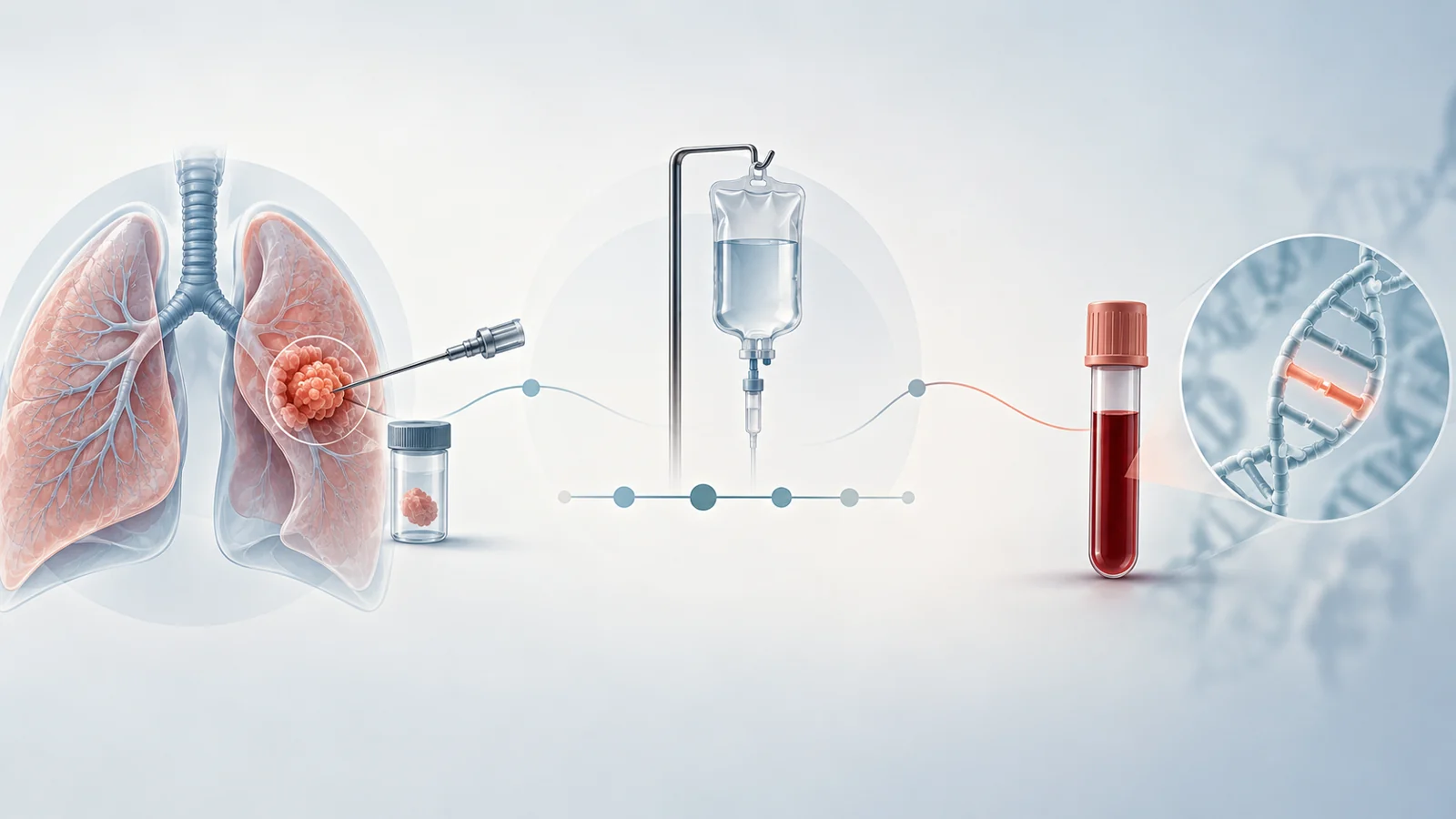
The STK11 mutation newly identified in circulating tumor DNA (ctDNA) was a frameshift, a change that shifts how a gene’s instructions are read. This is DNA shed by a tumor and measured in a blood sample. The result was detected in plasma at progression. That observation does not establish when the mutation arose, whether it was previously present below detection, or whether it was associated with a particular tumor cell population.
The report also describes a biopsy with PD-L1 expression of 50%, a level the authors called high. PD-L1 is a protein measured in tumor tissue that can inform immunotherapy decisions, but this number does not explain why the cancer progressed.
Lynch syndrome did not settle the explanation
The patient also carried a germline MSH6 variant associated with Lynch syndrome, an inherited cancer-predisposition condition. Yet the tumor was classified as proficient mismatch repair, or pMMR. Mismatch repair is a cellular process that corrects certain DNA-copying errors. An inherited variant and the tumor’s reported pMMR classification are both relevant details, but neither resolves why the cancer progressed during pembrolizumab.
The combination made the case unusual: Lynch syndrome is rarely reported in lung cancer, according to the paper. It also makes the interpretation more complex. The STK11 finding cannot be read in isolation from the tumor’s other reported features, and the case does not compare their contributions.
One patient can suggest a hypothesis, not test it
The authors propose that STK11 may have contributed to acquired resistance to pembrolizumab. The observed order—stable disease, progression, and detection of an STK11 frameshift in plasma—supports asking whether the mutation was involved. But a single case cannot establish that it caused progression, show how often this sequence occurs, or determine whether STK11 predicts acquired resistance across patients.
The paper’s literature review places the case in the context of broader questions about immunotherapy response and resistance. The evidence presented here remains a report of one patient, rather than a comparative estimate of risk or a validated treatment guide. It also does not show that changing therapy based on this blood result would improve outcomes.
What an STK11 blood signal could change for lung cancer care
If studies across patients show that an STK11 blood result reliably marks resistance, and that acting on it improves care, clinicians could use that result to help choose treatment after pembrolizumab stops controlling a cancer. This case shows only that the mutation was detected when this patient’s disease progressed.
Key Sources
- Primary source: The influence of STK11 mutation on acquired resistance to immunotherapy in advanced non-small cell lung cancer with Lynch syndrome: a case report and literature review.
DOI or Journal Page · Review or Meta-Analysis · 2021-03-23
Keep exploring