
Research Signal – Source date 2026-02-03
Sleep is not only a period of rest. It is also a time when newly learned information is processed, and researchers can measure parts of that process through brain activity and memory tests. A ClinicalTrials.gov study called “Autophagy-Enhancers to Reduce Sleep Disturbances” is asking whether spermidine, a naturally occurring compound found in foods such as wheat germ and soybeans, affects sleep-dependent memory in adults with subjective cognitive decline or mild cognitive impairment.
The study began on October 28, 2025, according to the registry record. The current record lists it as recruiting, with primary completion estimated for December 2028 and overall completion estimated for May 2029. Those dates describe the trial’s planned lifecycle, not completed results. The supplied record describes an experiment designed to detect possible changes; it does not report that spermidine improves sleep, memory, or everyday cognitive function.
Why autophagy is part of the question
Autophagy is a cellular breakdown and recycling process. Cells use it to handle and reuse components, and the investigators identify it as part of the biological rationale for studying spermidine in the context of aging and cognitive decline. The proposed connection is not that eating a particular food has already been shown to protect memory. It is that a compound with a possible relationship to cellular recycling may also be relevant to biological processes involved in brain maintenance and sleep.
The participants are people for whom the sleep question has particular importance, but they are not all at the same stage of cognitive change. Subjective cognitive decline means a person reports persistent cognitive difficulties even though standardized testing may remain within the expected range. Mild cognitive impairment involves objectively measured impairment that has not substantially disrupted everyday activities. Both groups can have an elevated risk of later dementia, but neither description makes dementia inevitable.
The trial’s rationale links these concerns with changes in sleep architecture, meaning the organization and characteristics of sleep across the night. The study is therefore testing a specific possibility: that an intervention associated with autophagy-related biology might alter measurable sleep processes that help newly learned information become more stable.
The comparison separates treatment from background
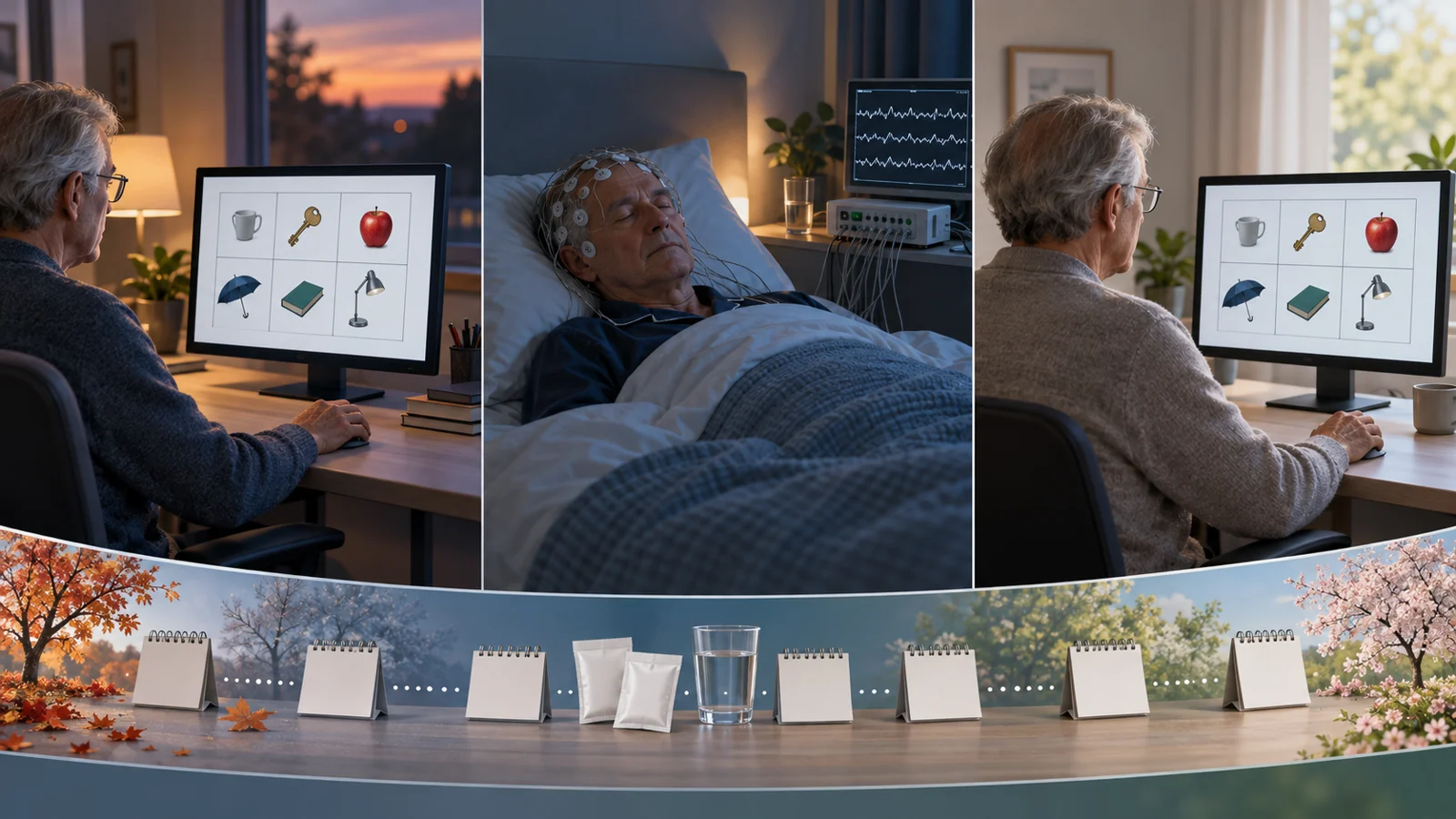
The planned randomized, double-blind, placebo-controlled comparison includes 76 adults aged 55 to 70 with subjective cognitive decline or mild cognitive impairment. Participants are assigned to receive either 6 milligrams of spermidine per day or a placebo for 12 weeks. The placebo sachets are described as identical in appearance and taste and containing microcrystalline cellulose.
Random assignment and blinding help researchers compare the groups without allowing expectations about the supplement to determine who receives it or how assessments are conducted. The placebo group provides the main reference for asking whether changes during the 12-week period are associated with spermidine rather than with time, repeated testing, or participation in the study itself.
A separate group of 38 cognitively healthy adults has a different role. These participants do not receive the supplementation and provide baseline sleep and cognitive measurements that can serve as a healthy reference. They are not a second treatment-control group, and their measurements should not be read as evidence that the supplement changes the difference between healthy aging and cognitive concerns.
The enrollment numbers are planned counts. They do not indicate how many people have completed the study.
From an adaptation night to morning recall
The measurement sequence is built around two overnight assessments. Participants first have an adaptation night, followed by a baseline sleep assessment. They then enter the 12-week supplementation period before returning for a follow-up overnight assessment. Actigraphs worn before the EEG visits are used to monitor sleep-wake cycles and physical activity outside the laboratory nights.
During each main overnight visit, electroencephalography, or EEG, records electrical activity from the brain through scalp electrodes. The study focuses especially on slow-wave activity and sleep spindle activity. These are measurable features of sleep that the investigators connect with sleep-dependent memory consolidation, the process by which information learned before sleep may be retained or reorganized overnight.
The researchers also test remembering directly. One planned visual-spatial task uses 60 objects placed in front of different background scenes. In the evening, participants learn the object locations and complete an initial retrieval test involving 30 images. The remaining 30 images are tested the next morning. Comparing performance across the evening and morning assessments gives the study a way to observe overnight retention rather than relying only on how rested someone feels.
Other cognitive tasks address declarative, procedural, and visuospatial memory. Testing before and after each EEG night allows the researchers to relate performance changes to the sleep recording. The important point is that the study combines two kinds of measurement: EEG describes brain electrical activity during sleep, while the tasks measure how well information is remembered.
What blood measurements can add
Blood samples collected during the EEG visits and two weeks after supplementation begins are intended to examine biological changes alongside the sleep and cognitive assessments. The listed measures include inflammatory markers such as interleukin-6 and tumor necrosis factor-alpha, metabolic indicators including fasting insulin, glucose, and lipid profiles, and markers associated with autophagy and neuroprotective biology.
These samples could help researchers ask whether a change in sleep or memory occurs alongside a measurable change in circulating biology. They may also help characterize how participants respond during the intervention. But a blood measurement is not a direct view of recycling inside a participant’s brain cells. An increase or change in an autophagy-associated circulating marker would not, by itself, demonstrate that spermidine increased autophagy in the brain.
The same caution applies to the study’s larger purpose. A 12-week intervention can test specific sleep and memory outcomes over a defined period. It cannot, from the supplied design description alone, establish lasting benefit after supplementation, dementia prevention, an effective consumer regimen, or treatment safety. No treatment-effect estimates or adverse-event findings are supplied here, so the record should be read as a description of an ongoing human experiment rather than as evidence of a successful intervention.
What this could mean for preserving memory
A nutrition-based approach could eventually be useful for adults with early cognitive difficulties if it produces reproducible improvements in the sleep physiology linked to remembering and in memory performance itself. For that possibility to matter outside a sleep laboratory, the changes would also need to be acceptably safe and connected to improvements that persist in ordinary daily life.
This trial is positioned to test an early part of that chain: whether 12 weeks of spermidine is associated with different overnight brain activity and better retention of learned information than placebo. A positive laboratory result would be a reason for further investigation, not proof that a supplement preserves cognition or prevents dementia. Longer-term cognitive preservation remains an open question.
Key Sources
- Primary source: Autophagy-Enhancers to Reduce Sleep Disturbances
Government or Regulator · Clinical Trial · 2026-02-03
Keep exploring