
Research Signal – Source date 2026-05-20
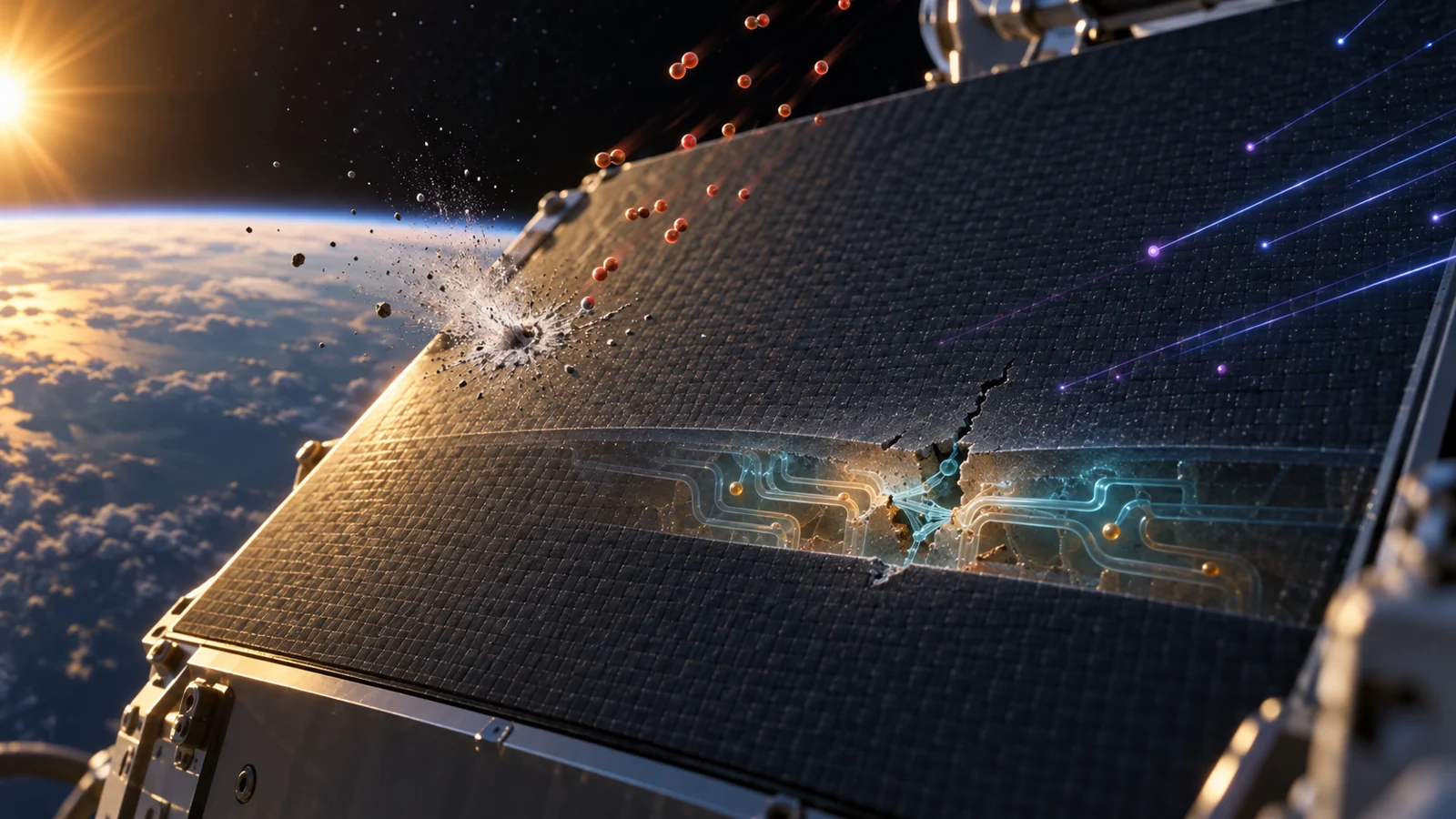
Polymers help make spacecraft lighter and more versatile. They are used in space stations, satellites and spacecraft, where lower mass and adaptable material properties matter. But the conditions that make space a demanding workplace can also wear these materials down, while repairing them in orbit is difficult.
A review published on May 20, 2026, considers a counterintuitive design idea: some of the same environmental stresses that damage polymers might also be used to activate a repair response. The authors call this approach “Harnessing Harshness.” It is a design proposal and survey of emerging approaches, not evidence that a spacecraft material has already demonstrated dependable self-repair in orbit.
When exposure becomes a design input
Self-healing polymers are materials designed to repair damage. The review describes designing them so that an environmental stress can serve as a stimulus for healing. In principle, a material could be made to respond to a kind of damage by activating a repair process, turning exposure into part of the design rather than treating it only as an outside threat.
That idea does not make the hazard harmless. A useful material would need to withstand the exposure and respond in a way that helps restore its function. The review surveys approaches associated with four distinct categories: impacts from micrometeoroids and orbital debris, atomic oxygen, high-energy radiation, and extreme temperature conditions. Each presents a different challenge for polymer durability and a potential source of stimulation for a designed response. The abstract does not establish a common mechanism or show that one category is easier to harness than another.
Four kinds of space stress
Impacts can damage a surface suddenly. Atomic oxygen can erode exposed polymer materials. Radiation brings another form of high-energy exposure, while temperature cycling repeatedly subjects materials to extreme conditions. These are not interchangeable problems: they differ in how they challenge material performance, even though the review groups each among the conditions that might activate self-healing systems.
The practical question is whether a designed response can address damage under the conditions that cause it. A response to one exposure category would not by itself show that a material can handle the others, or that it can keep doing so during spacecraft operations. The review’s abstract identifies recent approaches across these categories but does not provide comparative performance results or numerical validation.
Repair that can respond to damage
The review also discusses combining self-healing with damage sensing and adaptive repair. Sensing could add information about whether or where damage has occurred; adaptive repair could let a response be coordinated with that information. This would add a layer beyond a material reacting to exposure alone: the system could connect detection with a repair response.
That combination remains an emerging strategy in the account provided. The supplied evidence does not establish a new material proven to repair itself in orbit, quantify longer spacecraft service life, or measure reductions in debris or maintenance costs. A review of design approaches can help organize what researchers are trying to achieve, but dependable performance under relevant orbital conditions would need to be demonstrated before those operational benefits could be counted on.
What self-repair could change in orbit
For spacecraft operators, reliable repair of exposure damage could mean materials that last longer between interventions, easing maintenance demands and potentially reducing space debris. Those benefits depend on materials that can repair the relevant damage consistently in the actual space environment. The review sets out a route toward that possibility; the operational payoff remains conditional on proving the materials can deliver it.
Key Sources
- Primary source: Harnessing harshness: Leveraging extreme space conditions for self-healing polymer materials.
DOI or Journal Page · Review or Meta-Analysis · 2026-05-20
Keep exploring