
Research Signal – Source date 2022-07-01
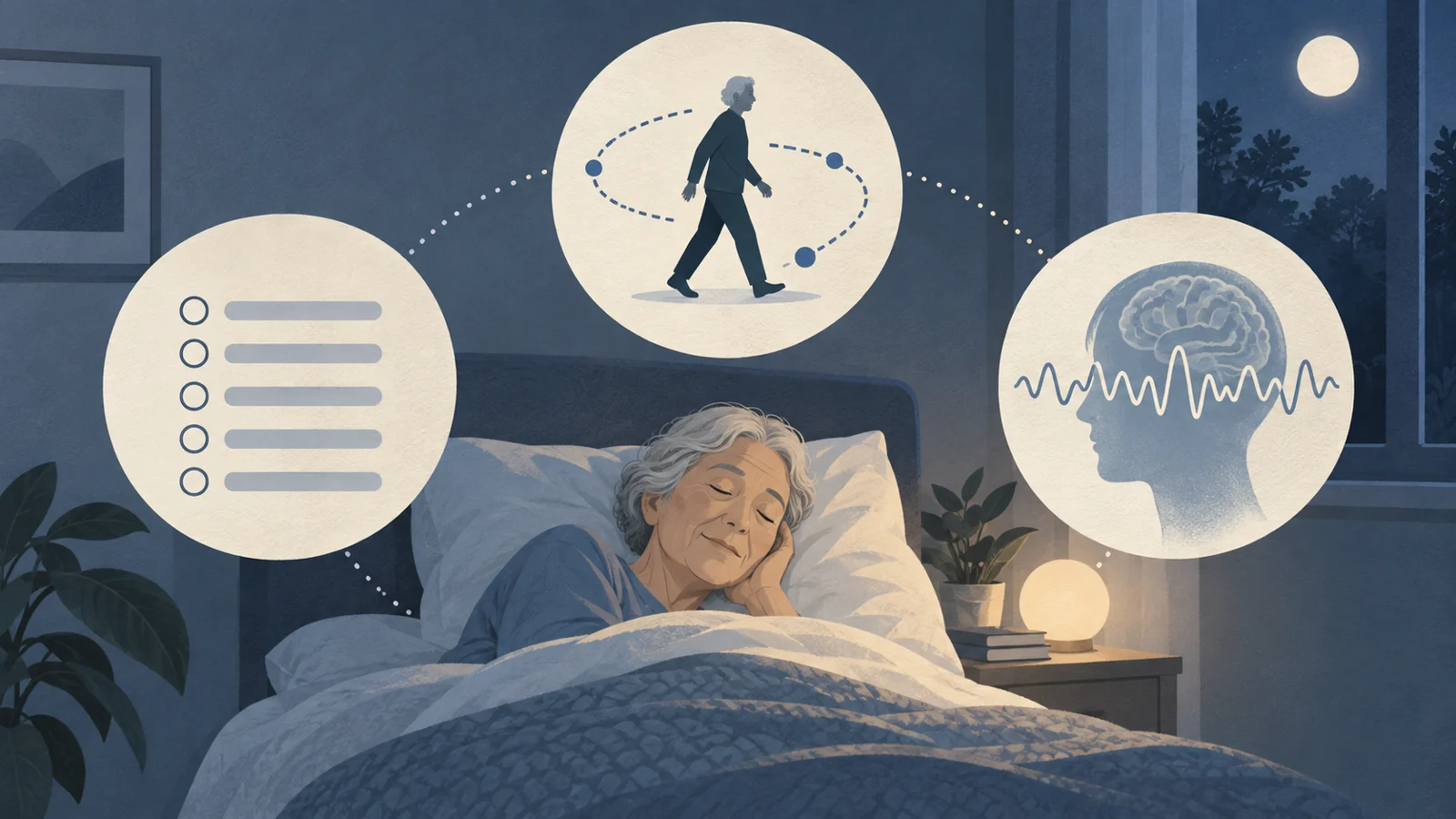
Someone with early memory problems says they are sleeping better. Perhaps their nights feel less disturbed, they spend more time asleep, or they feel less sleepy during the day. A recording might reveal changes in sleeping brain activity. Each observation answers a different question, and the phrase “sleep improved” leaves those differences hidden.
A scoping review published in July 2022 examines how researchers measure sleep in people with mild cognitive impairment—early problems with memory or thinking—and early dementia. It brings together 188 reports from 178 unique studies, with an estimated 17,139 unique participants. Its subject is how sleep has been studied, rather than whether a particular treatment works. For readers trying to interpret a claim about better sleep, it offers a useful starting point: identify exactly what changed and how that change was observed.
The experience of sleep and the signals of sleep
Questionnaires and diaries were the most frequently used measurement category in the included research. These can capture aspects of sleep that matter directly to people, including perceived sleep quality, insomnia symptoms and daytime sleepiness. They are relatively easy to administer and place little burden on participants. Relief from a distressing night or a less sleepy day can be a worthwhile outcome in its own right.
Different questionnaires, however, address different experiences. A measure of daytime sleepiness does not answer the same question as a measure of nighttime sleep quality. The review also notes discrepancies between subjective and objective sleep disturbance in people with mild cognitive impairment or early dementia. Remembering and describing sleep can be difficult in this population. A validated questionnaire remains useful, but its frequent use does not make it interchangeable with other tools.
Movement recording, known as actigraphy, provides a different view. It uses patterns of activity and rest to estimate sleep and wakefulness. Polysomnography, a physiological sleep study, records signals that allow researchers to examine sleep stages and disturbances such as disordered breathing. Movement alone does not supply the same information as recorded brain activity, and neither recording directly describes how satisfying a night felt.
The authors therefore favor using objective measurements alongside validated questionnaires. The combination can connect an experienced benefit with a recorded change. It also allows those observations to differ without automatically dismissing either one. Someone’s account of a more comfortable night and a physiological description of that night have distinct roles in understanding the result.
The diagnosis changes the question
The people being measured matter as much as the instruments. Mild cognitive impairment is a broad clinical category, and it does not identify a single underlying disease. People grouped under that label can have different causes of their cognitive difficulties. A similar sleep observation across the group may therefore have different biological meanings.
In the review, the underlying cause was unspecified for 60.6% of participants with mild cognitive impairment. This limits how precisely a sleep characteristic can be connected to a particular disease process. For example, finding a sleep pattern in a mixed group with memory problems would not, by itself, establish that the pattern identifies early Alzheimer’s disease.
The authors advocate more clearly characterized groups and avoiding aggregate reporting across mixed causes where possible. They acknowledge that identifying the underlying cause can require brain imaging or fluid biomarkers and can be difficult before dementia develops. That difficulty is central to interpreting the science. A broad diagnosis can describe who needs help while leaving unresolved why their sleep and cognition have changed.
Looking beyond the number of hours slept
A total sleep duration compresses a night into one number. Researchers can also examine the organization of sleep stages and the finer patterns of brain activity within them. These fine-scale features, often called sleep microarchitecture, include slow oscillations and brief bursts of activity known as sleep spindles.
The review discusses research linking such patterns with memory processes and features of dementia pathology. It describes the proposed involvement of coordinated sleeping brain activity in memory consolidation, while identifying a gap between findings in other settings and evidence in people with early symptomatic Alzheimer’s disease. Across the included literature, fine-scale sleep measures were reported in just 12 studies involving 360 participants. The interest in these observations was much broader than their use in the population being reviewed.
Daily sleep–wake rhythms offer another perspective. They concern how rest and activity are organized across the day and from one day to the next. Two people could accumulate similar amounts of sleep while having different daily patterns. Circadian measures were relatively underrepresented in the included research, leaving less detail about this dimension of sleep than about more commonly reported outcomes.
Home brain-wave recording could make some physiological observations easier to obtain. The authors found non-polysomnographic electroencephalography, or EEG, in only three studies involving 74 participants. They describe its potential for longer monitoring at home and for reducing the unfamiliarity and discomfort of laboratory visits, which can be especially challenging for people with cognitive impairment.
That potential comes with a population-specific validation problem. The review identifies limited validation in older adults and people with cognitive impairment as a possible reason for slow adoption. Its discussion concerns research access to brain activity during sleep. It does not establish that consumer wearables can diagnose dementia or replace clinical sleep assessment.
What a shared set of outcomes would mean
After combining synonymous terms, the authors still identified 165 separate sleep parameters. Of these, 62 appeared only once, and 97 appeared in at most two studies. Breadth can help researchers explore unfamiliar territory. But when studies report substantially different outcomes, readers cannot readily judge whether two interventions produced similar benefits or whether one addressed a problem the other did not measure.
The authors call for international agreement on a core, expandable outcome set. This would be an agreed minimum of outcomes for studies to report, with room for additional questions. Research on insomnia and research on sleep apnea could retain different primary targets while contributing some shared information. The review proposes developing that agreement; it does not announce a completed, internationally adopted set.
An outcome and its instrument are separate choices. Total sleep time, for instance, is an outcome; a diary or a recording system is a means of estimating it. Agreeing to report sleep duration would still leave researchers needing clear definitions and an explicit account of how it was measured. Likewise, agreeing to assess perceived sleep quality would not make all questionnaires equivalent. The proposed common ground concerns both what a result means and how it is described, while preserving the freedom to investigate more specialized features.
The limits of this evidence
The review searched five databases from their inception through March 12, 2021. That is its literature-search endpoint; the July 2022 publication date does not extend its coverage. It included English-language, peer-reviewed research across several experimental and observational designs. As a scoping review, it was designed to characterize reported sleep outcomes, and the authors did not assess study quality or perform a risk-of-bias analysis. Counts of studies and participants therefore describe research activity without establishing how dependable a particular treatment finding is.
Selection also shapes what the findings can tell us. Studies needed to begin with at least a subgroup already diagnosed with mild cognitive impairment or early dementia. Longitudinal studies starting with healthy people and examining who later developed dementia fell outside that focus. The findings consequently cannot be treated as a general assessment of sleep-based dementia-risk prediction.
Some included groups could contain people with more advanced dementia, although most participants in those groups had mild disease. The authors also acknowledge uncertainty in identifying participants reported across multiple papers, so the unique-participant total is an estimate. Together, these choices limit how far the findings extend across dementia stages and diagnoses. This work does not establish that improving sleep prevents dementia or slows its progression.
What this could change
If future trials combine shared outcomes, clearer diagnoses and measurements of both experienced benefit and relevant physiology, clinicians could gain a more useful basis for choosing sleep treatments for people with mild cognitive impairment or early dementia. They could better distinguish interventions that ease nighttime symptoms or improve daily wellbeing, weigh those benefits against side effects, and judge which findings apply to a particular patient group. The practical payoff would be better-informed choices about relief that matters to people—while keeping evidence of better sleep separate from the further evidence needed to show slower disease progression.
Key Sources
- Primary source: The past, present, and future of sleep measurement in mild cognitive impairment and early dementia-towards a core outcome set: a scoping review.
DOI or Journal Page · Review or Meta-Analysis · 2022-07-01
Keep exploring