
Research Signal – Source date 2023-06-25
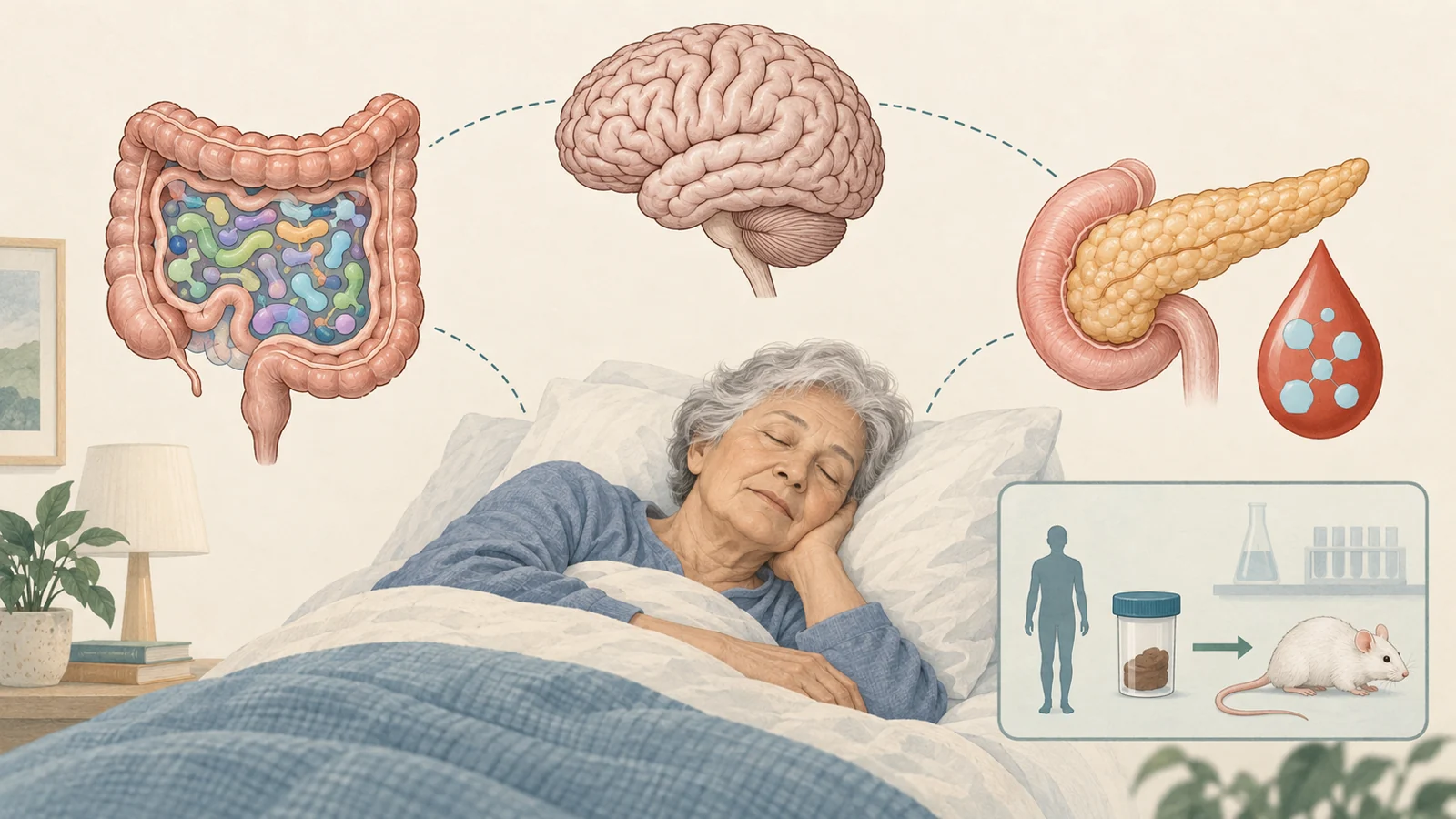
When disrupted sleep accompanies dementia, it is tempting to ask which came first. Did changes in the brain disturb sleep, or did years of disturbed sleep help make the brain vulnerable? A narrative review published on June 25, 2023, considers influence in both directions, with blood-sugar regulation and gut microbes potentially helping to explain the connection.
The authors describe a possible self-reinforcing relationship. Neurodegeneration can affect the brain’s central body clock, making sleep less orderly. Fragmented sleep, in turn, may interfere with processes that clear potentially harmful proteins from the brain, while sleep deprivation can activate inflammatory pathways. Metabolic disturbances could add another source of strain. This offers a biological explanation for why sleep problems, type 2 diabetes and cognitive decline might occur together, without establishing one inevitable sequence from poor sleep to dementia.
The paper’s contribution is to bring these areas of research into the same discussion. Its most intriguing extension concerns the gut microbiota—the community of microbes living in the gut—and whether changes there could carry some effects of sleep disruption to other parts of the body. That possibility raises a practical question: could treating sleep problems or changing gut microbes eventually help protect cognition?
Why insulin matters inside the brain
Insulin resistance means that cells respond less effectively to insulin signals. In the rest of the body, this can undermine blood-sugar regulation and is central to type 2 diabetes. Within the brain, insulin signaling also supports functions that reach beyond the amount of glucose circulating in the blood.
The review describes insulin receptors in the central nervous system and their involvement in neuronal metabolism, survival and communication. Insulin-related signaling helps regulate how receptors and ion channels are positioned on nerve cells, affecting the machinery through which those cells exchange messages. It also contributes to the maintenance of connections between neurons. These functions provide a concrete bridge between metabolism and cognition: an impaired response to a metabolic hormone can affect how brain cells work together.
The authors discuss altered insulin signaling in Alzheimer’s disease alongside inflammation and cellular stress. But the shared biology does not make Alzheimer’s disease and type 2 diabetes interchangeable diagnoses. The common mechanisms remain incompletely understood, including how much each contributes to cognitive decline.
Interrupted breathing and disrupted timing pose different problems
“Poor sleep” covers several biologically different experiences. Obstructive sleep apnea involves interrupted breathing, repeated sleep fragmentation and episodes of reduced oxygen. Circadian misalignment involves a mismatch in the timing of sleep, activity and eating. Both can affect metabolism, but they do not expose the body to the same conditions.
For sleep apnea, the review describes a particularly concrete feedback process. Sleep disruption can interfere with appetite regulation and metabolic control, encouraging weight gain. Increased fat around the upper airway can then worsen breathing obstruction. Repeated fragmentation and low oxygen add further metabolic stress, including effects on insulin responsiveness. Here, the relevant exposure includes what happens to breathing throughout the night, as well as how much sleep a person gets.
Timing adds another dimension. The brain’s central clock coordinates daily rhythms with clocks in organs such as the liver, pancreas and intestine. Those organs also respond to cues from eating and other daily activities. Their work is therefore organized around time as well as demand: processing a meal takes place within a changing physiological schedule.
The review points to night-shift workers as a human example of circadian disruption associated with higher type 2 diabetes risk. Studies it discusses observed reduced function of insulin-producing pancreatic cells and higher glucose concentrations after meals during night shifts. These observations help explain why counting hours asleep cannot fully describe a sleep-related metabolic exposure. When sleep and meals occur can matter alongside duration, while apnea adds the distinct burden of disrupted breathing.
What moving gut microbes into mice can reveal
Comparing microbial communities can show that people with different health conditions harbor different microbes. It is harder to tell whether those differences influence illness, follow from it, or reflect other features of their lives. A transfer experiment approaches the question differently by testing what happens when material from one host enters another.
The review describes experiments in which fecal microbiota from sleep-deprived human donors were transferred into germ-free mice. The sleep deprivation belonged to the human donors; the inflammatory and metabolic changes were measured in the mouse recipients. Keeping that distinction clear is essential to understanding the result.
After colonization, the mice showed increased gut permeability, sometimes called gut leakage, and higher circulation of bacterial products such as lipopolysaccharides, which can stimulate inflammation. Researchers also observed changes in inflammatory signaling in brain regions involved in cognition, including the hippocampus and prefrontal cortex. Several signals promoting inflammation increased, while anti-inflammatory activity decreased.
Microbial chemistry changed as well. The recipients had lower stool concentrations of short-chain fatty acids, including acetate, propionate and butyrate, and lower circulating butyrate. The review also describes poorer cognitive performance in transplanted mice, interpreted as potentially related to inflammation associated with the transferred microbiota.
This experimental approach gives microbes a more active role in the investigation. Researchers are testing whether transferring a community associated with an exposure can produce changes in a recipient, beyond observing that two microbial profiles differ. The findings support investigating gut microbes as a possible intermediary in the effects of sleep deprivation. They do not demonstrate that dementia passes between people, or that transplanting different microbes would prevent dementia in a human recipient.
Where the treatment argument remains unfinished
The evidence assembled in this paper answers several different questions. Human observations connect sleep disruption with metabolic disease and dementia. Experiments can examine biological responses under controlled conditions. Molecular findings identify processes through which an effect might occur. Together, these make the proposed connections plausible, but they do not establish the entire sleep–microbiota–metabolism–dementia pathway as a causal sequence in people.
The authors explicitly describe their method as a narrative state-of-the-art review. They searched PubMed/Medline using combinations of terms concerning sleep, inflammation, insulin resistance, diabetes, neurodegeneration and gut microbes. They considered research articles and reviews, excluding gray literature and non-English material. This approach allows them to connect findings across fields; interpreting those connections still requires keeping each study’s subjects and measurements in view.
That is especially important for the microbiota–dementia relationship, which the authors describe as predominantly studied in animals. They discuss mouse experiments in which some probiotic strains were associated with reduced amyloid-beta deposition, inflammatory activity and cognitive deficits. Such results identify potential therapeutic targets. Changes in a mouse’s brain chemistry or performance on cognitive tasks, however, do not by themselves establish that a probiotic preserves memory or prevents dementia in people.
The same translation problem appears in the discussion of diabetes drugs. Preclinical findings suggest possible cognitive protection from several classes of glucose-lowering medication. Yet the review reports contrasting results in population studies of cognitive benefits, with substantial differences in study design complicating interpretation. A plausible insulin-related mechanism therefore cannot establish that a particular medicine prevents cognitive decline.
The central gap is clinical. Better sleep, altered microbial composition and lower inflammatory markers are different outcomes from a lasting reduction in dementia or preserved everyday function. The review’s therapeutic proposals remain research possibilities, and its conclusion acknowledges the lack of high-quality evidence for those approaches. It does not establish that improving sleep, taking probiotics or using glucose-lowering medication prevents or treats dementia in an individual patient.
What this could change
If the proposed pathways materially influence human disease, they could expand care for people facing both metabolic problems and cognitive vulnerability. Targeted treatment of a specific sleep disorder could potentially do more than improve nights: reducing the associated metabolic or inflammatory disturbance might also help preserve brain function. Eventually, a microbiota-directed therapy could offer another way to modify a relevant biological process, provided researchers can identify which changes matter and alter them reliably.
Realizing that possibility would require interventions that produce durable clinical benefits with acceptable safety. From the June 2023 perspective of this paper, the potential payoff is a more coordinated approach to care—one in which addressing sleep and metabolic health, and perhaps selected microbial processes, helps vulnerable people maintain memory, daily abilities and independence for longer.
Key Sources
- Primary source: A State-of-Art Review of the Vicious Circle of Sleep Disorders, Diabetes and Neurodegeneration Involving Metabolism and Microbiota Alterations.
DOI or Journal Page · Review or Meta-Analysis · 2023-06-25
Keep exploring