
Research Signal – Source date 2025-08-31
Sleep problems are common in neurodegenerative disease. The harder question is when they begin and what they mean: can disrupted sleep help reveal disease before other symptoms appear, and could improving sleep affect what happens next?
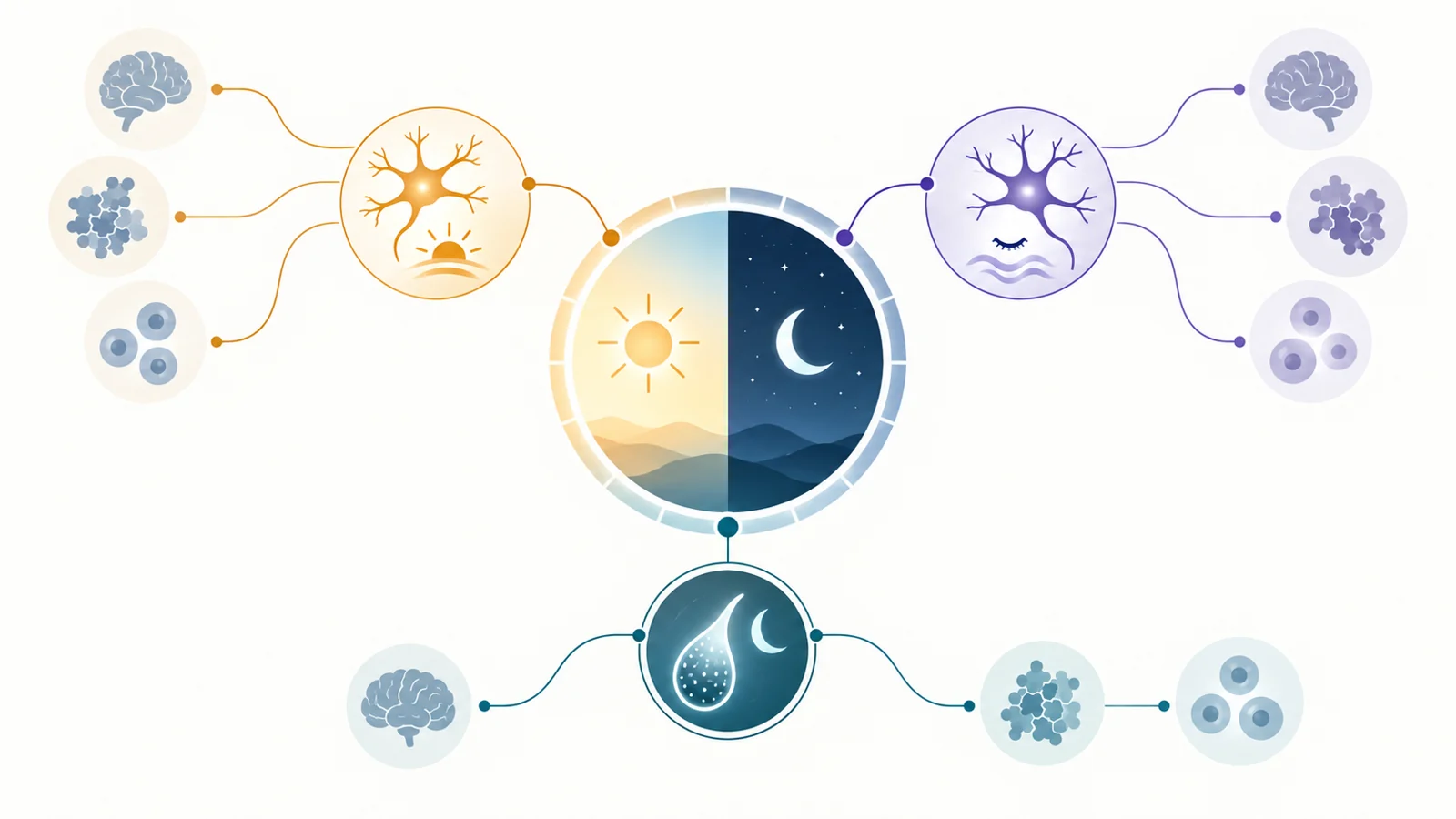
A review published on August 31, 2025, brings together research on sleep and daily rhythms in Alzheimer’s, Parkinson’s, Huntington’s disease, amyotrophic lateral sclerosis (ALS) and frontotemporal dementia. It considers three regulators—melatonin, orexin and melanin-concentrating hormone—alongside patient observations, clinical intervention reports and animal-model findings. The work is a synthesis of existing research, not a report of one new treatment result.
Sleep has several clocks and circuits
Sleep timing reflects an interaction between the body’s near-24-hour circadian rhythm and homeostatic sleep pressure, which builds during wakefulness and changes the depth and structure of sleep. The brain’s central clock helps synchronize daily rhythms with cues such as light, food and social activity. These timing signals work alongside neural circuits that promote wakefulness or sleep.
Orexin, also called hypocretin, is produced by neurons that help sustain wakefulness. Melanin-concentrating hormone (MCH) neurons are involved in REM sleep. Melatonin, released by the pineal gland around the onset of darkness, acts as a timing signal. They are parts of a connected system, but they do different jobs; a change in one does not stand in for a measurement of the others.
Age also changes this system. The review describes a gradual shift toward earlier sleep and wake times, changes in sleep quality and architecture, and declining melatonin with age. It also notes altered function of orexin and MCH neurons. These changes matter when interpreting sleep in older people: a disrupted rhythm can have several possible contributors, and age-related changes alone do not identify a neurodegenerative disease.
The sleep pattern depends on the disease
Parkinson’s disease illustrates how sleep disruption may involve the same brain systems that regulate alertness. The review describes lower orexin levels in cerebrospinal fluid and fewer orexin-positive neurons, alongside loss of MCH-positive neurons. People with Parkinson’s may experience excessive daytime sleepiness, insomnia, sleep apnea and other sleep problems. REM sleep behaviour disorder (RBD), in which the usual muscle stillness of REM sleep is absent and a person may act out dreams, is also associated with Parkinson’s.
In ALS, sleep can be disrupted through a different route. As respiratory muscles weaken, breathing may become inadequate during sleep, contributing to apnea or hypoventilation. The review also discusses fragmented sleep, reduced restorative sleep and other reported disturbances, including findings in people with presymptomatic gene variants. Animal models add clues about altered sleep and daily rhythms, but each model captures only part of a complex human disease.
Alzheimer’s disease brings together circadian changes and other disease processes. The review describes altered rhythms and reduced melatonin in models, as well as elevated cortisol in patients. It also discusses orexin findings that vary across studies: some reports find higher cerebrospinal-fluid orexin associated with amyloid burden, while others find no significant difference. That variation cautions against treating a single hormone level as a settled account of the disease.
These examples point to different routes into poor sleep: damage to sleep-regulating circuits, changes in daily timing, breathing impairment, or more than one process at once. A sleep complaint can be important to a person’s wellbeing even when it does not identify which route is involved.
Early change is not the same as prediction
RBD provides a concrete example of sleep symptoms that can precede recognizable Parkinson’s disease. The review describes it as a prodromal marker that may appear five to fifteen years before Parkinson’s onset. That makes it relevant to studying early disease processes, but it does not mean that a sleep symptom by itself reliably predicts an individual’s future diagnosis.
The review also points to changes in sleep microarchitecture—fine-grained features such as sleep spindles and slow oscillations—that have been associated with amyloid and tau burden in Alzheimer’s and cognitive decline in Parkinson’s. It discusses early sleep alterations in ALS and Huntington’s as well. These observations make sleep a candidate area for closer study and, potentially, earlier assessment. Establishing a useful biomarker would require evidence that a defined measure can distinguish disease risk and predict outcomes over time in people.
A possible two-way relationship
Neurodegeneration can disturb sleep by affecting the neural networks that control wakefulness, REM sleep and circadian timing. In ALS, the physical effects of disease on breathing can add another source of nighttime disruption. The consequences may then run in the other direction: the review discusses evidence that fragmented or insufficient sleep could affect processes involved in brain function and disease.
One proposed route involves the brain’s clearance of substances such as amyloid-beta and tau. The review describes sleep disruption as potentially impairing this clearance, and links fragmented sleep with changes relevant to memory and synaptic function. These are proposed mechanisms for a feedback loop, not proof that treating sleep disruption will slow neurodegeneration in people. Better sleep and altered disease progression are distinct outcomes, and evidence for one does not establish the other.
Treatments target different parts of the system
Melatonin is the most direct example in the review of a timing signal considered across diseases. Patient reports in Parkinson’s describe improved sleep quality, restored circadian rhythms and less fragmentation with melatonin. Other findings come from models: the review describes reduced amyloid and tau pathology in Alzheimer’s disease models, restored rhythms in a fruit-fly model of Huntington’s disease, and effects in ALS models. Those model results do not show that melatonin changes the course of these diseases in people. A frontotemporal dementia clinical trial discussed in the review also found worsened apathy, underscoring that effects may differ by condition and outcome.
Orexin-blocking medicines approach sleep from the wake-promoting side. The review discusses suvorexant, a dual orexin receptor antagonist, in Alzheimer’s clinical studies reporting better sleep and changes in amyloid and tau measures. It also describes cognitive and sleep findings in Huntington’s and ALS models. Clinical reports and model experiments answer different questions; they cannot be combined into one established treatment effect across diseases.
Non-drug approaches are also part of the picture. For Alzheimer’s, the review describes reports involving behavioural interventions, morning light therapy and continuous positive airway pressure (CPAP), with improvements in sleep-related measures and cognitive function. The approaches differ in what they address, and the review’s examples do not make them interchangeable or establish one general intervention for every disease.
MCH shows how a biologically interesting finding can run into a practical delivery problem. Supplementation in Alzheimer’s and Parkinson’s models was delivered directly into the brain, and ALS models showed partial sleep-related effects. MCH does not cross the blood–brain barrier, so the delivery used in these experiments does not translate readily into an ordinary treatment. Finding a way to target this system at the right time remains a separate challenge from showing that it can affect sleep in a model.
What earlier sleep care could make possible
If longitudinal studies show that specific sleep changes reliably flag elevated disease risk, clinicians could gain an earlier way to identify people who may benefit from closer assessment. If carefully tested interventions then show that improving sleep also changes disease outcomes in people, sleep care could become part of efforts to preserve health—not only a response to nighttime symptoms. The review makes those possibilities worth investigating; turning them into clinical use depends on validating the measures and separating sleep improvement from disease modification.
Key Sources
- Primary source: Sleep in neurodegenerative diseases: A focus on melatonin, melanin-concentrating hormone and orexin.
DOI or Journal Page · Review or Meta-Analysis · 2025-08-31
Keep exploring