
Research Signal – Source date 2021-01-18
Sleep problems can seem secondary beside memory loss, movement changes or psychiatric symptoms. In neurodegenerative disorders, however, disturbed nights and daytime alertness can become some of the most disabling parts of daily life. They may reduce quality of life, create safety concerns and add to the strain on caregivers.
The January 2021 review Circadian and Sleep Dysfunctions in Neurodegenerative Disorders—An Update examines why sleep deserves attention in Alzheimer’s disease, Parkinson’s disease and Huntington’s disease. Its central biological question runs in two directions: are sleep and circadian problems consequences of neurodegeneration, or might they also influence the processes that damage the nervous system?
The review does not answer that question with one experiment or one treatment result. Its contribution is a cross-disease synthesis of clinical observations, physiological rhythms, molecular mechanisms and therapeutic research. The picture that emerges is important precisely because it is uneven. Sleep disruption is common across these diseases, but its causes, timing and clinical meaning can differ substantially.
The body clock reaches beyond the night
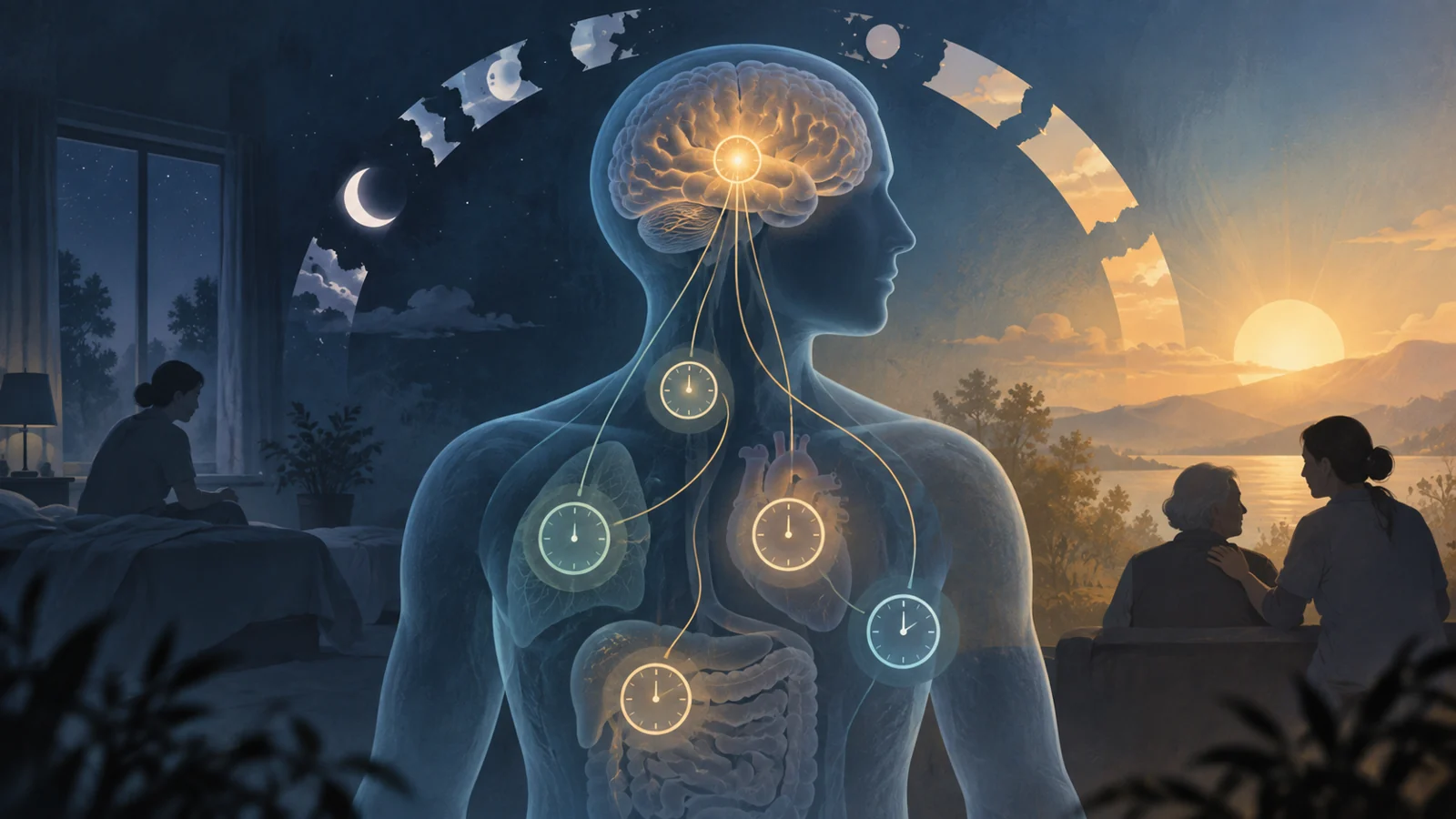
Circadian rhythms are the body’s daily timing system. They help coordinate sleep and wakefulness, but also regulate processes such as hormone release, cardiovascular activity, body temperature and urine production. A central timing structure in the brain, the suprachiasmatic nucleus, communicates with clocks in other tissues through neural connections and circulating signals.
This makes circadian dysfunction broader than simply sleeping badly at night. The review describes altered cortisol rhythms, disrupted or reversed daily patterns in blood pressure and heart-rate variability, changes in melatonin timing, altered urine excretion and impaired body-temperature rhythms in Alzheimer’s, Parkinson’s and Huntington’s disease. These findings point to a problem of coordination among timing systems, not just a complaint about bedtime.
The distinction matters clinically. A person may experience fragmented sleep, excessive daytime sleepiness or frequent naps while the underlying disruption also affects physiological rhythms that are less visible to patients and caregivers. The review describes this as a form of systemic circadian desynchrony. In its discussion, inflammation, oxidative stress and impaired communication between central and peripheral clocks are among the processes that may connect neurodegeneration with disrupted timing.
Molecular studies had begun to identify links between neurodegenerative processes and the genetic machinery of the circadian clock by the review’s publication date. Translating those findings into treatments that restore a strong but flexible daily rhythm, however, remained unfinished work.
One complaint can have several disease-specific causes
In Alzheimer’s disease, sleep often becomes fragmented, with shorter total sleep time and more daytime sleepiness or napping. Evening behavioral changes and agitation, commonly described as sundowning, can affect both patients and caregivers. The review also describes changes in sleep architecture, including less slow-wave sleep and alterations in sleep spindles, K complexes and REM sleep. Obstructive sleep apnea had increasingly been recognized as relevant to cognitive impairment in affected patients.
The Alzheimer’s discussion also illustrates the two-way nature of the question. The review summarizes evidence associating disturbed sleep with later Alzheimer’s risk and describes links between reduced slow-wave sleep and beta-amyloid levels. At the same time, Alzheimer’s-related pathology may itself interfere with sleep. These associations make sleep biologically relevant, but they do not mean that ordinary poor sleep can be used to predict an individual’s future diagnosis.
Parkinson’s disease has a different pattern of complexity. The review reports that poor sleep affects many patients and that fragmented sleep is the most common complaint. Possible contributors include coexisting sleep or psychiatric disorders, the overnight return of motor symptoms, medication effects, autonomic dysfunction and degeneration in brain regions involved in sleep-wake regulation. Daytime sleepiness can therefore arise from several interacting sources rather than one defect in the sleep system.
Huntington’s disease also brings frequent sleep disturbance, including fragmented sleep and changes in sleep stages. The review reports poor sleep in up to 90% of patients and notes that problems can appear early, including among people who carry the Huntington’s mutation but have not developed obvious symptoms. Yet sleep disorders in Huntington’s disease had been investigated less thoroughly than those in Alzheimer’s or Parkinson’s disease. Medication regimens, depression and other neuropsychiatric symptoms can further complicate assessment.
A shared complaint therefore does not imply a shared mechanism. The same description—poor sleep—can reflect protein-related pathology, overnight movement symptoms, medication effects, autonomic changes, psychiatric symptoms or altered timing across the body. That variation is one reason a single treatment should not be expected to work uniformly across all three diseases.
When sleep changes arrive before diagnosis
Some sleep symptoms matter because of when they appear, not only because they are disruptive. REM sleep behavior disorder is characterized by the loss of the usual muscle suppression during REM sleep, allowing dream-enactment behaviors. The review identifies it as a particularly important prodromal manifestation of Parkinson’s disease and related synuclein disorders such as dementia with Lewy bodies and multiple system atrophy. It reports that RBD affects up to 60% of patients with Parkinson’s disease.
Dream enactment is not merely another form of fragmented sleep. It can put patients and bed partners at risk of injury, and its reported relationship with Parkinson’s and related disorders is more specific than the general association between poor sleep and neurodegeneration. Even here, the clinical meaning depends on the symptom’s characteristic features and proper assessment; the review does not turn ordinary insomnia or daytime tiredness into an individual forecast.
Restless legs syndrome is a different case. It is frequently reported alongside Parkinson’s disease, and both conditions can respond to dopaminergic medicines. But the review emphasizes that their underlying biology differs and that whether restless legs syndrome predicts later Parkinson’s disease remains debated. Parkinsonian rigidity, akathisia and leg cramps can also resemble restless legs syndrome, making simple symptom counts unreliable.
Huntington’s disease adds another timing question. Sleep changes may occur early and can correlate with disease duration or severity, but the review’s evidence does not make early sleep disturbance a standalone diagnostic signal. These examples show why sequence and specificity matter: a characteristic parasomnia may carry a different clinical implication from a common, nonspecific complaint.
Better sleep is not yet the same as slower disease
The treatment evidence summarized in the review is promising in places but far from uniform. For Alzheimer’s disease, assessment may require caregivers because patients may not recognize or accurately report their own sleep disruption. The review describes beneficial findings for sleep hygiene and trazodone, while several studies of melatonin did not improve a range of sleep measures. A biologically plausible intervention can therefore fail to produce a clear benefit on the outcome being measured.
Parkinson’s disease presents a larger therapeutic gap. The review notes an absence of effective, evidence-based treatments for many sleep problems and calls for better disease-specific diagnostic tools and clinical investigations. Sleep may become an important target for improving both motor and non-motor symptoms, but the possibility that treatment could affect disease progression is a separate claim requiring direct clinical evidence.
The Huntington’s literature was thinner still. Complex medication regimens may worsen sleep or daytime alertness, and few therapeutic studies had focused on disturbed sleep. The review identifies physical exercise as a potentially useful non-pharmacological approach, but it does not establish one broadly effective intervention for Huntington’s disease or for neurodegenerative disease in general.
Circadian treatments offer another path. The review points to timed bright-light therapy as an example of chronotherapy that had produced positive outcomes in patients with neurodegenerative disorders. That example supports the value of targeting timing systems, not a conclusion that resetting the body clock prevents dementia, Parkinson’s disease or Huntington’s disease. The same boundary applies to the wider biological theory: evidence that sleep and circadian dysfunction may both result from and contribute to neurodegeneration does not demonstrate that treating it will slow the underlying disease.
What better sleep care could change for patients
More reliable nights and steadier daytime alertness could make daily life easier for people living with Alzheimer’s, Parkinson’s or Huntington’s disease. Care that addresses the particular sleep disorders, medication effects, movement symptoms and timing disruptions found in each patient group could also reduce overnight disruption for caregivers. Those benefits remain conditional on interventions demonstrating useful effects in the relevant populations and on assessments that measure the outcomes that matter to patients.
The prospect of changing disease progression should remain separate. As of this January 2021 perspective, the evidence supports sleep and circadian rhythms as important clinical and biological targets, but not as a proven route to slowing neurodegeneration. Establishing that larger benefit would require direct clinical evidence rather than an inference from associations, laboratory mechanisms or improvements in sleep alone.
Key Sources
- Primary source: Circadian and Sleep Dysfunctions in Neurodegenerative Disorders-An Update.
DOI or Journal Page · Review or Meta-Analysis · 2021-01-18
Keep exploring