
Research Signal – Source date 2025-01-20
A ClinicalTrials.gov entry dated January 20, 2025 describes an observational study asking whether measurable breathing and physical-function tests can help identify weakened breathing muscles in people with obstructive sleep apnea syndrome. The study uses the term respiratory muscle sarcopenia for the possibility of reduced strength or muscle volume in the diaphragm and other muscles involved in breathing.
The question is still about how to recognize that problem. The registry entry does not provide a diagnosis, a validated cutoff or observed predictor performance.
A question about breathing strength
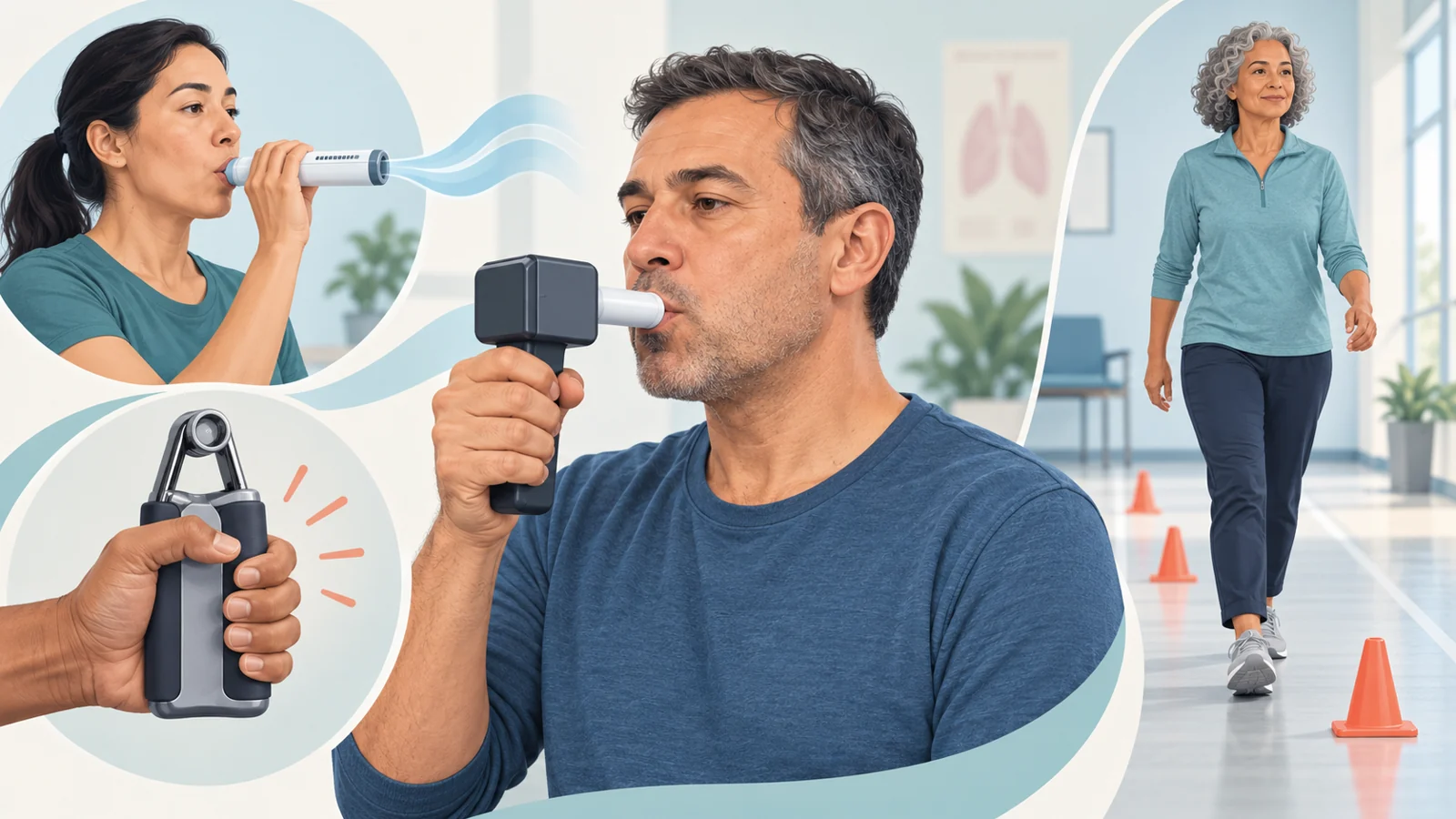
The study’s stated predictor question focuses on expiratory pressure, peak expiratory flow and six-minute walking distance. These measurements may offer different clues about breathing-muscle weakness, airflow and physical capacity, but they are not interchangeable readings of muscle tissue.
A mouth-pressure assessment is intended to capture respiratory muscle strength. Peak expiratory flow measures the rate at which air can be exhaled. Spirometry adds lung-function measurements, including FEV1/FVC and FEV1, under the stated testing conditions. The study’s broader respiratory battery therefore combines a pressure measure with airflow and pulmonary-function measures rather than treating them as one test.
The purpose is to examine whether these observable values relate to the breathing-muscle problem the researchers want to evaluate. The registry does not show that any one measurement can accurately identify respiratory muscle sarcopenia or predict what will happen to a participant later.
What the additional assessments contribute
The protocol also places the respiratory measurements alongside broader measures of the body. Bioelectrical impedance is listed for body weight, fat-free mass, appendicular skeletal muscle mass and skeletal muscle mass. These measurements describe body composition. Hand-grip testing adds a measure of general physical strength.
Walking is assessed in two distinct ways. The four-meter walking-speed test captures how quickly a participant covers a short distance. The six-minute walk test addresses functional exercise capacity by measuring performance over a longer, defined period. One emphasizes short-distance speed; the other reflects sustained walking capacity.
This combination gives researchers several physical dimensions to compare with respiratory measurements: body mass, general strength, short-distance mobility and longer-duration function. A pattern across those measures could help characterize participants more fully, while a single low result would not automatically identify weakened breathing muscles.
What the registry record can show
The later registry record describes an observational study with estimated enrollment of 150 Turkish-speaking adults aged 18 and older. Its eligibility wording spans people described as having normal, mild, moderate or severe OSAS. That wording alone does not establish that the study includes a separate healthy control group.
The record lists enrollment by invitation and an actual start date of May 15, 2025. It gives February 15, 2026 as the estimated primary completion date and April 15, 2026 as the estimated overall completion date. The actual start belongs to the later record and does not show that participants were already active on January 20, 2025; the estimated dates do not establish that the study finished.
The registry results field is listed as not posted in the supplied snapshot. What is available is therefore a description of the study’s planned measurements, not a report of associations, diagnostic performance or treatment effects. Because the design is observational, an association between a breathing measure and sleep apnea would not by itself show that breathing-muscle weakness causes the disorder. It also would not show that treating such weakness improves apnea or other health outcomes.
What this could add to sleep-apnea assessment
For adults with sleep apnea, the potential practical benefit is a more focused way to recognize accompanying breathing-muscle weakness. If pressure, airflow and functional measures reliably identify the intended problem and prove useful beyond this initial study, clinicians might gain a practical reason to direct further assessment toward respiratory muscle function alongside sleep-apnea evaluation.
From the January 2025 perspective, that was a possibility to test rather than a demonstrated clinical benefit. Recognizing weakness could add detail to a patient’s physical assessment; whether that changes treatment choices or outcomes would be a separate question.
Key Sources
- Primary source: Evaluation of Respiratory Muscle Sarcopenia in Obstructive Sleep Apnea Syndrome
Government or Regulator · Clinical Trial · 2025-01-20
Keep exploring