
Research Signal – Source date 2021-03-01
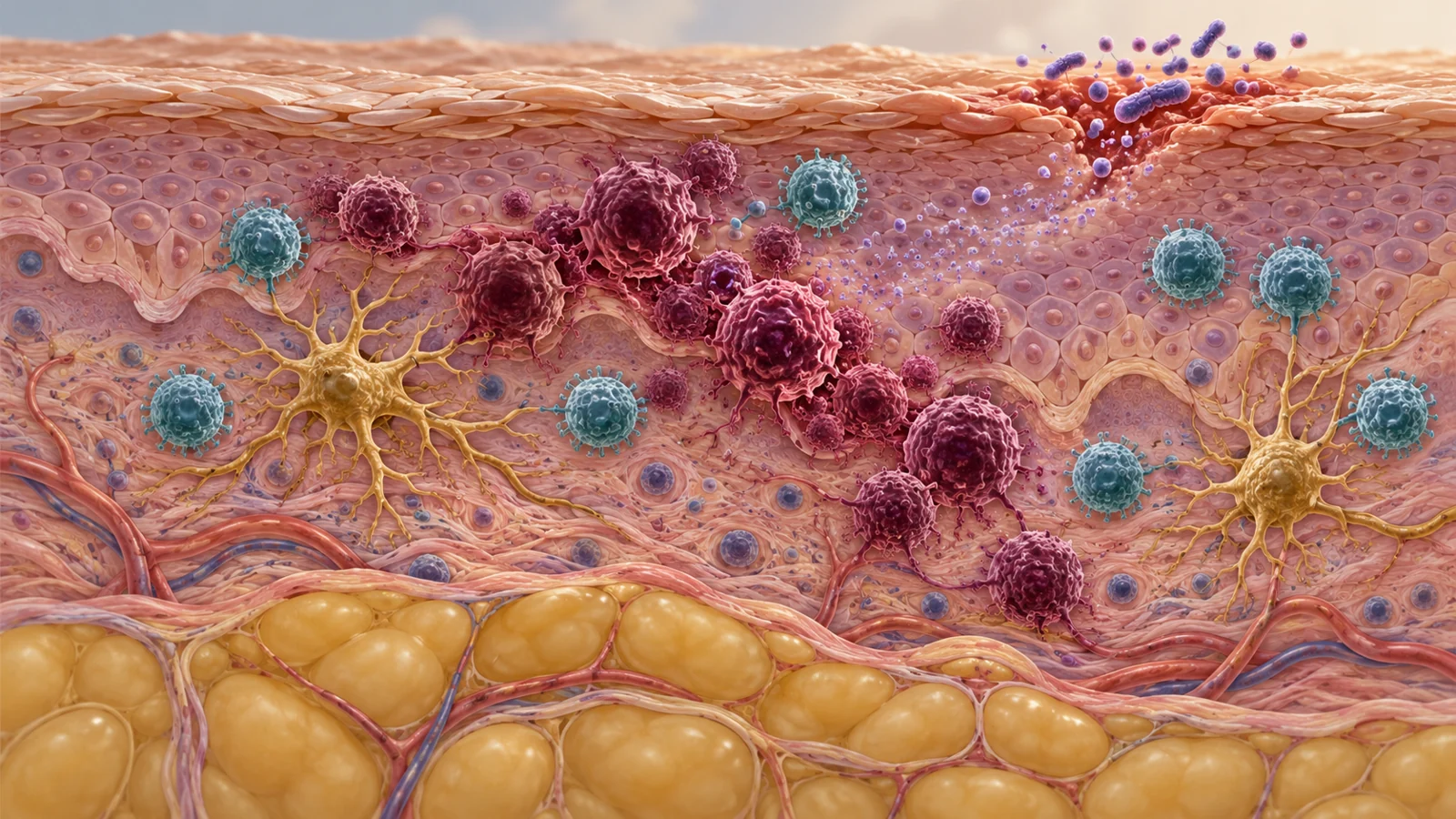
Cutaneous T-cell lymphoma begins in T cells, immune cells that travel to the skin. In advanced disease, however, those cancers are associated with weaker defenses against infection and a less effective immune response to the tumor. The March 2021 review brings together earlier clinical observations and laboratory research to explain how both problems may develop—and why reducing the cancer and restoring immune function are related but distinct goals.
The review focuses especially on mycosis fungoides and Sézary syndrome, the best-studied forms of cutaneous T-cell lymphoma. Their course can involve more than the growth of malignant cells: as disease advances, the surrounding immune response changes too.
The immune response changes as disease advances
In limited patch-stage mycosis fungoides, skin lesions often contain CD8 T cells, which can kill abnormal cells. A stronger presence of these reactive cells has been associated with a more favorable prognosis. T helper cells in early lesions may also show a type 1, or TH1, pattern of signaling that supports cell-based immune defense. The visible inflammation can therefore include the body’s effort to respond to the lymphoma.
Progressive disease has a different pattern. The review describes fewer CD8 cells in skin lesions and a shift toward type 2, or TH2, signaling. Malignant cells can produce TH2-associated signals that suppress TH1 activity and push other helper cells toward the same pattern. In Sézary syndrome, some CD8 cells also show signs of exhaustion: they respond less well to signals and have reduced ability to kill target cells.
This shift matters because immune cells may be able to recognize lymphoma cells yet still be poorly positioned to eliminate them. Laboratory findings cited in the review suggest that boosting TH1-related signals can restore some killer-cell activity. That points to a possible route for immune restoration, but a laboratory response does not establish that a particular approach will prevent infection or improve survival in patients.
Skin infection is part of the clinical picture
Infection risk rises with disease stage, and skin infections are a prominent concern in mycosis fungoides and Sézary syndrome. The review describes staphylococcal and streptococcal infections, as well as herpes infections, among common problems. Some infections can become severe, including bloodstream infection or pneumonia. People with these conditions may also carry Staphylococcus aureus on affected skin more often, particularly in Sézary syndrome.
The review also discusses a separate possibility: bacterial products might influence lymphoma-cell behavior. In laboratory work, certain S. aureus toxins activated signaling in lymphoma cell lines, including pathways linked to inflammatory and regulatory-cell features. Some patient observations also found toxin-producing strains alongside expanded lymphoma cell clones with T-cell receptors responsive to those toxins.
These findings make microbial influence a research question, not a demonstrated cause of progression in patients. Two small studies cited by the review found that antibiotic treatment cleared S. aureus colonization and improved clinical symptoms, but those observations do not show that bacteria cause the lymphoma or that antibiotics control it. Infection is an established clinical burden in this account; a role for bacterial products in driving the cancer remains a hypothesis.
Malignant cells can persist and reshape signaling
One way lymphoma cells persist is by resisting programmed cell death. Normally, repeated activation of a T cell can trigger a self-limiting process called activation-induced cell death. The review describes delayed signaling through this process in cutaneous lymphoma cells, including changes involving Fas, a receptor pathway that helps activated cells die when their work is done. Other alterations may dampen the signals that would ordinarily trigger that response. The result can be a survival advantage for malignant cells, while signals from those cells may also harm nearby benign immune cells.
A second feature is the lymphoma cells’ tendency toward TH2 signaling. The review describes changes in molecular signals that help determine whether helper T cells follow a TH1 or TH2 pattern. These changes are linked to production of TH2-associated cytokines. In advanced disease, some signaling may become less dependent on outside cues and more continuously active within the malignant cells.
These mechanisms help explain how the cancer can both evade cell death and weaken parts of the immune response. They also point to potential molecular targets. But findings about cell pathways do not by themselves show that blocking any one pathway will improve a patient’s outcome.
The skin environment helps shape the disease
The malignant cell is only part of the story. Chemokines—chemical cues that guide cell movement—can help T cells migrate into skin and may also support their survival. Other signals from the surrounding tissue can encourage lymphoma-cell growth. This means the skin environment may influence where malignant cells collect and how they behave.
Dendritic cells, which help coordinate immune responses, can also have different effects depending on their state. In laboratory studies summarized by the review, contact with immature dendritic cells supported lymphoma-cell growth and regulatory signaling. Mature dendritic cells did not produce the same growth effect. The review notes that interferon-gamma can promote dendritic-cell maturation, while dying lymphoma cells can also prompt signs of dendritic-cell activation.
This offers one possible explanation for why some treatments that kill large numbers of lymphoma cells may have immune effects beyond lowering tumor burden: cell death may help activate antigen-presenting cells. It remains a mechanistic explanation synthesized from prior research, rather than proof that this pathway accounts for clinical benefit in every treatment setting.
Immune restoration is part of the treatment rationale
The review reports that immune-targeted approaches in advanced cutaneous T-cell lymphoma have been associated with longer median progression-free survival than traditional chemotherapy. Progression-free survival measures the time before disease worsens or a patient dies. This comparison supports interest in treatments that engage immunity, but it is an association discussed in a review, not proof that immune-targeted treatment causes better outcomes for every patient.
There is also evidence, described separately, that reducing the malignant-cell burden can allow parts of the immune system to recover. When treatment reduces the population of malignant T cells, a wider range of normal T cells may return; some treatments have also been associated with a better balance between TH1 and TH2 activity and recovery of dendritic and natural killer cells. This matters because lowering the cancer and rebuilding immune capacity could reinforce one another, while treatments that suppress immunity may complicate recovery.
The treatment landscape described in this 2021 review includes established immune-oriented approaches such as interferons and extracorporeal photopheresis, alongside radiation and other therapies used in combinations. It also discusses newer strategies then under development, including checkpoint inhibitors, Toll-like receptor agonists and engineered T cells. The review’s central point is not that one immune treatment fits all, but that immune state is part of the disease and may shape both treatment response and vulnerability to infection.
A target on a T cell may also belong to healthy cells
Researchers have identified surface molecules that could help guide treatment toward lymphoma cells. CCR4, for example, is found on cutaneous lymphoma cells and regulatory T cells, while other markers are associated more with Sézary syndrome. Antibodies against targets such as CCR4 and CD52 illustrate that surface proteins can be used therapeutically.
Selectivity is the challenge. A marker may also appear on healthy or activated immune cells, so targeting it can affect more than the cancer. The two best-studied forms, mycosis fungoides and Sézary syndrome, also appear to differ in molecular and genetic features despite sharing some characteristics. A target that matters in one form may therefore be less relevant in the other. More detailed molecular profiles could help identify which patients and malignant cells are most likely to match a given target.
What immune restoration could change in lymphoma care
If treatments can reduce malignant cells while allowing protective immune functions to recover, care could address two linked burdens: lymphoma growth and the infections that become more likely as disease advances. That possibility depends on finding approaches that work for the relevant disease form and preserve or rebuild useful immune activity. The review gives a biological rationale for pursuing that goal, while leaving the effectiveness of individual strategies to clinical evidence.
Key Sources
- Primary source: The immunopathogenesis and immunotherapy of cutaneous T cell lymphoma: Pathways and targets for immune restoration and tumor eradication.
DOI or Journal Page · Review or Meta-Analysis · 2021-03-01
Keep exploring