
Research Signal – Source date 2026-05-23
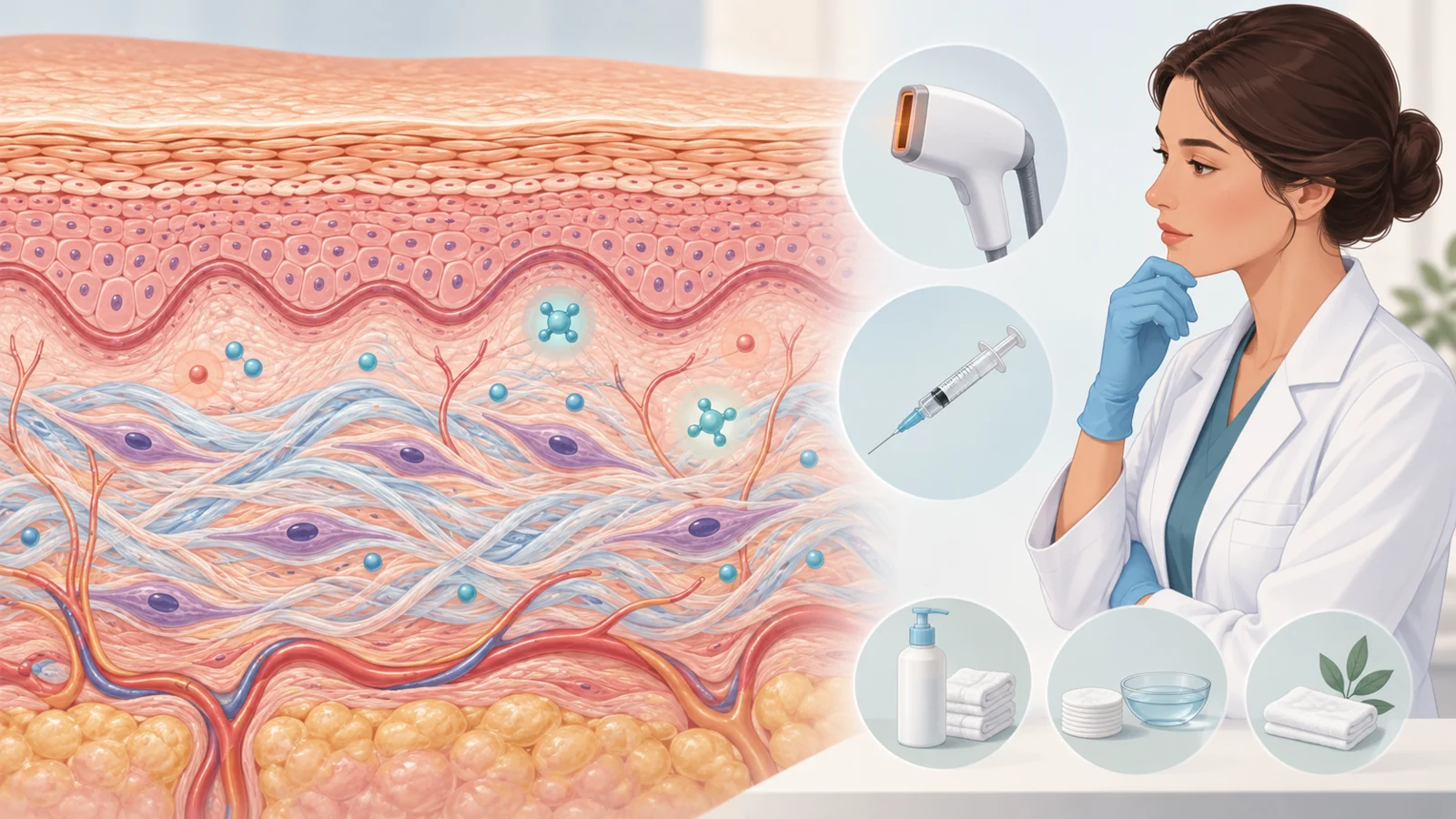
A laser or injectable procedure works in living tissue, whose condition may shape how it responds. A May 2026 narrative review calls the effort to optimize that condition before treatment “skin bed preparation.” The idea is to support the skin’s barrier and biological activity before a procedure that depends on tissue repair or remodeling.
The review brings together mechanistic, laboratory, animal, and clinical literature. It offers a rationale for preparing skin and discusses several approaches, but those approaches differ in how they are supposed to work and in how much clinical evidence supports them. One cited 90-day comparison provides a specific example, not a test of every proposed method.
Why aging may change the skin’s response
Skin changes through both time and exposure. With intrinsic aging, epidermal turnover slows, fibroblast activity declines, and production of extracellular matrix components falls. The extracellular matrix, or ECM, is the structural network around cells; its collagen helps give skin support. Ultraviolet radiation, pollution, and tobacco smoke can add oxidative stress, inflammation, and matrix breakdown.
Energy production is part of this picture. Mitochondria help supply the energy cells use for their work. When mitochondrial function declines, the review says, reduced energy availability can constrain fibroblast activity and collagen synthesis, slow turnover in epidermal cells, and weaken barrier repair. Dysfunctional mitochondria may also contribute inflammatory signals. Persistent inflammation can encourage matrix degradation and disrupt communication between the epidermis and dermis.
These processes matter to aesthetic procedures because some treatments aim to activate fibroblasts or prompt collagen remodeling. A procedure meets a tissue environment already shaped by barrier function, inflammation, cellular energy, and the condition of the matrix. The review’s central proposal is that improving parts of that environment could make the tissue more receptive. That biological rationale is not, on its own, proof that a particular preparation improves a patient’s result.
Preparation enters before the procedure
In the approach described by the authors, care begins with an appraisal of the skin’s condition. Clinicians might then use preparation intended to support barrier integrity, metabolic function, or inflammatory balance before a laser, injectable, or other intervention. Some strategies are topical; the review also discusses non-ablative energy-based treatments used in a preparatory role to encourage controlled remodeling.
The agents discussed include antioxidants, retinoids, mitochondrial cofactors, signaling peptides, barrier-supporting lipids, and repair-oriented biomolecules such as polydeoxyribonucleotides (PDRN). These are categories in the review’s discussion, not a single established protocol or a recommended regimen. The proposed sequence is assessment, preparation suited to the tissue, then a procedure whose effects depend partly on the skin’s response.
The review also describes combining preparation with conventional treatments. In one cited clinical comparison, calcium hydroxyapatite (CaHA), an injectable, was paired with a regenerative solution containing cosmetic actives. The authors describe enhanced neocollagenesis and more organized dermal remodeling over 90 days compared with standard saline dilution. This example concerns that particular combination and observation period. It cannot establish long-term durability or show that every preparation method improves outcomes across different procedures and patients.
Similar goals, different biological approaches
The review groups several emerging ideas under the broader aim of improving the skin microenvironment, but their mechanisms are not interchangeable. Senolytics are intended to selectively remove senescent cells, which have stopped dividing and can release inflammatory and matrix-degrading signals. Senomorphics aim to reduce those signals while leaving the cells in place. Both approaches target aspects of cellular senescence, but in different ways.
Mitochondrial and epigenetic rejuvenators have a different focus: supporting cellular energy or addressing age-related changes in how genes are regulated. PDRN is discussed as a repair-oriented biomolecule. The review describes evidence that it can activate adenosine A2A receptor signaling and support processes such as fibroblast activity, collagen production, and tissue repair. Those mechanistic and preclinical findings do not by themselves establish reliable improvements in aesthetic outcomes.
Extracellular vesicles, including exosomes, are presented as carriers of proteins, lipids, and nucleic acids that may influence communication between cells. Their proposed multi-molecule signaling differs from the action of a single topical ingredient. The review also emphasizes that these approaches have different delivery needs and clinical footing. It describes exosome-based applications as an emerging area supported largely by mechanistic work and pilot clinical data, while evidence for other agents varies by intervention.
Repair is not the same as regeneration
“Regenerative” can suggest that adult skin returns completely to its original structure and function. The review draws a sharper biological boundary: complete regeneration means restoring tissue architecture, cellular identity, and function without fibrosis. That type of response is largely associated with early development. Adult human skin generally heals through repair, which closes injury but can leave structural changes such as scarring.
For aesthetic care, the more precise goal is to improve tissue quality or shift repair toward a more functional outcome. The proposal is to address factors such as inflammation, matrix disorganization, cellular senescence, and impaired energy production so that skin may respond more favorably to a later intervention. Describing that goal as creating a more supportive environment is different from claiming that adult skin can be fully regenerated.
What better skin preparation could mean for patients
If comparative research identifies which preparation methods help particular patients and procedures, clinicians could use skin assessments to tailor care before lasers or injectables. Better matching of preparation to tissue condition might make healing and results more predictable. Whether that practical benefit follows depends on studies that establish effectiveness, safety, and durability for specific approaches; the review’s rationale and one 90-day comparison do not yet settle those questions.
Key Sources
- Primary source: Regenerative Approaches to Enhance the Skin Microenvironment and Boost Aesthetic Efficacy: A Narrative Review.
DOI or Journal Page · Review or Meta-Analysis · 2026-05-23
Keep exploring