
Research Signal – Source date 2024-03-06
A planet that takes years to circle its star offers astronomers few chances to catch it passing in front. During that crossing, called a transit, the star’s measured brightness briefly dips. A short-period planet repeats the event often, allowing researchers to combine observations and pull a faint pattern out of the noise. A distant planet may leave only one usable dip.
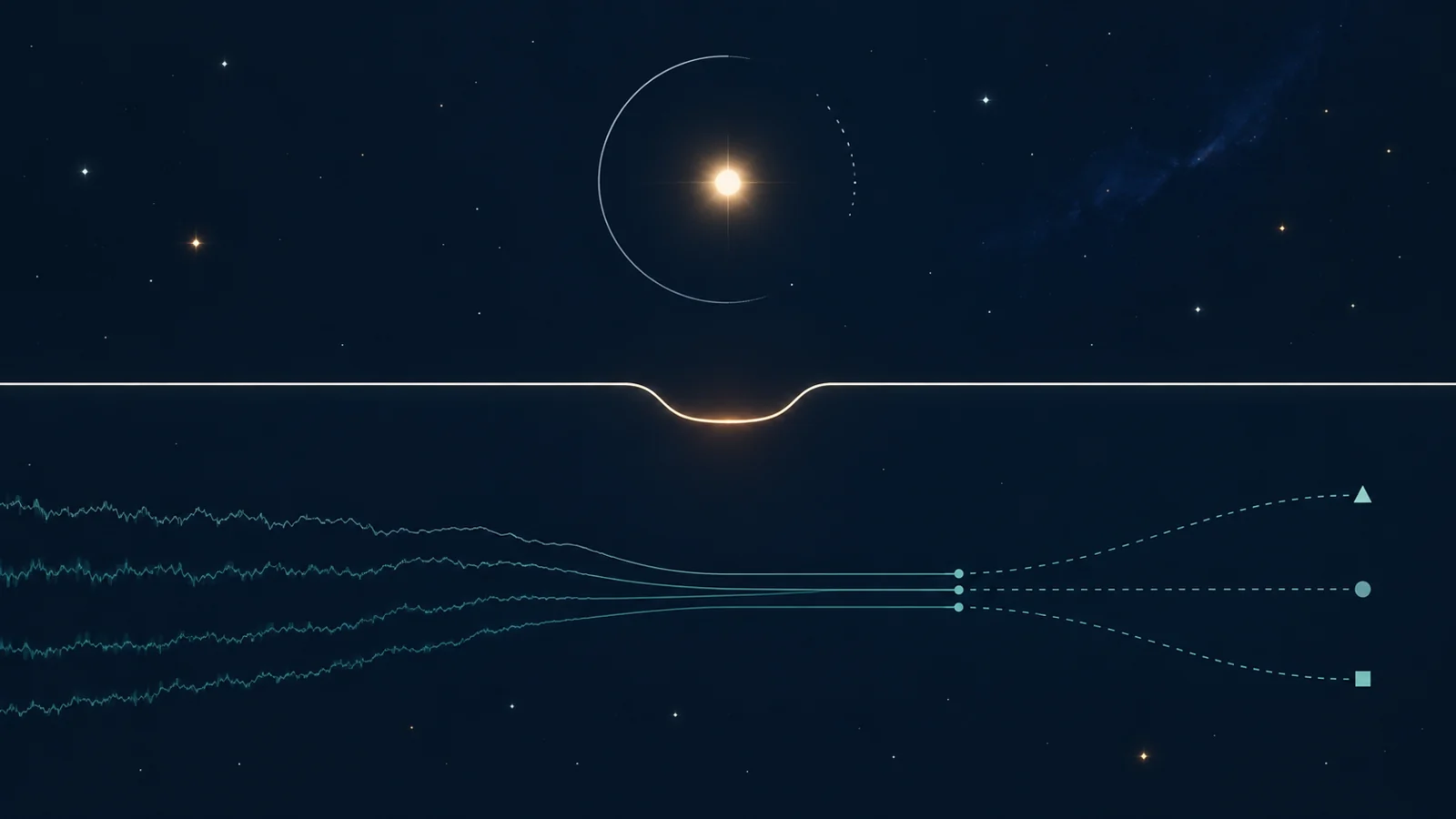
That scarcity is the problem behind a March 6, 2024 arXiv preprint on searching Kepler observations with machine learning. The researchers train a group of neural networks to recognize individual transits, using both stellar brightness measurements and information about the spacecraft taking them. Their first reported candidate, KOI 1271.02, illustrates the opportunity and the unfinished work. Finding a plausible crossing gives astronomers something to investigate; establishing the planet’s orbit and physical properties takes additional evidence.
The study is a preprint, not yet peer-reviewed. Its contribution is a detection method with reported test results and a candidate whose possible configurations the authors explore.
Recognizing a dip without waiting for a pattern
Repeated-transit searches gain strength by lining up observations from successive orbits. This process, known as phase folding, lets recurring dips reinforce one another while some of the noise averages away. But an Earth-like orbital period of 365 days would produce at most four transits within Kepler’s observing record, the paper notes. Longer periods leave still fewer opportunities, weakening the advantage of repetition.
The proposed method starts with a smaller question. Given a segment containing 500 brightness measurements, does it contain a transit? The model chooses between two labels, transit and no transit. It does not need a sequence of regularly spaced crossings to make that initial classification.
The researchers use convolutional neural networks, a type of machine learning suited to recognizing shapes in data. Here, the relevant shape is a temporary decrease in brightness within a light curve, the record of a star’s brightness over time. Rather than rely on one network, they combine 25 networks with different internal structures. The networks share training data, but their different designs give them opportunities to learn different features associated with a transit.
This ensemble approach improves classification compared with an individual network in the authors’ tests. It also separates two tasks that can sound deceptively similar. Recognizing a transit-like event concerns the shape of the data around one crossing. Recovering an orbital period requires information about how crossings are spaced, or other constraints on the system. A successful answer to the first question does not automatically supply the second.
The spacecraft becomes part of the evidence
A brightness measurement carries information about the star and about the instrument observing it. The paper tests whether Kepler’s onboard engineering measurements help the networks interpret the light curve. These diagnostics provide context for a brightness change.
The authors first establish a baseline using brightness, or flux, alone. They then compare it with 53 ensembles incorporating individual diagnostics or temperature differences. Eleven exceed 79% classification accuracy, and two exceed 80%. The variation between inputs matters. Adding more spacecraft information is useful only when it helps distinguish the patterns the model is trying to classify.
The study’s distinctive move is to let the classifier consider the observing spacecraft alongside the apparent behavior of the star.
What the recovery numbers measure
The researchers construct examples from known transit locations and segments labeled as containing no transit. The collections contain 26,066 transit segments and 35,627 no-transit segments. They divide the material into training, validation, and testing groups, with an intended 80/10/10 split and separation by star. Keeping a star’s examples within one group helps prevent familiarity with that particular star from making the test look easier.
Classification accuracy measures how often the model assigns the correct label to these examples. Transit-recovery sensitivity asks how many relevant events the search retrieves. Those measurements answer different questions, even when their percentages happen to be similar.
The preprint reports greater than 80% transit-recovery sensitivity out to an 800-day orbital period. This describes the pipeline’s recovery of transits in its evaluation, rather than a probability that any particular candidate is a planet.
The distinction explains how a search can remain useful at long periods even when it struggles to recover the orbit. A single visible event can be recognizable while the next crossing falls outside the observations. Conversely, success at finding individual events does not mean the orbital period is known with the same success rate.
These tests establish performance under the study’s data selection and recovery definitions. They do not translate directly into a prediction that eight out of ten newly flagged objects will be real planets. That would require knowing how often other phenomena produce convincing detections in the wider search. Nor does the reported percentage specify how many additional planets Kepler’s archive contains. It is a measure of the method’s behavior, not a census of discoveries.
KOI 1271.02 has a clue beyond its single crossing
After the pipeline identifies KOI 1271.02, the investigation moves from classification to physical modeling. The system offers another source of information: the already known KOI 1271.01 exhibits strong transit-timing variations. Its crossings arrive earlier or later than a simple, evenly spaced orbital schedule would predict.
Such timing changes can carry information about gravitational interactions between planets. A possible companion must therefore fit more than the appearance of its own transit. Its proposed orbit and mass also need to be compatible with the timing behavior of the known planet. The authors jointly model the transits and timing variations to explore configurations that could explain the observations.
This is where the paper’s quoted physical values enter the story. The authors report a possible radius of 5.32 ± 0.20 times Earth’s radius and a mass of approximately 29 times Earth’s mass for KOI 1271.02. These are results of the subsequent system modeling, not measurements produced by the neural-network classifier. The candidate is also substantially larger than Earth, despite the method’s longer-term motivation to improve searches for smaller planets.
The available observations allow multiple configurations. One crossing does not directly reveal the interval until the next, and the timing evidence does not uniquely settle the system. The quoted radius and mass must therefore be read within the authors’ proposed solutions. A numerical uncertainty around a model estimate does not eliminate uncertainty over which orbital configuration describes reality.
The authors identify two concrete ways to tighten those constraints. Further transit-timing measurements of KOI 1271.01 could better reveal the gravitational disturbance it experiences. Observing a second transit of KOI 1271.02 would add a direct timing constraint on the candidate itself. Those observations could help distinguish the possible solutions and test whether the proposed companion consistently explains both kinds of evidence. At this stage, KOI 1271.02 remains a candidate rather than a confirmed, uniquely characterized planet.
What this could change
If the recovery behavior holds up in wider searches and follow-up observations support the resulting candidates, this approach could extract more long-period planets from an archive that already exists. The causal path is concrete. Recognizing isolated crossings would bring more sparsely observed systems into consideration; physical modeling and additional observations could then turn some of those detections into characterized planets.
A larger sample would help astronomers investigate planetary systems on longer orbital timescales, where repeated-transit searches have fewer events to combine. The authors also connect the method to the eventual goal of estimating how common Earth-like planets are. Reaching that goal would require useful sensitivity to small planets as well as reliable handling of the objects a search misses or misclassifies.
The broader scientific payoff would be more observational support for estimates of planet abundance at long periods. Kepler’s engineering records could contribute to that work alongside its measurements of starlight, helping researchers recover information from crossings that may occur only once in the available record.
Key Sources
- Primary source: Single Transit Detection In Kepler With Machine Learning And Onboard Spacecraft Diagnostics
arXiv · Preprint · 2024-03-06
Keep exploring