
Research Signal – Source date 2025-08-20
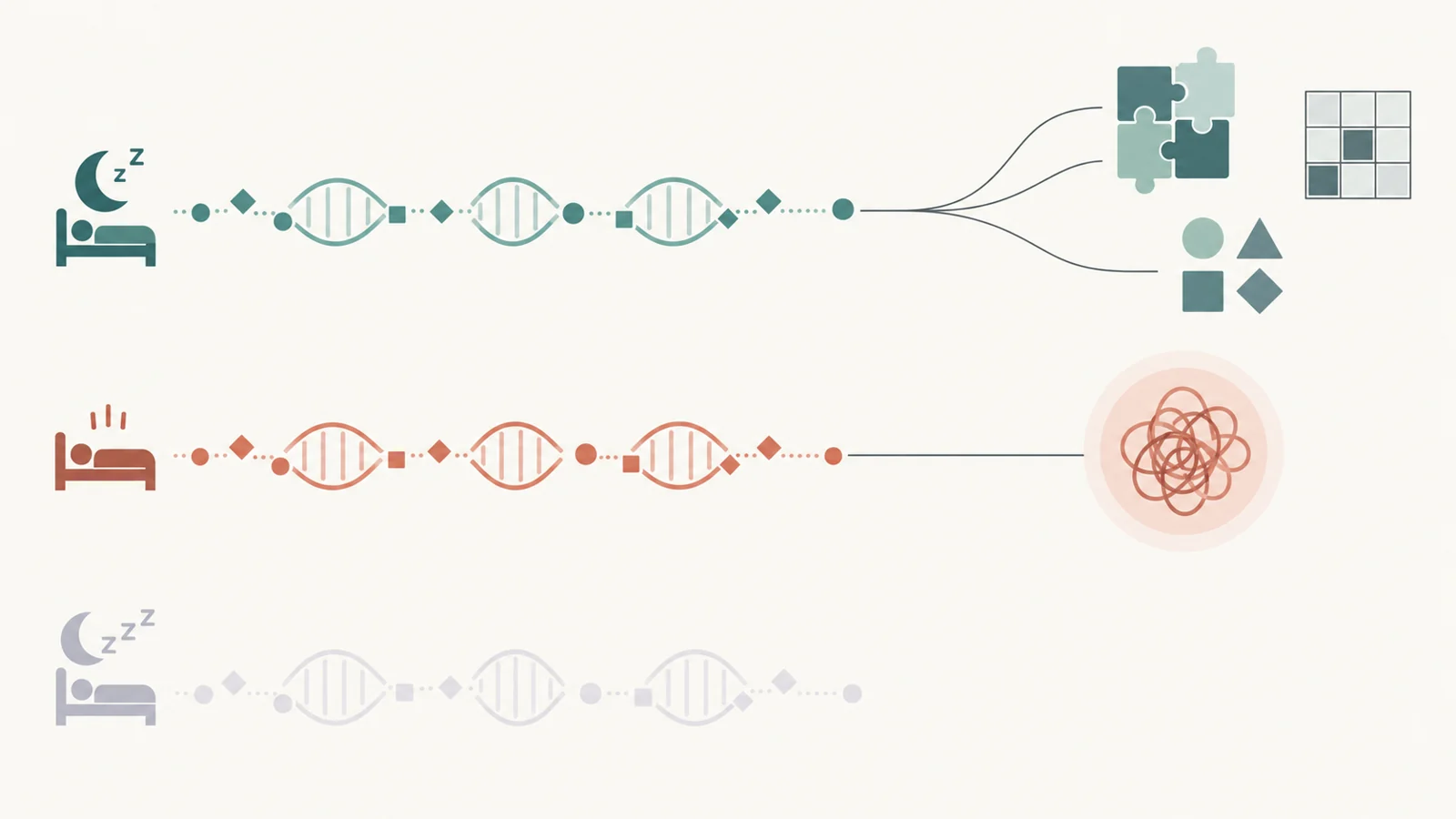
A study published on 20 August 2025 used genetic data to explore whether self-reported sleep patterns might contribute to differences in cognition and Alzheimer’s disease risk. Its results point in different directions: genetic proxies for short sleep were associated with several lower cognitive-test scores, while proxies for insomnia were associated with Alzheimer’s disease risk but not the measured cognitive tests. The long-sleep analysis remained unresolved.
The findings are clues about possible causal relationships, not estimates of what would happen if a person changed their sleep. And although several results met the conventional P < 0.05 threshold, none of the highlighted associations cleared the study’s stricter threshold for multiple comparisons.
Genetic variants served as indirect clues about sleep
The researchers used a method called Mendelian randomization. It draws on the fact that genetic variants are assigned at conception and can be associated with traits such as reported sleep duration. The study used those variants as proxies for short sleep, long sleep and insomnia, then compared their associations with separate genetic datasets covering cognitive outcomes and dementia.
This two-sample approach can reduce some sources of bias that complicate ordinary observational comparisons. But its interpretation depends on demanding assumptions: the selected variants must reliably relate to the sleep trait, must not be tied to other factors that affect the outcome, and must influence cognition or disease risk through the sleep trait rather than through another route. Those assumptions cannot be guaranteed just because the analysis uses genes.
The sleep measures also came from self-report. In the underlying sleep-duration data, short sleep was defined as six hours or less per day and long sleep as nine hours or more, with seven to eight hours as the reference. The analysis included 26 genetic instruments for short sleep, 240 for insomnia and seven for long sleep. Participants in the datasets were primarily of European ancestry, which limits how confidently the estimates can be applied to other populations.
Short sleep tracked several different test results
In the primary analysis, genetic proxies for short sleep were associated with lower scores on tests of overall cognitive performance, fluid intelligence and memory. The reported estimates were beta = −0.15 for overall performance, beta = −0.38 for fluid intelligence and beta = −0.10 for memory. These are study-scale estimates, not predictions that an individual who sleeps less will lose a particular number of points.
The study also found associations with two Trail Making Test measures. Genetic proxies for short sleep were associated with a longer interval between steps on the Trail 2 path and a longer time to complete that path. The test is used to assess executive function and attention switching, so the result adds a different kind of task performance to the overall, reasoning and memory findings.
These outcomes are related but not interchangeable. A lower score on a group-level test does not diagnose dementia or show that every person with short sleep will experience cognitive decline. The estimates describe associations in the analyzed genetic datasets, under the assumptions of the method.
Insomnia and Alzheimer’s risk separated from test scores
For insomnia, the primary analysis found no supported association with the measured cognitive-test outcomes. It did find an association with Alzheimer’s disease risk: the estimated odds ratio was 1.13, with a 95% confidence interval of 1.02 to 1.24 and P = 0.02. In this analysis, the genetic proxies linked to insomnia corresponded to higher odds of Alzheimer’s disease, while the cognitive tests did not show a clear accompanying association.
The authors discuss several possible reasons the results might differ. They suggest that the tests may not detect subtle or early changes, that any disease-related processes could unfold before changes show up on those tests, or that people might compensate in ways that temporarily preserve measured performance. These are proposed explanations in the discussion; this analysis did not test those mechanisms.
The long-sleep result remains open
The analysis did not find strong evidence that long sleep caused changes in the cognitive outcomes. That result is inconclusive rather than proof of no effect. Only seven genetic instruments represented long sleep, leaving the analysis with less evidence to estimate its relationship with cognition than was available for the other sleep traits.
Long sleep also meant a distinct self-reported category: nine or more hours per day, compared with seven to eight hours. The study’s result therefore does not settle what longer sleep means for cognition across different people or circumstances. Its long-sleep finding should be read as an unanswered question, separate from the associations reported for short sleep and insomnia.
The highlighted results did not pass the stricter test
The paper tested 45 Mendelian-randomization estimates and set a Bonferroni-corrected threshold of P < 0.001 to account for the number of comparisons. The highlighted results had P values from 0.006 to 0.04. They are below 0.05, often called conventionally significant, but above the paper’s multiple-testing threshold. The authors therefore treated results in this range as suggestive rather than meeting the stronger criterion.
That distinction matters when several outcomes and sleep traits are examined: some associations can look persuasive by the conventional cutoff simply by chance. Self-reported sleep measures, the method’s assumptions and the primarily European-ancestry data also leave the findings as leads for further research.
Why sleep could become a prevention target
If these associations hold up and trials show that treating insomnia or helping people who sleep too little improves later outcomes, sleep care could become one way to reduce cognitive decline or Alzheimer’s risk. The two possibilities need separate tests: this analysis linked short sleep to cognitive-test scores and insomnia to Alzheimer’s risk, but it did not test whether changing either sleep pattern prevents harm.
Key Sources
- Primary source: Mendelian randomization study of self-reported long sleep duration, short sleep duration, and insomnia and cognitive function.
DOI or Journal Page · Peer-Reviewed Paper · 2025-08-20
Keep exploring