
Research Signal – Source date 2021-02-02
A wave can be useful for inspecting a structure because of how it travels, but that property alone does not determine how an inspection works. A 2021 review of shear horizontal (SH) wave transducers brings the wave and the sensor into view together: the wave’s behavior matters, and so does the arrangement used to launch it and receive it.
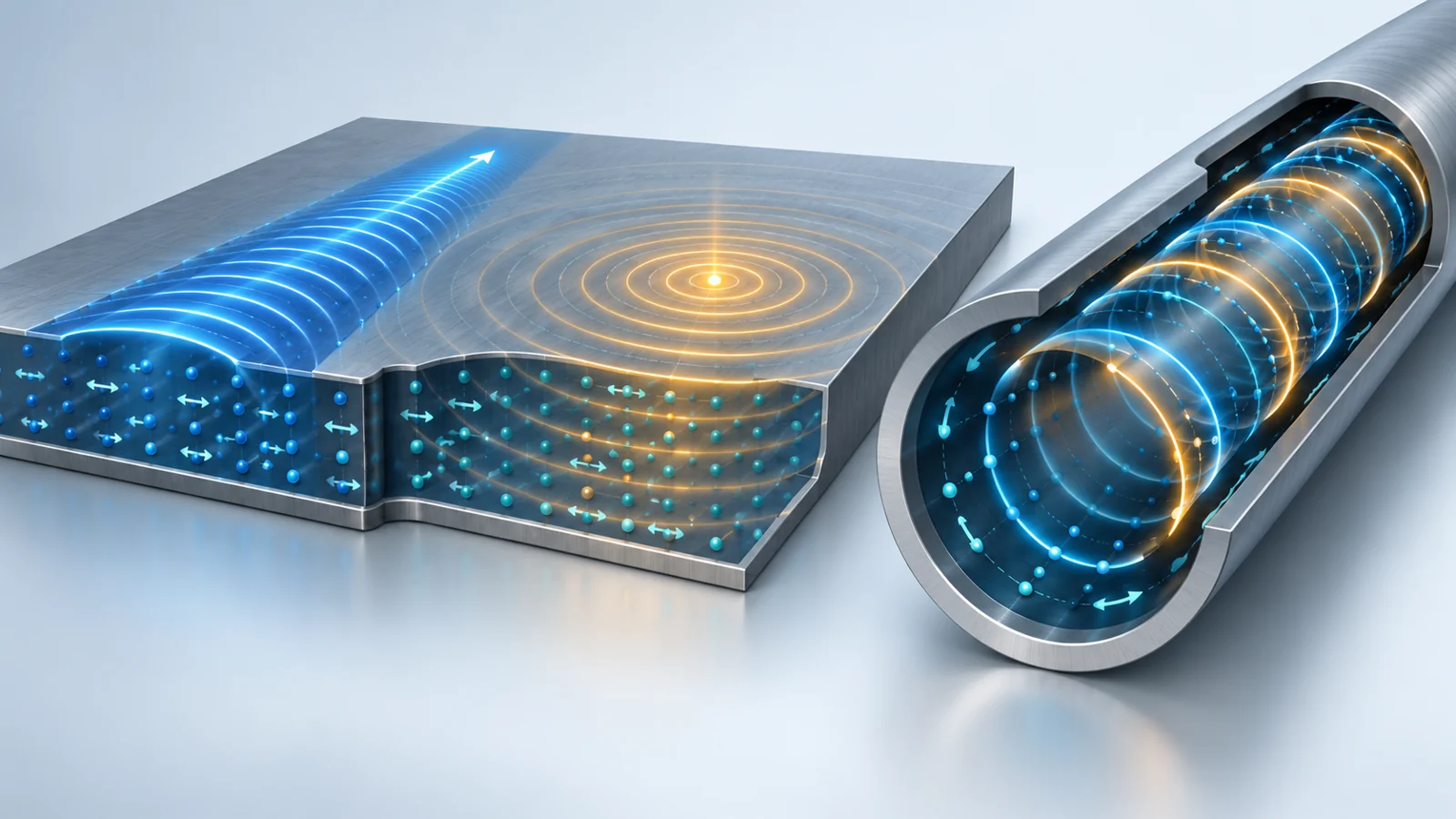
SH waves are waves in which material moves sideways relative to the direction the wave travels. The review highlights one particular case: the lowest-order SH wave in an isotropic plate, meaning a plate whose properties are the same in every direction. This mode is non-dispersive. In plain terms, its different frequency components travel without spreading apart because of frequency-dependent speed. That can make the mode attractive for inspection, but the claim is specific to this plate-wave mode; it does not describe every wave in every material.
Related wave behavior across plates and pipes
The review also brings together SH waves in plates, circumferential SH waves, and torsional waves in pipes. Circumferential waves travel around a pipe, while torsional waves involve twisting motion. The authors report resemblances among these wave types in their dispersion characteristics and wave structures. Those similarities help explain why the review discusses them within one broad family of inspection approaches.
A resemblance is not an assertion that the waves follow identical paths or behave identically in every structure. A plate and a pipe have different shapes, and the review’s framing preserves those distinct geometries. It lets researchers consider related wave behavior across both while asking how a transducer can excite and receive the appropriate wave in each.
Five transducer families, two broad approaches
The review groups the transducers into two electromagnetic acoustic approaches and three piezoelectric approaches. The electromagnetic acoustic transducers (EMATs) include Lorentz-force-based and magnetostrictive designs. The piezoelectric group includes shear-wave wedge, thickness-shear, and face-shear transducers.
These are different ways to excite waves in a structure and receive them back. The review summarizes their working principles, applications, merits, and limitations. The abstract names these families but gives no numerical comparison of sensitivity, inspection range, reliability, or cost. The categories are a useful guide to the approaches under discussion, not a verdict on which sensor is best.
The pattern sent through the structure matters
A transducer configuration also determines the wave pattern it is intended to excite or receive. For plates, the review discusses both directional and omnidirectional SH waves. A directional arrangement focuses on a particular direction; an omnidirectional one sends or receives waves around the source in multiple directions. For pipes, the configurations include torsional waves.
This is a separate design choice from the wave’s material behavior. A non-dispersive plate mode may be appealing, but an inspection still depends on a suitable arrangement for sending and receiving waves in the geometry of interest. The review’s focus on these configurations shows why “which wave?” and “how is it launched and received?” are linked questions in sensor design.
What the 2021 review can establish
Published on February 2, 2021, this review surveys prior research on SH wave transducers for structural health monitoring and nondestructive testing. Its abstract identifies device families and wave configurations, but presents no new device validation or field deployment.
The distinction matters when interpreting the review’s promise. It organizes approaches that researchers could use to inspect structures; it is not evidence that a particular arrangement has already proved reliable in a specific operating setting.
What this could mean for inspecting plates and pipes
If suitable configurations prove reliable in their intended settings, inspectors could use a selected SH wave pattern to examine a plate or pipe without damaging it. The review maps approaches toward that use, while leaving the performance of each arrangement to be established in context.
Key Sources
- Primary source: Shear horizontal wave transducers for structural health monitoring and nondestructive testing: A review.
DOI or Journal Page · Review or Meta-Analysis · 2021-02-02
Keep exploring