
Research Signal – Source date 2026-06-04
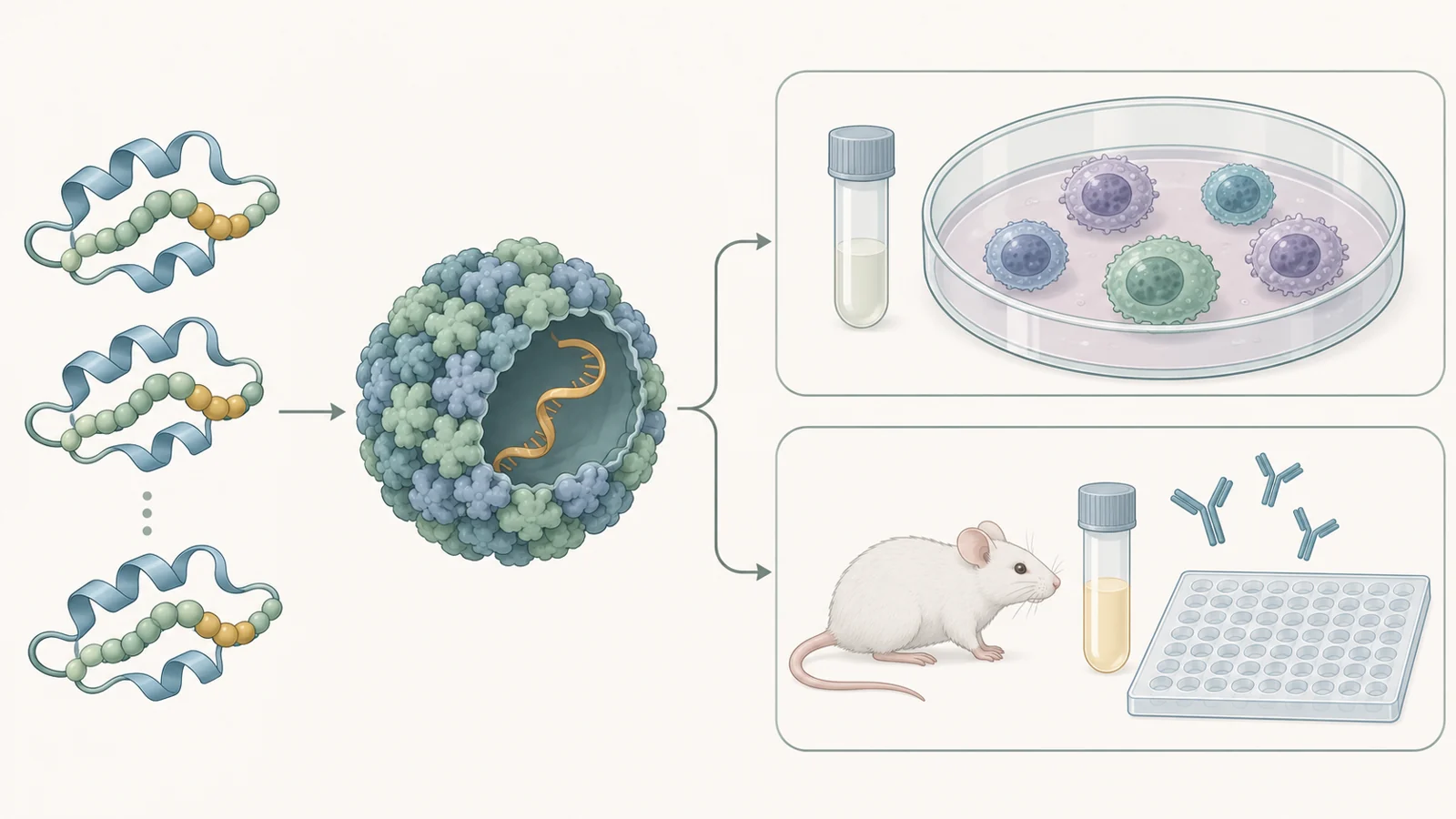
Some colorectal cancers carry different mutations in the same gene, but a few of those changes can create similar altered protein fragments. Researchers used altered sequences from frameshift mutations in three regions of APC, a gene that normally helps restrain cell growth, to design an experimental vaccine. Donor immune cells responded to supplied mutant fragments, and mice given the RNA-carrying particles produced antibodies to the mutant antigen.
The study, published June 4, 2026, offers an early proof of concept: a mutation shared by some patients might give a vaccine a target beyond one person’s tumor. Its experiments do not show that vaccination prevents colorectal cancer or that immune cells can attack tumors carrying these mutations.
A shared target within a varied gene
APC mutations are common in colorectal cancer, but “an APC mutation” does not mean one identical change in every tumor. The study focused on frameshifts in a region of the gene where mutations associated with familial adenomatous polyposis (FAP) are often found. FAP is an inherited condition linked to a high lifetime risk of colorectal cancer.
A frameshift changes how the genetic code is read, creating a new sequence of protein building blocks after the mutation. Those new segments can differ from the normal APC protein and may be recognized as unfamiliar by the immune system. This gives the vaccine designers a more specific target than APC mutation in general: selected altered sequences that recur in more than one person.
The researchers searched patient mutation data for frameshift changes in APC’s mutation cluster region. They identified three regions that produce altered protein sequences and inserted them into a shortened version of the normal APC sequence. The largest reported shared count was 133 among 4,767 queried patients with APC mutations. That is evidence of recurrence within the database search, not a measure of coverage across all people with colorectal cancer or inherited APC risk.
From altered sequence to a delivered message
The team encoded the combined mutant APC sequence in self-amplifying RNA, or saRNA. RNA provides cells with instructions for making a protein; the “self-amplifying” design includes a replicon sequence that can make additional copies of the RNA inside cells. The RNA was packaged in a virus-like particle, a delivery vehicle built with modified viral components. It carried the instructions but was not described as a virus that causes infection.
After cells take up the particle, the RNA can direct them to produce the designed APC mutant protein. The study’s construct included secretory signals intended to help the antigen move outside the cells that made it. Researchers compared candidate constructs and selected one for the mouse experiment based on its observed APC mutant expression.
The intended chain is straightforward: deliver instructions, have cells produce the altered protein, and make its fragments available for immune recognition. Each link matters. Finding a sequence in patient data identifies a possible target; it does not by itself show that a vaccine can deliver that target or that the immune system responds to it.
Donor immune cells responded to supplied fragments
To test whether the selected mutant regions could prompt immune activity, researchers synthesized 35 short peptide fragments from those regions. They added the peptides to immune cells collected from multiple human donors, stimulated and restimulated the cells, and measured interferon-gamma, a molecule released by activated immune cells.
Twenty-nine of the 35 fragments elicited interferon-gamma levels more than twice those of unstimulated cells in at least one donor sample each. The responding fragments came from all three mutant regions. A follow-up assay detected interferon-gamma inside T cells, supporting the conclusion that T cells in the donor samples responded after peptide restimulation.
This experiment tested responses to peptides supplied directly to cells in a dish. It did not test whether a vaccinated person’s immune system would recognize the same fragments when they are naturally produced and displayed by a colorectal cancer cell. In particular, the assay does not show that T cells can find and kill cells carrying the relevant APC mutation.
The mouse comparison pointed to the mutant sequence
The in vivo experiment used three groups of eight BALB/c mice. One group received empty particles, one received particles encoding ordinary mouse APC, and one received particles encoding the mutant APC construct. The particles were injected into muscle on day 0, with a boost on day 14.
Researchers measured APC mutant-specific IgG, an antibody, in the animals’ blood. Mice given the mutant construct developed higher antibody levels than both the empty-particle group and the group given ordinary APC. The comparison with ordinary APC is especially informative: it suggests the measured response was directed toward the altered sequences in the construct, rather than simply toward APC protein shared with the normal version.
The mouse endpoint was serum antibody, not a directly measured T-cell attack on tumors. Antibodies against the vaccine antigen and T-cell responses to supplied peptides are signs of immune recognition under these test conditions; neither demonstrates that vaccination prevents polyps or cancer. Mouse weights progressed without reported outliers or signs of toxicity during the study, a limited observation that cannot establish safety in people or with broader use.
What this could make possible
For someone with an inherited APC risk, a future mutation-matched vaccine might someday add a preventive option before dangerous polyps develop. The potential advance would be dependable immune targeting of a defined mutation shared by more than one person, using RNA delivery to present that target. The evidence here offers an early bridge toward that possibility: recurrent altered sequences were identified, donor T cells responded to matching supplied fragments, and mice produced antibodies that distinguished the mutant construct from ordinary APC.
A key milestone would be showing that vaccine-induced T cells recognize and attack cells that naturally carry the matched APC mutation. Before prevention could be considered, researchers would also need to establish that relevant cells display the target, that targeting them is acceptably safe, and that it improves disease outcomes. The study’s responses are a starting point for those questions, not evidence that protection has been achieved.
Key Sources
- Primary source: Identification, design, and in vivo proof of concept of a shared APC neoantigen delivered via a self-amplifying RNA containing virus-like nanoparticle for cancer vaccination.
DOI or Journal Page · Peer-Reviewed Paper · 2026-06-04
Keep exploring