
Research Signal – Source date 2021-06-08
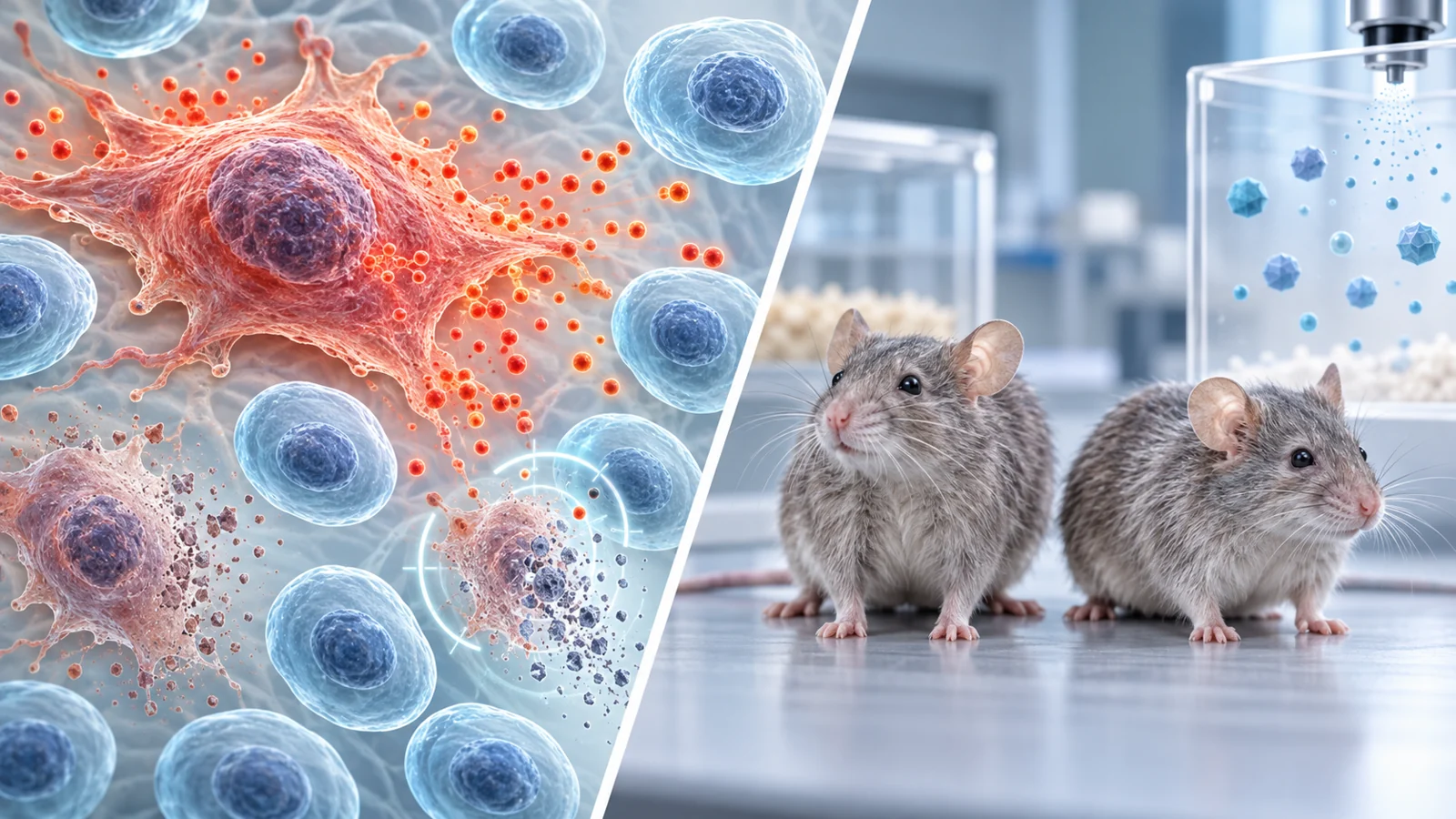
A June 8, 2021 study tested a striking idea about why infections can become more dangerous with age: accumulated senescent cells may help push an already stressed immune system toward harmful inflammation. Senescent cells have stopped dividing, but they are not necessarily quiet. Many release a mixture of inflammatory molecules known as the senescence-associated secretory phenotype, or SASP.
The researchers found that drugs used to clear some of these cells improved survival in old mice exposed to a mixture of mouse pathogens. The result is important because it points to the host response—not only the pathogen—as a possible treatment target. It is also easy to overread. The experiment did not infect people with SARS-CoV-2, and it did not show that senolytic drugs, meaning drugs intended to clear senescent cells, protect older adults from COVID-19.
Why the exposure was so severe for old mice
The intervention experiment used a “normal microbial experience,” or NME. Laboratory mice were exposed to pathogens through contact with pet-store mice or their used bedding. Young mice generally tolerated this exposure: across the study’s experiments, 89% survived. Old mice, more than 20 months of age, responded very differently. Nearly all died within two weeks.
The exposure involved several infectious agents, so the researchers had to work out which component was driving the severe outcome. One important suspect was mouse hepatitis virus, or MHV, a mouse beta-coronavirus. Unlike SARS-CoV-2, MHV is an enteric virus transmitted through oral or fecal spread and tends to infect the liver more than the lungs. The researchers nevertheless found inflammation in several tissues, including the lung, and evidence that MHV was a major cause of the old mice’s illness.
A useful test came from immunization. Old mice given a sublethal MHV exposure before the NME challenge developed a reduced antibody response compared with young mice, but the immunization protected them from dying after the later mixed exposure. Naive old mice still succumbed. That result linked the mortality to MHV within the broader pathogen mixture, while also showing why the model cannot simply be treated as a mouse version of respiratory COVID-19.
The old mice exposed to NME also accumulated more senescence markers and inflammatory SASP factors in tissues such as the liver and kidney. Their blood contained higher levels of several inflammatory cytokines than the blood of young exposed mice. The pattern suggested that age-related cellular changes were helping turn an infectious challenge into an unusually inflammatory systemic illness.
How senescent cells could amplify the response
The study combined animal experiments with tests in human cells to examine the proposed mechanism. In one set of experiments, senescent human kidney endothelial cells were exposed to recombinant SARS-CoV-2 spike protein S1. The protein acted as a pathogen-associated molecular pattern in these assays: it increased secretion of many inflammatory SASP factors from the senescent cells.
The researchers then asked what those secretions did to neighboring cells. Conditioned medium—the liquid collected from cultures of senescent cells—was applied to nonsenescent human endothelial and lung epithelial cells. In endothelial cells, the medium reduced expression of antiviral-defense genes including IFITM2 and IFITM3. In lung epithelial cells, it increased expression of the viral-entry genes ACE2 and TMPRSS2; in endothelial cells, it increased TMPRSS2 expression. Neutralizing some SASP factors partly reversed selected changes, and direct treatment with IL-1α increased TMPRSS2 expression in the tested cells.
These experiments give the host-response hypothesis a concrete biological route. Senescent cells can react strongly to an infection-related signal, release inflammatory molecules, and alter the behavior of nearby cells. But the measured outcomes were secretion and gene expression. The assays did not demonstrate that recombinant S1 caused increased infection by intact SARS-CoV-2, nor did they establish that a change in entry-gene expression would translate into more severe disease in a person.
The human-cell work therefore supplies mechanism-level evidence, while the mouse experiments supply evidence about survival and whole-organism inflammation. Those are related but different forms of evidence. A change in a cultured cell’s gene expression cannot carry the same meaning as a mouse living longer after pathogen exposure.
What changed when the researchers cleared cells
The strongest numerical comparison used two pharmacological senolytic approaches. Aged female mice received either fisetin or dasatinib plus quercetin, commonly abbreviated D+Q, after NME exposure. Treatment was given on two occasions, beginning around days 3 or 4 and repeated around days 11 or 12. All old mice receiving vehicle died, whereas approximately half of the mice in each senolytic group survived.
The comparison matters for two reasons. First, the similar survival curves for fisetin and D+Q make it less likely that the observation depended on one compound’s unique unrelated action. Second, treatment began after the pathogen exposure, so the result was not limited to a purely preventative intervention. It still does not establish a human dose, a safe treatment window, or a comparable benefit in older people.
Other fisetin schedules added information about timing. In one experiment, a higher dose was given for two consecutive days before NME exposure, followed by a lower dose after exposure; mortality was reduced in both male and female old mice. In separate short-course experiments, two doses on days 3 and 4, with or without a second pair later, delayed mortality even without continuous fisetin in the diet. The authors interpreted this as consistent with a “hit-and-run” senolytic effect: reducing the burden of senescent cells might continue to matter after the drug itself has been cleared.
The study also measured more than survival. Fisetin-treated old mice had lower levels of senescence markers in the liver, kidney, lung, and spleen, along with reductions in several tissue and circulating inflammatory factors. Anti-MHV antibodies reached levels described as youthful by day 16, while untreated old mice had already died. A separate comparison reported different long-term survival percentages in old male and female mice, but the groups were not the same age, so those percentages do not establish a sex-dependent treatment effect.
“Delayed mortality” is an important distinction here. Some regimens clearly prolonged life, and some produced long-term survivors in the reported experiments. But a delay in death is not automatically the same as complete protection, and percentages from different experiments cannot be combined as though they came from one trial.
What the genetic experiment adds
The researchers tested whether the benefit was connected to senescent-cell removal without relying only on drugs. They used INK-ATTAC mice, which carry a genetic system that allows p16-expressing cells to be eliminated after treatment with AP20187. In old mice exposed to NME, this genetic senolysis reduced markers of senescence and some inflammatory genes in several tissues. It also significantly delayed mortality.
That result supports a contribution from clearing senescent cells. It is useful because a drug can have multiple biological effects, while the genetic experiment targets a defined marked-cell population. The two approaches point in the same direction: lowering at least part of the senescent-cell burden can improve outcomes in aged mice facing an acute pathogen challenge.
The finding still does not prove that every protective effect of fisetin or D+Q depends exclusively on senolysis. The genetic system removes cells identified by p16 expression, whereas pharmacological treatments may affect a broader or different set of cells. The drug and genetic experiments also differed in their schedules and experimental details, making direct numerical comparisons difficult. The most defensible conclusion is narrower: senescent-cell clearance contributes to the improved outcome, while the full action of each intervention remains more complicated.
What the mouse findings can and cannot say about COVID-19
The study’s antibody results are encouraging within the model, but they have more than one possible interpretation. Treated mice may have mounted a better response because reducing inflammatory stress improved immune function. They may also simply have survived long enough to produce antibodies that untreated mice could not produce before dying. The experiment does not separate those explanations completely.
The viral measurements require similar care. Old mice had more MHV RNA than young mice, and fisetin treatment tended to reduce viral RNA in one analysis. The reported trend was not a statistically significant demonstration of viral clearance, and it does not establish direct antiviral action. Survival, tissue markers, viral RNA, and antibodies each answer different questions; improvement in one does not automatically prove improvement in all the others.
The distance to human treatment is substantial. The mouse exposure involved multiple pathogens and a beta-coronavirus with a different route and tissue preference from SARS-CoV-2. The cell experiments used recombinant spike protein rather than a whole human infection. The survival experiments used aged laboratory animals, not older people with the varied diseases, medications, and immune histories that shape clinical outcomes. Nothing in these results establishes that senolytics prevent or treat COVID-19 in humans, improve human vaccine responses, or make dietary fisetin-containing foods beneficial.
The findings therefore support a testable therapeutic idea, not a ready-made prescription. To become clinically useful, selective clearance of senescent cells would need to show a favorable safety profile and comparable benefit in people. Senescent cells can have biological roles, and removing a marked population in a mouse model is not the same as safely altering aging biology throughout an older human body.
What targeting aging could change for infection care
The potential consequence is a change in where infection treatment looks for leverage. Instead of targeting only the pathogen, clinicians might eventually be able to reduce severe outcomes by temporarily lowering an aging-related source of harmful inflammation in people who are especially vulnerable. In practical terms, that could mean greater resilience during infection and fewer deaths among older adults or people with age-linked chronic disease.
That possibility remains conditional on human evidence showing that senolytic treatment can selectively remove harmful senescent cells, work across the complexity of human infections, and do so safely. If those bottlenecks are solved, targeting a mechanism of aging could become a way to help older people withstand infection rather than merely responding after inflammation has already become dangerous.
Key Sources
- Primary source: Senolytics reduce coronavirus-related mortality in old mice.
DOI or Journal Page · Peer-Reviewed Paper · 2021-06-08
Keep exploring