
Research Signal – Source date 2023-11-13
When an organ comes from an older donor, age is not just a number attached to the donor. It may also describe the biological condition of the tissue being transplanted and how strongly that tissue engages the recipient’s immune system. A November 2023 review examined this possibility through the biology of cellular senescence, with particular attention to immune cells, kidney grafts, and liver tissue.
The review connects several kinds of evidence. Human kidney-transplant observations link senescence markers with later graft function. Mouse experiments suggest that treating older donors before heart procurement can prolong graft survival. Early human senotherapy findings in another setting show that senescent cells can be cleared from fat tissue. These results point toward a possible way to make some older organs more usable, but they answer different questions and do not amount to an established treatment for transplant patients.
Why an older organ raises a cellular question
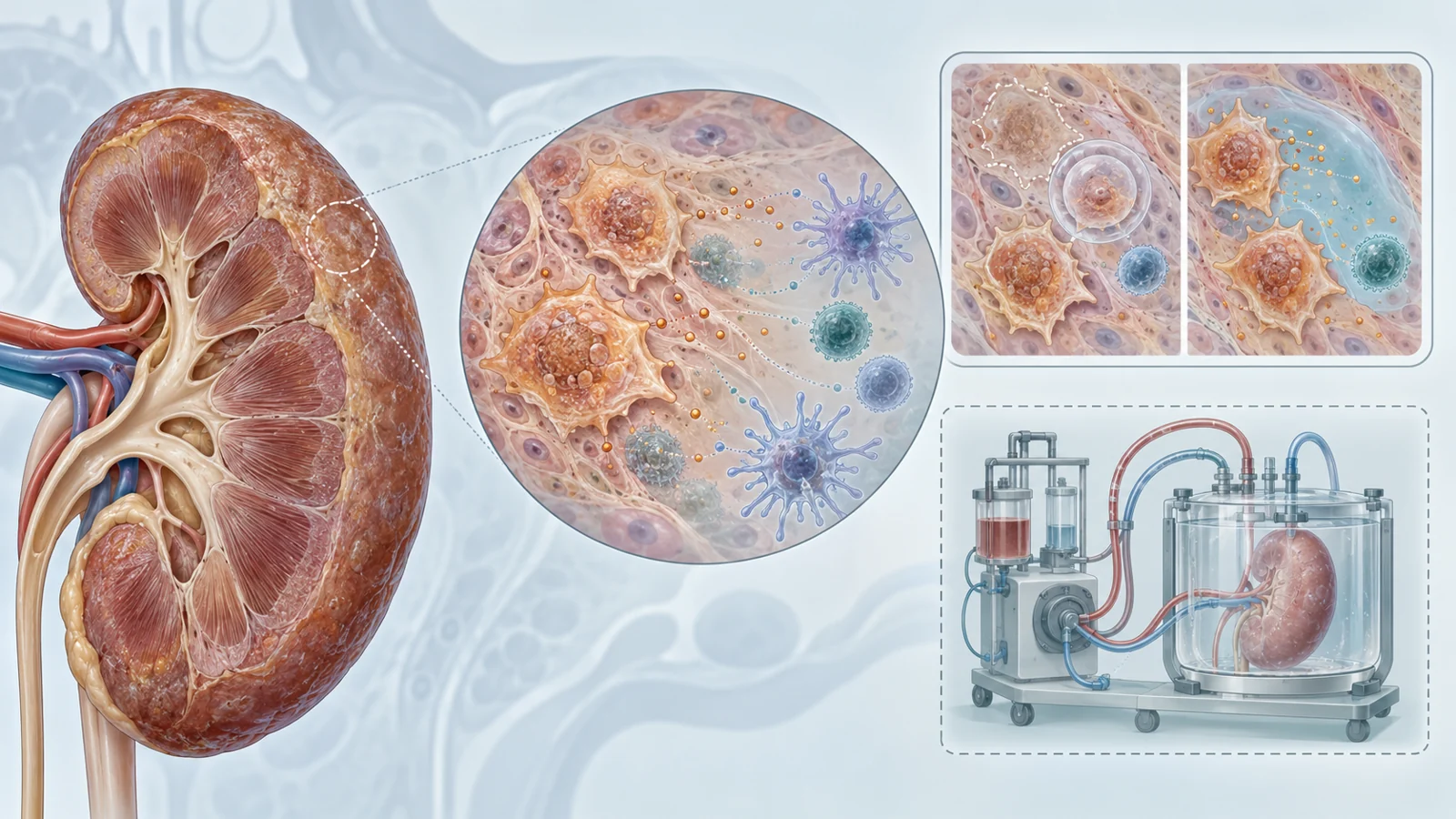
Cellular senescence is a stress response in which a cell enters a stable arrest of division. The arrest can protect against problems such as uncontrolled growth, but a senescent cell does not become biologically silent. It can release growth factors, proteases, inflammatory cytokines, and chemokines through what is often called the senescence-associated secretory phenotype, or SASP.
In a healthy repair process, immune cells can help remove senescent cells after their temporary contribution is finished. With aging or chronic disease, senescent cells may accumulate as immune clearance becomes less effective. Their secreted signals can activate other immune cells, while senescent immune cells themselves may become less effective at clearing damaged or senescent cells. The result can be a self-reinforcing cycle of inflammation, impaired tissue maintenance, and further senescence.
Transplantation adds several stresses to that cycle. The age and health of the donor and recipient matter, as do ischemia-reperfusion injury when the organ is implanted, the recipient’s response to donor tissue, and the possibility that the original disease may return. The review describes these factors as contributors to systemic and organ-level senescence rather than as one uniform process.
This makes the practical question more specific than whether an organ is old. Could changing the cellular condition of an older organ before or around transplantation reduce harmful immune activation while preserving the forms of senescence that help tissue repair?
Senescence is a stress response with two sides
The evidence summarized in the review does not support treating every senescent cell as an unwanted cell. Timing and cell type can change its role.
In kidney tissue, ischemia-reperfusion injury increases oxidative stress and raises markers including p16INK4a and p21CIP1. A temporary arrest through the p21CIP1 pathway may allow time for DNA damage to be repaired. Prolonged arrest associated with p16INK4a, by contrast, is linked in animal models with poorer transplant outcomes. These examples show why the pathway involved and the duration of arrest matter.
The liver provides another example. Hepatic stellate cells help produce extracellular matrix during injury, and excessive matrix deposition contributes to fibrosis. When activated stellate cells become senescent, their fibrogenic activity can be limited and immune clearance can help remove them. In that setting, senescence may restrain scar-forming activity rather than simply drive it. The review also describes aged stellate cells as more responsive to injury, with greater production of matrix components that can worsen fibrosis, showing why the surrounding tissue state matters.
A strategy that removes all cells carrying a senescence marker could therefore discard a short-term repair response along with a harmful chronic state. The relevant target may be a particular cell population, a persistent secretory phenotype, or a specific point in the transplant process.
The transplant evidence answers different questions
Human kidney-graft studies provide an observational clue about organ condition. In the review, higher p16INK4a in a pretransplant kidney-graft biopsy was associated with serum creatinine at six months and with subsequent graft dysfunction. In another analysis, p16INK4a levels considered alongside chronological donor age were the best predictor of kidney-graft function at one year. These findings suggest that donor age and tissue senescence markers can carry information about how a graft may perform.
They do not show that lowering p16INK4a would improve that graft. A marker can reflect injury or biological age without being the cause that should be removed. Nor do these observations create a universal test that can determine whether an organ should be accepted for transplantation. They describe associations in particular human kidney-transplant studies.
The mouse experiments address a more direct intervention question. In a cardiac allotransplantation model, older donor animals were treated before their hearts were procured. The review reports that pretreatment prolonged heart-graft survival, particularly alongside an immunosuppression approach that dampened T-cell responses. The experimental work connected senescent cells with cell-free mitochondrial DNA, which can activate recipient dendritic cells and help initiate an immune response against the graft. Removing senescent cells from older mouse hearts before transplantation reduced that age-associated immune activation in the model.
Those results are encouraging mechanistically, but they remain mouse transplant results. They do not establish that treating human donors will improve human graft survival, nor do they define a safe regimen for people who may already be receiving several immunosuppressive medicines.
A third finding comes from patients with diabetic kidney disease rather than transplant recipients. The review reports that senescent cells in subcutaneous fat were cleared within 11 days after treatment with dasatinib and quercetin. The observation shows that a senescence-targeting combination can affect a human tissue compartment. It does not establish improved kidney function, durable glycemic benefit, or any transplant benefit. Clearance in fat, a marker in a kidney biopsy, and survival of a transplanted heart are different endpoints.
Keeping those study designs separate is important. One asks whether a tissue marker is associated with later graft function. Another asks whether donor treatment changes immune behavior and graft survival in mice. The human senotherapy observation asks whether cells associated with senescence can be reduced in a particular tissue. Together they support a biological hypothesis, not one clinical efficacy result.
Possible treatments would have to fit the transplant setting
The review separates senolytics from senomorphics. Senolytics are intended to selectively remove senescent cells. Senomorphics are intended to suppress aspects of senescence or its inflammatory secretions without necessarily removing the cells. The difference matters because eliminating a cell may remove its SASP, while suppressing its secretions may preserve a temporary cell-cycle arrest that is still helping with repair.
The effects also depend on the drug and the biological setting. The review describes different infection-related findings in animal models. A BCL2/Bcl-xL inhibitor caused premature death of noncancerous cells during influenza A infection and was associated with impaired viral clearance in that model. Fisetin or dasatinib and quercetin produced more favorable outcomes in a separate aged-mouse model of a coronavirus-related infection. These contrasting results make it difficult to treat senolytics as interchangeable.
Transplant recipients add further constraints. Rapamycin is already used in transplantation and has senomorphic-like activity, but its effects on immunity can contribute to infections and poor healing. For any senotherapy, clinicians would need to understand how its mechanism interacts with immunosuppression, tissue repair, infection risk, and the condition of the particular organ. The review identifies timing, duration, success measures, and safety alongside multi-drug regimens as unresolved transplantation-specific issues.
The proposed delivery points are also different. An older donor might receive treatment before organ procurement, as in the mouse heart experiments. A recipient might receive treatment while waiting for an organ or after transplantation. A marginal liver, kidney, heart, or lung might instead be treated outside the body on an ex vivo perfusion device before implantation. The last idea is a proposed intervention opportunity, not a validated transplant protocol. Each route would expose different cells to treatment and would create different requirements for demonstrating that the organ remains functional and safe.
What this could mean for people waiting for a transplant
The larger possibility is that an organ’s biological age could become more manageable than its calendar age suggests. If senescence-targeted treatment can reduce harmful immune activation while preserving useful repair responses, older donor organs might become more reliable options for some recipients. Conditioning the donor, the recipient, or the organ during ex vivo perfusion could eventually support better graft durability and allow organs that are currently approached cautiously to be considered more confidently.
That benefit remains conditional. Human transplantation studies would need to show safe, sustained organ function, not just lower senescence markers or short-term changes in inflammatory signals. The supplied evidence does not quantify how much the donor pool could expand or suggest that senotherapy would eliminate shortages.
For people waiting for a transplant, the meaningful promise is more practical: an organ once viewed as biologically too old might one day become a viable option, with its expected durability supported by evidence rather than age alone.
Key Sources
- Primary source: Effect of Cellular Senescence in Disease Progression and Transplantation: Immune Cells and Solid Organs.
DOI or Journal Page · Review or Meta-Analysis · 2023-11-13
Keep exploring