
Research Signal – Source date 2023-05-30
An adhesive that holds particles together must withstand damage while maintaining its grip. Giving it the ability to repair itself adds another demand. The molecular connections need enough freedom to rearrange after a break, while the material still needs to resist tearing and slow deformation under load.
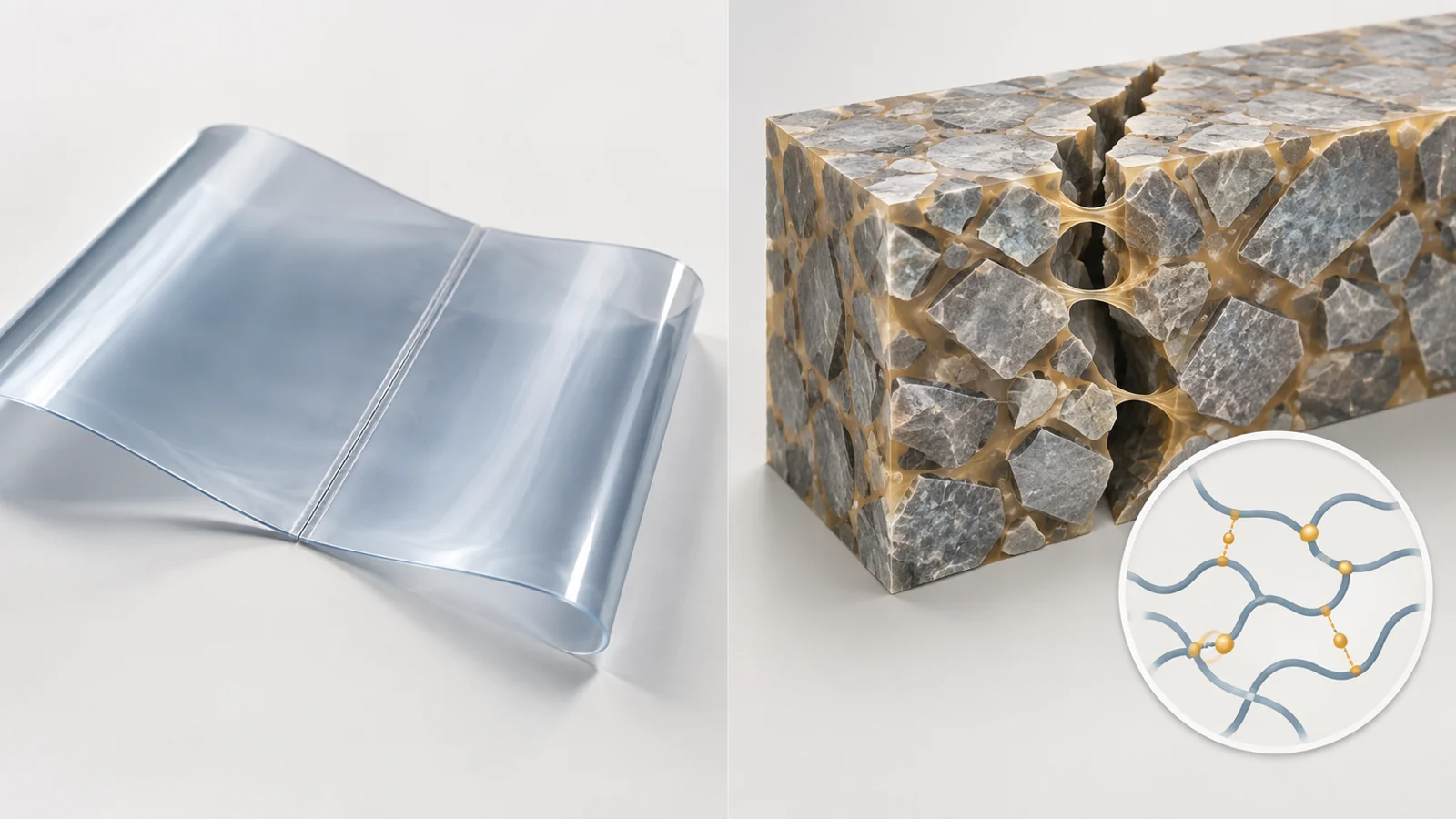
A research report dated May 30, 2023, describes polyurethane adhesives designed to combine those properties. The researchers report recovery of toughness in cut and reassembled polymer films, alongside a separate demonstration of healing in cracked energetic composites—materials containing ingredients that can release chemical energy. Understanding the advance means keeping those two experiments distinct.
Giving the polymer strength and room to reconnect
Three properties matter here. Toughness measures how much energy a material absorbs before breaking. Creep resistance describes its ability to resist gradual deformation under sustained load. Self-healing describes recovery after damage. An adhesive can perform well on one measure without necessarily doing well on the others.
The researchers modified the harder regions within a soft polyurethane, a polymer made of long molecular chains. They introduced asymmetric alicyclic structures—carbon rings without the aromatic bonding found in benzene—and bent biphenyl structures, built from paired benzene rings. The authors associate these additions to the hard regions with improved mechanical performance.
A complementary part of the design supplies connections that can rearrange. Disulfide bonds are links between sulfur atoms that can exchange bonding partners under suitable conditions. Hydrogen bonds are weaker attractions between molecular groups that can break and form again. The authors attribute healing to the combined action of these two kinds of connection.
The design therefore assigns different jobs to different molecular features. The ring-containing hard regions support mechanical performance, while the dynamic connections offer a way for the polymer network to reconnect after damage. That combination addresses the central difficulty of making an adhesive both tough and repairable.
What the two repair times describe
The polymer films reportedly reached a toughness of 20.93 megajoules per cubic meter. This is energy absorbed per unit volume before breaking, rather than a measure of how much force the adhesive can hold at a joint.
After films were cut in half and reassembled, they recovered more than 90% of their original toughness within 20 minutes. The recovery concerns a mechanical property, so it says more than simply observing that two pieces stick together again. The pieces were brought back into contact as part of the test.
The composite result has a different timescale and condition. The authors report that cracked energetic composites could heal within 24 hours at 60 °C, or 140 °F. The 20-minute result belongs to the polymer films; the heated, 24-hour result belongs to the composites. The abstract does not provide a corresponding percentage of recovered composite toughness, so the film’s greater-than-90% figure cannot be transferred to that demonstration.
There are also limits to combining the film numbers. The abstract alone does not establish the film-healing temperature or whether the highest toughness and the headline recovery performance came from the same formulation. Those details matter when judging what a particular adhesive can achieve under a particular set of conditions.
The adhesive must also connect to the particles
A polymer film tests the adhesive material itself. A particle-filled composite adds another question: how well does the adhesive interact with the particles it binds? Restoring connections within the polymer addresses only part of that combined structure.
The researchers examined interactions with TATB, an energetic compound used here as the material contacting the adhesive. Both experimental measurements and molecular dynamics simulations—computer models of molecular behavior—indicated stronger interaction with TATB as the adhesive’s hard-segment content increased.
This finding connects the polymer’s composition to its behavior at the boundary with another material. The harder regions are relevant both to the adhesive’s mechanical design and to its interaction with the particles. It gives researchers a composition-dependent relationship to investigate, without establishing a universally best hard-segment content or equivalent behavior with other ingredients.
How far the evidence reaches
The available account is the report’s abstract, which summarizes characterization, mechanical measurements, healing experiments and simulations. It supports a laboratory demonstration spanning the polymer film, its interaction with TATB and a cracked composite. Detailed methods, statistical information and peer-review status cannot be assessed from that account alone.
Repeated repair, resistance to slow deformation over long periods, service lifetime and operational safety remain questions for verification. Establishing those properties would require examining the relevant measurements and test conditions. The reported recovery does not by itself establish that an adhesive can repeatedly repair damage during use or that a composite becomes safer as a result.
What this could change
If the adhesive can retain its mechanical properties and its attachment to particles through aging and repeated damage, repairable bonds could help particle-filled materials retain useful integrity for longer. Small cracks could become damage that can be addressed through a controlled repair process before the material loses its usefulness. The practical payoff would be a route toward longer-lasting composites and less need to replace material after limited damage, provided the repair conditions are compatible with the intended use.
Key Sources
- Primary source: Development of robust and rapid self-healing polymers for the repair of microcracks in energetic composite materials
DOI or Journal Page · Peer-Reviewed Paper · 2023-05-30
Keep exploring