
Research Signal – Source date 2021-09-29
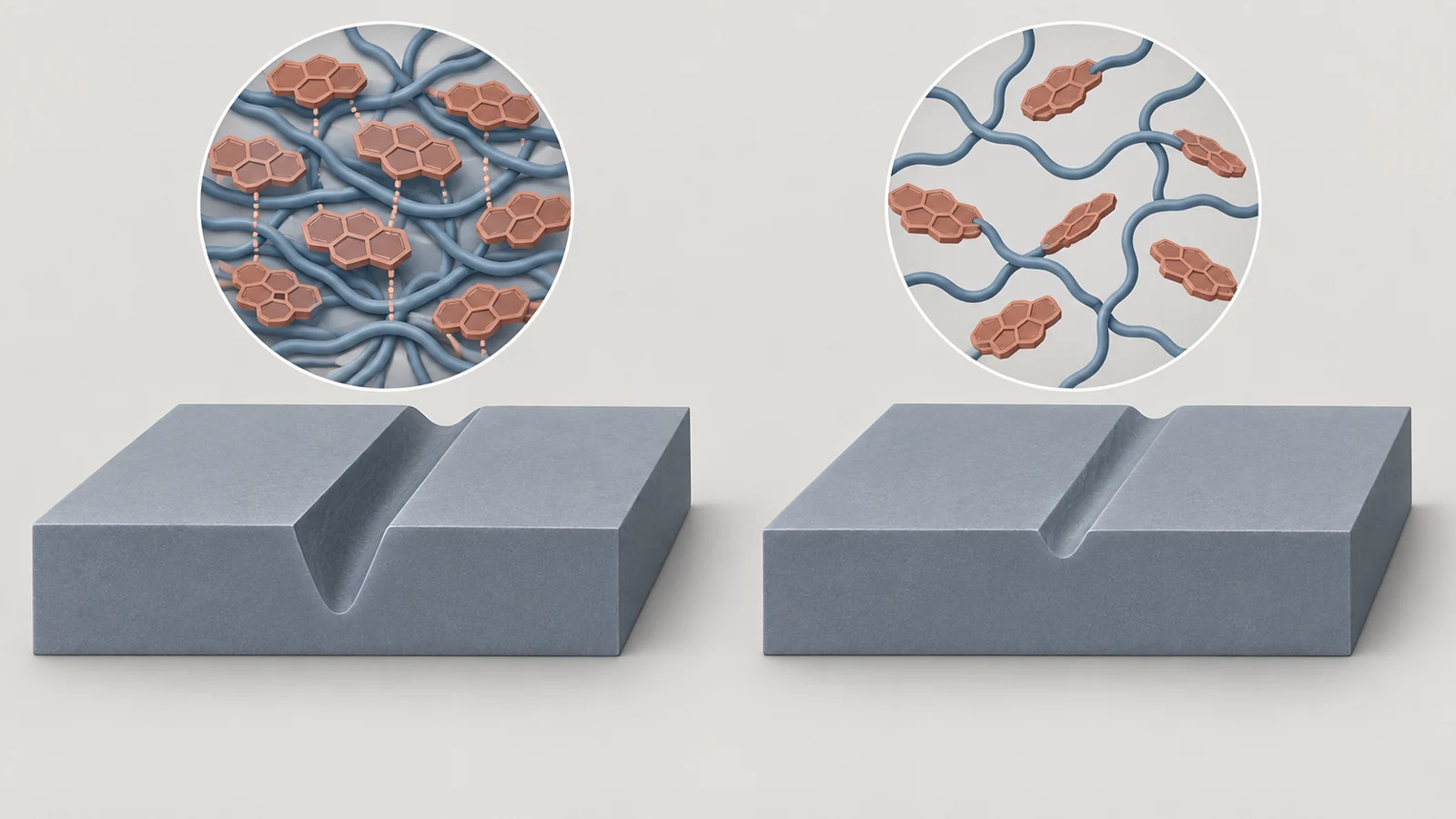
Heating a scratched material can give its molecules enough freedom to move and reduce the groove. In a laboratory study published on September 29, 2021, researchers measured that process in a polymer—a material made of long molecular chains. At 150 °C, one scratch closed almost completely, while another closed only partly. The result depended on both the heating conditions and the particular scratch.
The researchers assessed closure by measuring how much scratch volume remained. That gives a more useful account of surface damage than an impression that a mark has faded, although it does not measure restored strength, toughness or resistance to repeated loading.
A second polymer made the comparison more revealing. It shared the same type of reversible molecular attractions but had a different backbone, the chemical structure running along its chains. Under the test conditions, it would not retain a measurable scratch. The authors attributed this behavior to rapid elastic recovery. Together, the two formulations show why understanding a self-healing material requires looking at both the attractions holding chains together and the chains’ own ability to move.
Measuring the space left by a scratch
The researchers prepared pressed, polished samples and used an indenter to introduce a scratch. They then rotated the sample by 90 degrees and measured its profile with an indenter, allowing them to calculate the groove’s volume. After heating, they measured the profile again to determine how much of that volume had disappeared.
For the first polymer, P1, the contrast between depth and volume mattered. At 125 °C, the maximum scratch depth fell from about 64 micrometers to 23 micrometers, a reduction of more than 60%. Yet the scratch’s width and length remained nearly unchanged. The reported healing efficiency, based on volume, was therefore lower, at 50.64%.
A groove can become substantially shallower while still occupying much of its original footprint. Measuring all three dimensions captures that distinction and makes the result easier to interpret than a single depth measurement would.
Temperature also changed the outcome. The nearly complete closure of one scratch occurred at 150 °C, but a second scratch at that temperature showed only partial closure. At 80 °C, healing was much weaker, and a scratch remained detectable after 36 hours. The experiments establish heat-assisted surface recovery in P1, with variation that rules out treating its best result as a uniform repair rate.
The same attractions on different chains
Both polymers contained perylene-based units, relatively flat aromatic structures that can associate through what chemists call π–π interactions. These are noncovalent attractions: the units can associate without forming the permanent chemical bonds that make up the polymer chains. Their reversible associations help create a network within the material.
The researchers built P1 using poly(propylene glycol) segments. For P2, they used a three-block segment with a central poly(ethylene glycol), or PEG, block flanked by shorter poly(propylene glycol) blocks. Both starting materials had amine groups at their ends and were reacted with the same perylene-containing compound to make the polymers.
This change gave the team a way to examine how the flexible parts of the material affect its behavior alongside the shared associating units. P2’s PEG block introduced a thermal feature absent from P1: a melting transition at about 13 °C, below ordinary room temperature. That difference would become central to interpreting its response to scratching.
The finished polymers also differed in measured average molecular mass. Chromatography calibrated against a PEG standard gave values of 11,400 grams per mole for P1 and 17,400 grams per mole for P2. The experiment therefore compares two formulations with meaningful structural differences; it does not isolate backbone chemistry independently of every other material property.
Heat changes the network that holds the material together
Closing a groove requires material to move into the damaged region. The study connected that large-scale movement to changes in the molecular associations using three complementary approaches: measurements of heat absorbed by the polymers, measurements of their mechanical response, and infrared spectroscopy.
Thermal analysis found a transition at 129 °C for P1 and 126 °C for P2, which the researchers associated with changes in the perylene domains. Mechanical measurements showed a network structure below roughly 120 °C. Above that range, the response changed sharply, with a large drop in the quantities describing how the materials store and dissipate mechanical energy. The network became much less mechanically restrictive over a narrow temperature interval.
Infrared spectroscopy supplied a closer view of the molecular changes. As the samples heated, characteristic absorption bands shifted and broadened. Broadening was consistent with the perylene units occupying a wider range of arrangements as their mobility increased. A particularly strong change appeared at 150 °C. Differences in sample preparation, heating rates and experimental setups help explain why the infrared response did not line up at exactly the same temperature as the thermal and mechanical transitions.
Taken together, these measurements support a causal explanation for P1’s scratch closure. Heating weakens the associations between perylene units, reducing the constraints on chain movement. The more mobile material can redistribute and reduce the groove. The surface measurement records the result, while the thermal, mechanical and spectroscopic measurements explain how that movement becomes possible.
On cooling, the infrared band shifts and broadening reversed, supporting the reversible nature of the molecular process. That is useful evidence that the associations can reorganize after heating. It does not, by itself, establish how much mechanical performance a previously scratched sample regains.
When the surface springs back before healing can be measured
P2 could not be evaluated in the same way because the scratching procedure left no measurable groove. Without a persistent starting scratch, the researchers could not quantify a subsequent reduction in its volume. Assigning P2 a higher healing efficiency would turn a limitation of the comparison into a result the experiment did not establish.
The authors proposed that P2 underwent efficient elastic recovery, linked to the PEG block melting below room temperature. In that interpretation, the material rapidly rebounds after deformation without needing heat to activate the perylene associations. A surface returning toward its original shape through elastic recovery is a different physical response from a persistent groove gradually closing as heated chains rearrange.
This makes P2 informative even though it could not provide a matching scratch-healing measurement. Altering the backbone changed whether stable damage could be produced under the chosen conditions. The shared reversible attractions alone were insufficient to predict the observable response, and P2’s behavior establishes neither superior healing nor an inability to heal.
Mobility comes with a mechanical cost
The mechanism that helps a scratch close also creates an engineering tension. Chains must gain enough freedom to move into the groove, but the same loss of network constraints changes how firmly the material resists deformation. The sharp mechanical transition is therefore part of both the repair opportunity and the practical challenge.
For a future surface made from such a material, a heated repair step would need to accommodate that temporary change in mechanical support. A part carrying a load might require support or unloading while its surface becomes mobile. The surrounding components would also have to tolerate the heating conditions. These are consequences of the proposed repair mechanism, rather than demonstrated capabilities of a finished object.
The study concerns two laboratory formulations and controlled surface scratches. Translating the result into dependable use would require connecting scratch reduction to the mechanical performance needed afterward, as well as establishing consistent behavior across damage conditions. Neither the variable P1 outcomes nor P2’s rebound supports describing these materials as demonstrated autonomous repair systems operating at room temperature.
What this could change
If this balance between mobility and mechanical support can be controlled, polymer surfaces could be designed for a deliberate heating step that reduces scratches and allows continued use. Reversible attractions would provide a way to release molecular movement during repair, while backbone design would help determine how the surface responds to damage in the first place.
The potential benefit is a surface that can recover enough of its useful condition to avoid some repairs or replacements prompted by surface damage. Realizing that benefit would depend on reliable closure, suitable performance after cooling and compatibility with the object being heated. This study supplies an experimental basis for that possibility by linking measurable groove reduction to molecular motion—and showing how strongly the backbone can change the outcome.
Key Sources
- Primary source: In-depth characterization of self-healing polymers based on π-π interactions.
DOI or Journal Page · Peer-Reviewed Paper · 2021-09-29
Keep exploring